Boring Queen’s Gambit? Try the Slav!

Many players, especially beginners, dislike the Queen’s Gambit. They call it boring, positional, and not fun to play, from either side! Some even wonder why this opening is not banned (due it being boing, etc.).


Maybe they should try the Slav. It’s tactical, full of tension and a single misstep can be fatal.


Here is a list of miniatures to play when you are feeling sluggish.


And a final game, which is not a miniature, but belongs here. You’ll see why at the end.


Meanwhile …  enjoy!


~~~~~~~~~~~~~~~~~~~~~~~~~~~~~~~~~~~~~


Jensen (1873)-Fries (2038)
US Open
Los Angeles, 1991
1.d4 d5 2.c4 c6 3.Nc3 dxc4 4.e4 b5 5.a4 e5 6.Nge2 b4 7.Nb1 Nf6 8.Bg5 h6 9.Bxf6 Qxf6 10.d5 Bb7 11.Ng3 Bc5 12.Nf5 cxd5 13.Ne3 Bxe3 14.fxe3 Qh4+ 15.g3 Qxe4 16.Rg1 Qxe3+ 17.Qe2 Qxg1 18.Qxe5+ Kd8 0-1


GM Agdestein (2600)-Zsuzsa Polgar (2565)
Active Chess
Exhibition Match
Oslo, 1996
1.d4 d5 2.c4 e6 3.Nc3 c6 4.e3 Nf6 5.b3 Nbd7 6.Bb2 Bd6 7.Qc2 O-O 8.O-O-O?! (Premature. Better is 8.Nf3 and try to castle kingside.)  8…a5 9.Nf3 a4 10.Nxa4 dxc4 11.bxc4 b5! (Using her queenside pawns Zsuzsa opens up the queenside with her pawns.) 12.cxb5 cxb5 13.Bxb5 Ba6 14.Bxa6 Rxa6 15.Nd2 Qa8 16.Nc3 Rc8 17.Ndb1 Rxa2 18.Rd3 Nd5 19.Qb3 Nb4 20.Rd2 Qxg2 21.Rhd1 Qb7! 0-1 (Black threatens 22…Nd3+.)


Riedel-Zurek
Berlin, 1987
1.d4 d5 2.c4 c6 3.Nf3 Nf6 4.Nc3 Bf5 5.cxd5 Nxd5 6.Qb3 Qb6 7.Nxd5 Qxb3 8.Nc7+ Kd8 9.axb3 Kxc7 10.Bf4+ Kc8 11.Ne5 f6 12.Nc4 Nd7 13.f3 Bc2 14.e4 Bxb3 15.Na5 Bf7 16.Nxc6 e5 17.Nxa7+ Kb8 18.dxe5 fxe5 19.Be3 Bc5 20.Rd1 Bxe3 21.Rxd7 Be8 22.Rd3 Bd4 0-1


Jelena Popovic-Elena Stotskaja
Rimavska Sobota, 1992
[D15]
1.d4 d5 2.c4 c6 3.Nf3 Nf6 4.Nc3 Bf5 5.Bg5 e6 6.e3 Be7 7.Ne5 h6 8.Bh4 g5 9.Bg3 Nbd7 10.Bd3 Bxd3 11.Qxd3 Nh5 12.cxd5 exd5 13.Qf5 f6 14.Qg6+ Kf8 15.Qf7mate 1-0


Dias (2295)-Gillford
World Jr. Ch.
Calcutta, 1998
1.d4 d5 2.c4 c6 3.Nc3 Nf6 4.Nf3 Bf5 5.Qb3 Qb6 6.Bf4 Nbd7 7.e3 e6 8.Qxb6 axb6 9.Nh4 Bg4 10.f3 Bh5 11.Bd3 Bg6 12.Nxg6 hxg6 13.O-O Nh5 14.Bg5 Bd6 15.Rfb1? Bxh2+! 16.Kxh2 Nf4+ 17.Kg3 Nxd3 18.cxd5 exd5 19.e4 f6 20.Bd2 dxe4 21.Nxe4 f5 22.Ng5 Nf6 23.b4 f4+ 0-1


Kuzubov (2535)-Wademark (2182)
Port Erin Open
Isle Of Man, Sept. 24 2005
1.d4 d5 2.c4 c6 3.Nf3 Nf6 4.Nc3 Na6 5.cxd5 cxd5 6.Bf4 Qa5 7.e3 e6 8.a3 Bd7 9.Bd3 Be7 10.Ne5 Nb8 11.O-O O-O 12.Bg5 Qd8 13.f4 Nc6 14.Rf3 Nxe5 15.fxe5 Ng4 16.Bxh7+ Kxh7 17.Rh3+ Nh6 18.Qd3+ Kg8 19.Bxh6 f5 20.exf6 Bxf6 21.Bxg7 Kxg7 22.Qh7mate 1-0


 Technically, the next three games constitute the Tolush-Geller Gambit (1.d4 d5 2.c4 c6 3.Nf3 Nf6 4.Nc3 dxc4 5.e4).


Hoshino-Hori
corres.
JCCA Webchess Open
ICCF, 2007
1.d4 d5 2.c4 c6 3.Nf3 Nf6 4.Nc3 dxc4 5.e4 b5 6.Be2 e6 7.O-O Be7 8.a4 b4 9.e5 Nd5 10.Ne4 c3 11.bxc3 Nxc3 12.Nxc3 bxc3 13.Ba3 c5 14.Qc2 Ba6 15.Bb5+ Bxb5 16.axb5 O-O 17.dxc5 Qa5 18.Rfb1 Nd7 19.c6 Bxa3 20.cxd7 1-0


Bosboom (2471)-Stellwagen (2621)
Netherlands Ch.
Hilversum, Apr. 4 2008
1.d4 d5 2.Nf3 Nf6 3.c4 c6 4.Nc3 dxc4 5.e4 b5 6.Qc2 e6 7.g4 Bb7 8.g5 Nfd7 9.h4 Na6 10.a3 Be7 11.Be3 Qa5 12.Nd2 c5 13.d5 Ne5 14.Ra2 exd5 15.exd5 O-O 16.Qf5 Bd6 17.h5 Rae8 18.h6 g6 19.Qb1 Ng4 20.Nde4 Bxd5 21.Bd2 Bf4 22.Kd1 Bxe4 23.Nxe4 Nxf2+ 0-1


GM Gaprindashvili-Z. Polgar
FIDE Women’s Candidates Tournament
Shanghai, 1992
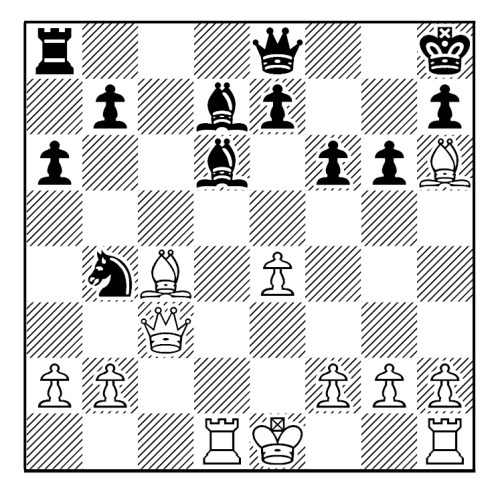
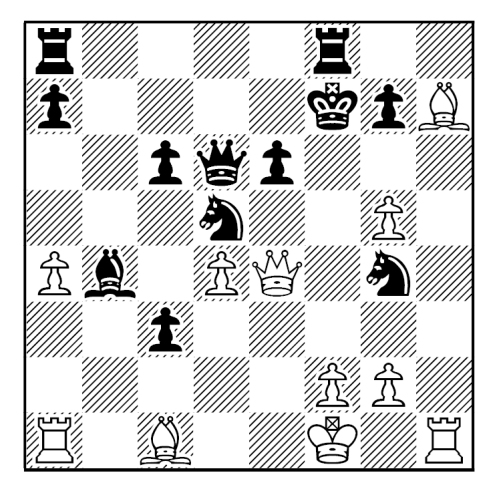
1.d4 d5 2.c4 dxc4 3.Nf3 Nf6 4.Nc3 c6 5.e4 b5 6.e5 Nd5 7.a4 Bf5 8.Be2 b4 9.Nh4 bxc3 10.Nxf5 e6 11.Ng3 cxb2 12.Bxb2 Bb4+ 13.Kf1 c3 14.Bc1 O-O 15.Ne4 Nd7 16.Bd3 f5 17.exf6 N7xf6 18.Ng5 Qd6 19.Qc2 h6 20.h4 hxg5 21.hxg5 Ng4 22.Bh7+ Kf7 23.Qe4
2019_05_08_A

23…Nxf2 24.Kxf2 Ke7+ 25.Ke2 Qg3 0-1


Sulava (2531)-Abolianin (2385)
Imperia Open
Italy, 2001
1.d4 d5 2.Nf3 c6 3.c4 Nf6 4.Nc3 a6 5.a4 g6 6.e3 Bg7 7.Bd3 O-O 8.O-O c5 9.Nxd5 Nxd5 10.cxd5 cxd4 11.e4 e6 12.dxe6 Bxe6 13.Ng5 Bc8 14.f4 Nc6 15.Bd2 h6 16.Nf3 Be6 17.Qe1 Re8 18.Qg3 Qd6 19.h4 Kh8 20.Rae1 Rad8 21.h5 g5 22.e5 gxf4 23.Qxg7+ 1-0


Krueger-Seepe
German Northwest League, 1988
1.d4 d5 2.c4 c6 3.Nf3 Nf6 4.Nc3 a6 5.e3 e6 6.Bd3 dxc4 7.Bxc4 b5 8.Bd3 c5 9.e4 cxd4 10.Nxd4 Bd6 11.Be3 O-O 12.e5 Bxe5 13.Qf3 Bxd4 14.Qxa8 Bxc3+ 15.bxc3 Qxd3 16.Qxb8 e5 17.Qa7 Qxc3+ 18.Ke2 Be6 19.f3 Qb2+ 20.Bd2 Bc4+ 0-1


Miller (2180)-Stephen Jones (2359)
Southern California Open, 1995
[I first annotated this game in Rank and File.]
1.d4 d5 2.c4 c6 3.Nf3 Nf6 4.Nc3 a6 5.e3 b5!? 6.cxd5 cxd5 7.Bd3 Bb7?! (Unless Black gets a Knight on e4 to exchange off and open the diagonal, the Bishop will merely be an onlooker to the proceedings.) 8.O-O Nbd7 9.Ne5 e6 10.f4 Be7 11.Qf3 O-O 12.g4! b4 (Black has little counterplay, and cannot come up with a good play to organize his forces.) 13.Ne2 Ne4 14.Ng3 Nd6 15.Bd2 (To connect both Rooks.) 15…Nb6 (The Black Knights are still trying to find good squares. Meanwhile White continues to build his attack.) 16.g5 a5 17.Qh5 Ne4 18.Rf3 Qe8 19.Nxe4 dxe4 20.Rh3 (White’s Bishop is, of course, immune from capture.) 20…h6 21.Ng4 (D Nxh6+) 1-0


Fang (2355)-Nichols (2046)
New Hampshire Open, 1997
1.d4 d5 2.Nf3 Nf6 3.c4 c6 4.Nc3 a6 5.c5 g6 6.Bf4 Bg7 7.h3 Nbd7 8.e3 O-O 9.Be2 Re8 10.O-O Ne4 11.Nxe4 dxe4 12.Nd2 e5 13.dxe5 Nxc5 14.Rc1 Nd3 15.Bxd3 exd3 16.Nc4 Re6 17.Rc3 Re8 18.Rxd3 Qh4 19.Nb6 Ra7 20.Nxc8 Rxc8 21.Rd7 g5 22.Rd8+ Rxd8 23.Qxd8+ Bf8 24.Bxg5 1-0


GM Kamsky-GM Kramnik
Candidate’s Match, 1994
1.d4 d5 2.c4 c6 3.Nc3 Nf6 4.Nf3 e6 5.Bg5 dxc4 6.e4 b5 7.e5 h6 8.Bh4 g5 9.Nxg5 hxg5 10.Bxg5 Nbd7 11.exf6 Bb7 12.g3 c5 13.d5 Qb6 14.Bg2 O-O-O 15.O-O b4 16.Na4 Qb5 17.a3 Ne5 18.axb4 cxb4 19.Qd4 Nc6 20.dxc6 Rxd4 21.cxb7+ Kc7 22.Be3 e5 23.Nc3 bxc3 24.bxc3 Bc5 25.cxd4 1-0


R. Hungaski (2366)-A. Nasri (2227)
World Jr. Ch.
Yerevan, 2006
1.Nf3 d5 2.d4 e6 3.c4 c6 4.Nc3 Nf6 5.Bg5 h6 6.Bh4 dxc4 7.e4 g5 8.Bg3 b5 9.Be2 Bb7 10.h4 g4 11.Ne5 h5 12.O-O Nbd7 13.Qc2 a6 14.Rad1 Be7 15.f3 Rg8 16.fxg4 hxg4 17.Nxf7 Kxf7 18.e5 c5 19.d5 Qb6 20.exf6 Bxf6 21.Ne4 1-0


GM Loek Van Wely-GM Alexander Morozevich
Wijk aan Zee, 2001
[D16]
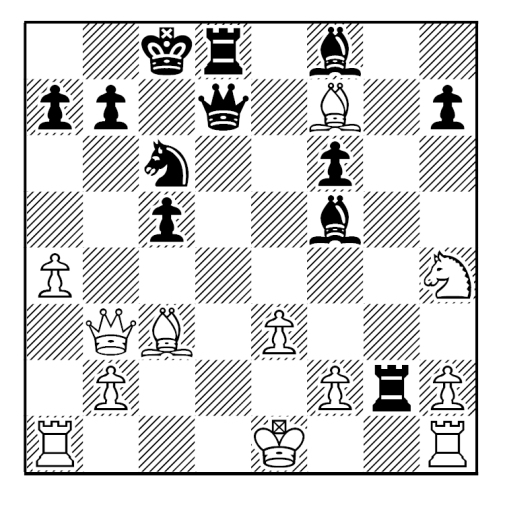
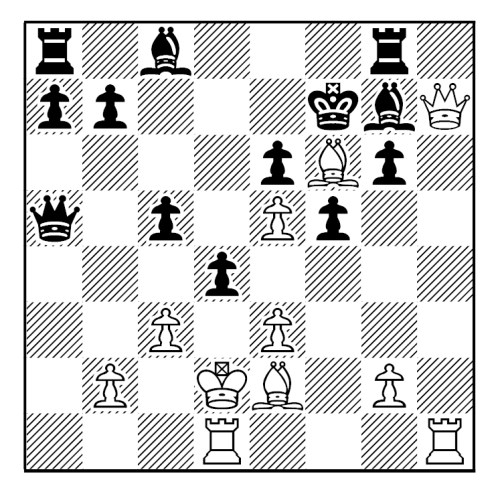
1.d4 d5 2.c4 c6 3.Nf3 Nf6 4.Nc3 dxc4 5.a4 c5 6.d5 Bf5 7.e3 e6 8.Bxc4 exd5 9.Nxd5 Nc6 10.Qb3 Qd7 11.Nxf6+ gxf6 12.Bd2 Rg8 13.Bc3!?  O-O-O 14.Bxf7 Rxg2! 15.Nh4
2019_05_08_B
15…Ne5! 16.Nxf5 Nd3+ 17.Kf1 Rxf2+ 18.Kg1 Kb8 19.Qe6?! Rxf5 20.h4 Bd6 21.Rf1? Rg8+ 0-1 (In view of …Qg7#)


Ikonnikov (2560)-Vitoux (2264)
Port Erin Open
Isle Of Man, Sept. 24 005
1.d4 d5 2.Nf3 Nf6 3.c4 c6 4.Nc3 dxc4 5.a4 c5 6.d5 Bf5 7.e4 Nxe4 8.Nxe4 Bxe4 9.Bxc4 Qd6 10.O-O Nd7 11.Re1 Nf6 12.Bb5+ Kd8 13.Bc4 h6 14.Bd2 a6 15.Bc3 Qf4 16.Ne5 Kc8 17.f3 Bg6 18.g3 Qg5 19.f4 Qh5 20.Be2 1-0


Alan Fichaud-Robert Jacobs (2415)
corres.
ATB 2, 1998
1.c4 c6 2.d4 d5 3.Nf3 Nf6 4.Nc3 dxc4 5.a4 Na6 6.e4 Be6 7.Ne5 Qa5 8.f3 Rd8 9.Be3 Qb4 10.Qe2 g6 11.Nxc4 Bg7 12.a5 O-O 13.Ne5 Rxd4 14.Nxc6 bxc6 15.Bxd4 Qxd4 16.Qxa6 Rb8 17.Qe2 Nd7 18.Nd1 Nc5 19.Qc2 Nb3 20.Ra3 Qb4+ 21.Nc3 Nd4 22.Qc1 Qxb2 23.Qxb2 Rxb2 24.Bd3 Rxg2 0-1


Eduardo Ortiz-Matthew Ho
Pacific Southwest Open
Los Angeles 2003
1.d4 d5 2.c4 c6 3.Nf3 Nf6 4.Nc3 dxc4 5.a4 Na6 6.e4 Bg4 7.Bxc4 Bxf3 8.gxf3 e6 9.Be3 Be7 10.Rg1 O-O 11.f4 Qa5 12.Kf1 Qb4 cxd4 15.Bxd4 Nc5 16.Rg5! h6 17.Rxc5! Bxc5 18.Bxf6 Be7 (18…gxf6 19.Ra4 snares the Queen.) 19.Be5 Bf6 20.Bxf6 gxf6 21.f5 Qd6 22.Qg4+ Kh8 23.fxe6 fxe6 24.Rd1 Qe7 25.Bxe6 1-0


GM Polugaevsky (2585)-Drasko (2465)
Sarajevo, 1987
1.d4 d5 2.c4 c6 3.Nf3 Nf6 4.Nc3 dxc4 5.a4 Bf5 6.e3 e6 7.Bxc4 Bb4 8.O-O O-O 9.Nh4 Nbd7 10.f3 Bg6 11.Nxg6 hxg6 12.Qc2 Rc8 13.Rd1 Qb6 14.Kh1 c5 15.d5 Ne5 16.Be2 Rfe8 17.dxe6 Qxe6 18.Nb5 Nc6 19.Bc4 Qf5 20.Bxf7+ 1-0


Vandenburg (1979)-Blechar (2237)
corres.
CCLA Team Ch., 1999
1.d4 d5 2.c4 c6 3.Nf3 Nf6 4.Nc3 dxc4 5.a4 Bf5 6.Ne5 e6 7.Bg5 Bb4 8.Nxc4 Qd5 9.Bxf6 Qxc4 10.Qd2 Qb3 11.Bxg7 Rg8 12.Be5 c5 13.Bxb8 cxd4 14.Be5 O-O-O 15.Bxd4 Rxd4! (16.Qxd4 Qxb2) 0-1


Waxman-Wes White
Jay Chemical, 1981?
1.d4 Nf6 2.Nf3 d5 3.c4 c6 4.Qc2 Ne4 5.Bf4 Bf5 6.Qb3 Qa5+ 7.Nbd2 e5 8.dxe5 Bc5 9.e3 Bb4 10.Rd1 Nc5 0-1


C. Gabriel (2531)-GM Huebner (2636)
Bundesliga
Germany, Jan. 28 2006
1.d4 d5 2.c4 c6 3.Nf3 Nf6 4.Qb3 dxc4 5.Qxc4 Bf5 6.g3 e6 7.Bg2 Be7 8.O-O O-O 9.Qb3 Qb6 10.Nbd2 Rd8 11.Nc4 Qxb3 12.axb3 Rd5?? (13.Nb6 axb6 14.Rxa8 +-) 1-0


 GM Gelfand (2733)-GM Van Wely (2683)
Blindfold Game
Melody Amber
Monaco, 2007
1.d4 d5 2.c4 c6 3.Nf3 Nf6 4.Qb3 e6 5.Bg5 h6 6.Bh4 Nbd7 7.e3 Be7 8.Nc3 O-O 9.Bd3 b6 10.cxd5 cxd5 11.O-O Bb7 12.Rfc1 a6 13.Na4 b5 14.Nc5 Nxc5 15.dxc5 Ne4 16.Bxe7 Qxe7 17.c6 Bc8 18.a4 bxa4 19.Rxa4 Nd6 20.Qa3 Qc7 21.b4 Qb6 22.b5 Nxb5 23.Bxb5 Qxb5 24.Rb4 Qe2 25.Rb2 1-0


And the last game, as promised. It’s a game full of Queens, and appropriately quite tactical.


Zawadski-Peyrat
Metz-Chess1, 1991
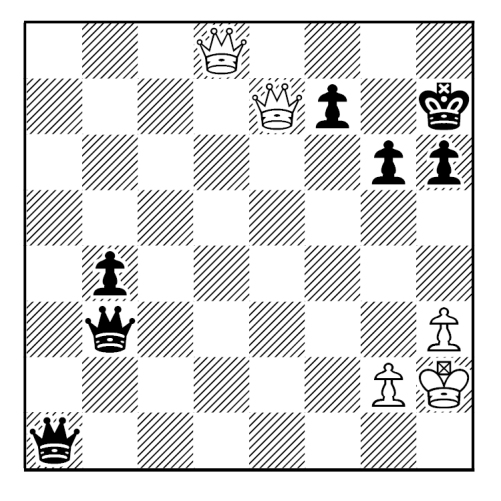
1.d4 d5 2.c4 c6 3.Nf3 Nf6 4.Nc3 e6 5.e3 Nbd7 6.Bd3 dxc4 7.Bxc4 b5 8.Be2 Bb7 9.O-O b4 10.Na4 Be7 11.Qc2 Rc8 12.Rd1 O-O 13.Bd2 a5 14.Be1 c5 15.dxc5 Qc7 16.Rac1 Nxc5 17.Rd4 Qb8 18.Nb6 Rcd8 19.Nc4 Be4 20.Qd2 Qa7 21.Nce5 h6 22.h3 Ba8 23.Bc4 Nfe4 24.Qe2 Qb8 25.Rcd1 Bf6 26.Nd7 Nxd7 27.Rxd7 Rxd7 28.Rxd7 Bc6 29.Rd1 Rd8 30.Nd4 Ba8 31.f3 Nc5 32.Rc1 Qb6 33.Bf2 g6 34.Nb3 Nxb3 35.Bxb3 Bb7 36.Rd1 Rxd1+ 37.Bxd1 Ba6 38.Qd2 Be7 39.Bb3 Bc5 40.Bd1 Kg7 41.e4 e5 42.Bxc5 Qxc5+ 43.Kh2 Bb5 44.Bb3 Bc6 45.Qd8 a4 46.Bd5 Qd4 47.b3 a3 48.Qd6 Bb7 49.Qd7 Bxd5 50.exd5 Qf4+ 51.Kh1 Qc1+ 52.Kh2 Qf4+ 53.Kh1 e4 54.fxe4 Qf1+ 55.Kh2 Qf4+ 56.Kh1 Qf1+ 57.Kh2 Qf4+ 58.Kh1 Qxe4 59.d6 Qe1+ -/+ 60.Kh2 Qe5+ 61.Kh1 Qa1+ 62.Kh2 Qxa2 63.Qe7 Qd2 64.Qe5+ Kh7 65.Qf6 Qd5 66.Qe7 a2 67.d7 a1=Q 68.d8=Q Qxb3
2019_05_08_C
69.Qdf8 (69.Qef8? Qe5+ -+) 69…Qg7! -+ 70.Qb8 h5 71.Qbxb4 Qd5 72.Qbe4 Qb3 73.Q7e5 Qxe5+ 74.Qxe5 Qe6 75.Qc7 g5 76.Qc2+ Kh6 77.Qc3 f6 78.Qb4 Qe5+ 79.Kg1 Qe3+ 80.Kf1 Qf4+ 81.Qxf4 gxf4 82.Ke2 Kg5 83.Kd3 Kh4 84.Ke4 Kg3 85.Kf5 h4 86.Ke4 Kxg2 87.Kxf4 Kxh3 88.Kf3 f5 0-1


AN INTRODUCTION TO THE ART OF QUEEN SACRIFICES, Part 1

Perhaps the most popular games ever published are those in which a player sacrifices his Queen. Bravery is required for that player who thrusts his most valuable piece into the fight, usually with no hope of ever recovering her.

 
In the over 500 years of chess, fewer topics have been more exciting, more spectacular, and more aesthetically pleasing to the player than when he freely sacrifices his powerful Queen. In all cases, the desired result, whether immediately or indirectly, is to gain something more valuable; the enemy King.


Basically, there are three types of Queen sacrifices.


The first type is the one made for material gain. Sometimes called a pseudo-sacrifice, the Queen is given up and won back a few moves later.


Doroshkevich-Astashin
USSR, 1967 (D24)
1.d4 d5 2.c4 dxc4 3.Nf3 Nf6 4.Nc3 a6 5.e4 b5 6.e5 Nd5 7.a4 Nxc3 8.bxc3 Bb7 9.e6 fxe6 10.Be2 Qd5 11.Ng5 Qxg2 12.Rf1 Bd5 13.axb5 Qxh2?! 14.Bg4 h5 15.Bxe6 Bxe6 16.Qf3 c6 17.Nxe6 Qd6 18.Qf5 g6 19.Qxg6+ Kd7 20.Nc5+ Kc8 21.Qe8+ Qd8 22.b6! 1-0


The Queen sacrifice for gain may turn into a mate if the opponent tries to hold on the female material.


Muller-Calderone
Compuserve, 1996
(B57)
1.e4 c5 2.Nf3 d6 3.d4 cxd4 4.Nxd4 Nf6 5.Nc3 Nc6 6.Nxc6 bxc6 7.Bc4 g6 8.e5 Nd7 (Certainly not 8…dxe5?? 9.Bxf7+. Best is 8…Ng4.) 9.exd6 exd6 10.O-O Nf6 11.Re1+ Be7 12.Qf3 O-O 13.Qxc6 Bf5 14.Bh6 Re8 15.Nd5 Rc8 16.Qxe8+! Qxe8 17.Nxe7+ Kh8 18.Nxf5 Ne4 19.Nxd6 Qc6 20.Nxf7+ (20…Kg8 21.Ne5+) 1-0


Levitzky-Marshall
Breslau, 1912
(C10)
Chernev says that spectators showered the board with gold pieces after Black’s 23rd move. Soltis says it was bettors who lost the wager on the outcome.
1.d4 e6 2.e4 d5 3.Nc3 c5 (The Marshall Gambit, as played by its inventor.) 4.Nf3 Nc6 5.exd5 exd5 6.Be2 Nf6 7.O-O Be7 8.Bg5 O-O 9.dxc5 Be6 10.Nd4 Bxc5 11.Nxe6 fxe6 12.Bg4 Qd6 13.Bh3 Rae8 14.Qd2 Bb4 15.Bxf6 Rxf6 16.Rad1 Qc5 17.Qe2 Bxc3 18.bxc3 Qxc3 19.Rxd5 Nd4 20.Qh5 Ref8 21.Re5 Rh6 22.Qg5 Rxh3 23.Rc5 Qg3!! [O.K. Here are the variations: 24.Qxg3 Ne2+ 25.Kh1 Nxg3+ 26.Kg1 Nxf1 27.gxh3 Nd2 and extra piece wins. If White tries to hold onto the Queen, he tries loses his King. 24.hxg3 Ne2#, or 24.fxg3 Ne2+ 25.Kh1 Rxf1#.] 0-1


A second popular Queen sacrifice is another form of a pseudo-sacrifice. The sacrifice is made solely for a player to checkmate an opponent. The mate is immediate and happens most frequently in the opening, as these short games show.


Greco-N.N.,
Rome, 1619?
1.e4 b6 (Despite all the players who have invested 400 years to analyze and perfect this opening, this defence has remained on the sidelines of theory.) 2.d4 Bb7 3.Bd3 f5?! 4.exf5 Bxg2 5.Qh5+ g6 6.fxg6 Nf6? 7.gxh7+!! (The Queen is willing offered, an offer that cannot be ignored or declined.) 7…Nxh5 (And now the coup d’état) 8.g6mate 1-0


Teed-Delmar
New York, 1896
1.d4 f5 2.Bg5 h6 3.Bh4 g5 4.Bg3 f4 5.e3 h5 6.Bd3 Rh6 7.Qxh5+! Rxh5 8.Bg6mate 1-0


De Legal-Saint Brie
Paris, 1750? (C40)
1.e4 e5 2.Nf3 d6 3.Bc4 [3.d4 is now considered to be the best move when facing Philidor’s Defence. But then White would miss all the fun of this classical trap!] 3…Bg4? 4.Nc3 g6 5.Nxe5! Bxd1 6.Bxf7+ Ke7 7.Nd5mate 1-0


Paul Morphy-Duke of Brunswick and Count Isouard
Paris, 1858
(C41)
A short classic that displays all the qualities that make up a great game; rapid development, pins, sacrifices, and slightly inferior moves by the opponent.
1.e4 e5 2.Nf3 d6 3.d4 Bg4? 4.dxe5 (Simple enough. White threatens 4…dxe5 5.Qxd8+ Kxd8 6.Nxe5, netting a pawn.) 4…Bxf3 5.Qxf3 dxe5 6.Bc4 Nf6 7.Qb3 Qe7 8.Nc3 c6 9.Bg5 b5 10.Nxb5! (The whole mating sequence begins with a Knight sacrifice.) 10…cxb5 11.Bxb5+ Nbd7 12.O-O-O! Rd8 13.Rxd7 Rxd7 14.Rd1 Qe6 15.Bxd7+ Nxd7 16.Qb8+! (And ends with a Queen deflection sacrifice!) 16…Nxb8 17.Rd8mate 1-0

 
Queen sacrifices for the checkmate may also be more involved and take a few additional moves to execute the mate.

 
Maryasin-Kapengut
Minsk, 1969
(D01)
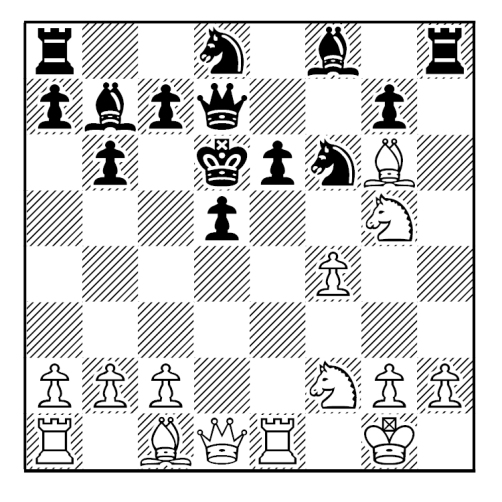
1.d4 Nf6 2.Nc3 d5 3.Bg5 (The often neglected Veresov’s Opening.) 3…Nbd7 4.Nf3 g6 5.e3 Bg7 6.Bd3 c5 7.Ne5 O-O 8.Qf3 Qb6 9.O-O-O e6 10.h4 Nxe5 11.dxe5 Nd7 12.h5 Nxe5 13.Qh3 f5 14.hxg6 hxg6 15.Be2 d4 16.Na4 Qb4 17.f4 Qxa4 18.fxe5 Qxa2 19.Qh7+ Kf7 20.Bf6 Qa1+ 21.Kd2 Qa5+ 22.c3 Rg8
2019_04_25_A
23.Qxg6+! Kxg6 24.Bh5+ Kh7 25.Bf7+ Bh6 26.Rxh6+ (with the unstoppable threat of Rh1#.) 1-0


The third type of Queen sacrifices are those initiating King hunts. The Queen is given up so that the enemy King is brought out into the open. The checkmate, if there, comes many moves later.

 
These sacrifices differ from the mating sacrifices in that, while a mating sacrifice can usually be calculated out to the end, a King Hunt is made on a player’s belief that he can find a mate somewhere down the line. In other words, a King Hunt is made more on intuition rather than calculation.


D. Byrne-Fischer
Rosenwald Memorial
New York, 1956
(D97)
1.Nf3 Nf6 2.c4 g6 3.Nc3 Bg7 4.d4 O-O 5.Bf4 d5 6.Qb3 dxc4 7.Qxc4 c6 8.e4 Nbd7 9.Rd1 Nb6 10.Qc5 Bg4 11.Bg5 Na4 12.Qa3 Nxc3 13.bxc3 Nxe4 14.Bxe7 Qb6 15.Bc4 Nxc3 16.Bc5 Rfe8+ 17.Kf1
2019_04_25_B
17…Be6!! 18.Bxb6 (White almost has to take the Queen. 18.Bxe6? loses to 18…Qb5+! 19.Kg1 Ne2+ 20.Kf1 Ng3+ 21.Kg1 Qf1+! 22.Rxf1 Ne2#. Yes, Black’s position is so overwhelming he can sacrifice his queen more than once. See below for other examples.) 18…Bxc4+ 19.Kg1 Ne2+ 20.Kf1 Nxd4+ (Now Black initiates a “windmill” attack.) 21.Kg1 Ne2+ 22.Kf1 Nc3+ 23.Kg1 axb6 24.Qb4 Ra4 25.Qxb6 Nxd1 26.h3 Rxa2 27.Kh2 Nxf2 28.Re1 Rxe1 29.Qd8+ Bf8 30.Nxe1 Bd5 31.Nf3 Ne4 32.Qb8 b5 33.h4 h5 34.Ne5 Kg7 35.Kg1 Bc5+ 36.Kf1 Ng3+ 37.Ke1 Bb4+ 38.Kd1 Bb3+ 39.Kc1 Ne2+ 40.Kb1 Nc3+ 41.Kc1 Rc2mate 0-1


Averbakh-Kotov
Zurich, 1953
(A55)
1.d4 Nf6 2.c4 d6 3.Nf3 Nbd7 4.Nc3 e5 5.e4 Be7 6.Be2 O-O 7.O-O c6 8.Qc2 Re8 9.Rd1 Bf8 10.Rb1 a5 11.d5 Nc5 12.Be3 Qc7 13.h3 Bd7 14.Rbc1 g6 15.Nd2 Rab8 16.Nb3 Nxb3 17.Qxb3 c5 18.Kh2 Kh8 19.Qc2 Ng8 20.Bg4 Nh6 21.Bxd7 Qxd7 22.Qd2 Ng8 23.g4 f5 24.f3 Be7 25.Rg1 Rf8 26.Rcf1 Rf7 27.gxf5 gxf5 28.Rg2 f4 29.Bf2 Rf6 30.Ne2 Qxh3+!! 31.Kxh3 Rh6+ 32.Kg4 Nf6+ 33.Kf5 Nd7 34.Rg5 Rf8+ 35.Kg4 Nf6+ 36.Kf5 Ng8+ 37.Kg4 Nf6+ 38.Kf5 Nxd5+ 39.Kg4 Nf6+ 40.Kf5 Ng8+ 41.Kg4 Nf6+ 42.Kf5 Ng8+ (These last few moves were apparently played to reach adjournment.) 43.Kg4 Bxg5 44.Kxg5 Rf7 45.Bh4 Rg6+ 46.Kh5 Rfg7 47.Bg5 Rxg5+ 48.Kh4 Nf6 49.Ng3 Rxg3 50.Qxd6 R3g6 51.Qb8+ Rg8 0-1


Mating threats may occur more than once in a game. Which also means a player can sometimes a player can offer his original Queen more than once.


Nigmadzianov-Kaplun
USSR, 1977
(B05)
1.e4 Nf6 2.e5 Nd5 3.d4 d6 4.Nf3 Bg4 5.Be2 c6 6.c4 Nb6 7.Nbd2 N8d7? (ECO suggests 7…dxe5.) 8.Ng5! Bxe2 9.e6!! (White offers his Queen for the first time. This offer can be turned down.) 9…f6 (9…Bxd1? fails to 10.exf7#) 10.Qxe2 fxg5 11.Ne4 +/- Nf6 12.Nxg5 Qc7 13.Nf7 Rg8 14.g4 h6 15.h4 d5 16.c5 Nc8 17.g5 Ne4 18.gxh6 gxh6 19.Qh5 Nf6 20.Nd6+ Kd8 21.Qe8+ (The second offer cannot be refused.) 1-0


Gonssiorovsky-Alekhine
Odessa, 1918
(C24)
1.e4 e5 2.Bc4 Nf6 3.d3 c6 4.Qe2 Be7 5.f4 d5 6.exd5 exf4 7.Bxf4 O-O 8.Nd2 cxd5 9.Bb3 a5 10.c3 a4 11.Bc2 a3 12.b3?! (12.Rb1 is better. Lusin-Morgado, corres. 1968 continued with 12…Bd6 13.Qf2 Ng4 14.Qg3 Re8+ 15.Kd1 Ne3+ 16.Kc1 Nf5 17.Qf2 Bxf4 18.Qxf4 Re1+ 19.Bd1 Ne3 20.Ngf3 Rxh1 21.Qxe3 axb2+ 22.Rxb2 Nc6 23.a4 Rxa4 24.Qe2 Ra1+ 25.Rb1 Rxb1+ 26.Nxb1 h6 27.Nbd2 Qe7 28.Kb2 Qxe2 29.Bxe2 g5 30.Nf1 Bg4 31.Ng3 Bxf3 32.Bxf3 Rxh2 33.Bxd5 h5 34.Kc1 Kg7 35.Kd2 Ne5 36.d4 Ng4 37.Ke2 h4 38.Nf1 Rh1 39.Bxb7 h3 40.gxh3 Rxh3 41.c4 f5 42.c5 Kf6 43.c6 Rc3 1/2-1/2) 12…Re8 13.O-O-O Bb4 14.Qf2 Bxc3 15.Bg5 Nc6 16.Ngf3 d4 17.Rhe1 Bb2+ 18.Kb1 Nd5! (The Queen is offered for the first time.) 19.Rxe8+ (Naturally 19.Bxd8 fails to 19…Nc3#) 19…Qxe8 20.Ne4 Qxe4! (The second offer!) 21.Bd2 Qe3 (The third offer!) 22.Re1 (Now White gets into the act!) 22…Bf5 23.Rxe3 dxe3 24.Qf1 exd2 25.Bd1 Ncb4! (And White finally realizes that he cannot stop Nc3#.) 0-1


E. Z. Adams-C. Torre
New Orleans, 1920 (C62)
1.e4 e5 2.Nf3 d6 3.d4 (Ah!, there is the better move in Philidor’s Defence) 3…exd4 4.Qxd4 Nc6 5.Bb5 Bd7 6.Bxc6 Bxc6 7.Nc3 Nf6 8.O-O Be7 9.Nd5 Bxd5 10.exd5 O-O 11.Bg5 c6 12.c4 cxd5 13.cxd5 Re8 14.Rfe1 a5 15.Re2 Rc8 16.Rae1 Qd7 17.Bxf6 Bxf6 18.Qg4! (The first offer) 18…Qb5 19.Qc4! (The second offer) 19…Qd7 20.Qc7! (The third!) 20…Qb5 21.a4! Qxa4 22.Re4 Qb5 23.Qxb7 (This, the fourth offer, is too much for Black to handle.) 1-0

 
These games are extremely rare. After all, how many Queen sacrifices do you need once you have mated your opponent?

The Daring Damiano

The Petrov (1.e4 e5 2.Nf3 Nf6) has a reputation for being drawish. But that doesn’t mean that there no pitfalls.


Let’s take a look at one of them, sometimes called “The Daring Damiano” (don’t ask me why).


The moves are 1.e4 e5 2.Nf3 Nf6 3.Nxe5 Nxe4. Although White has several moves available to choose from, he almost always chooses 4.Qe2. The main reason is that it activates his queen and he can quickly win the game if Black stumbles.


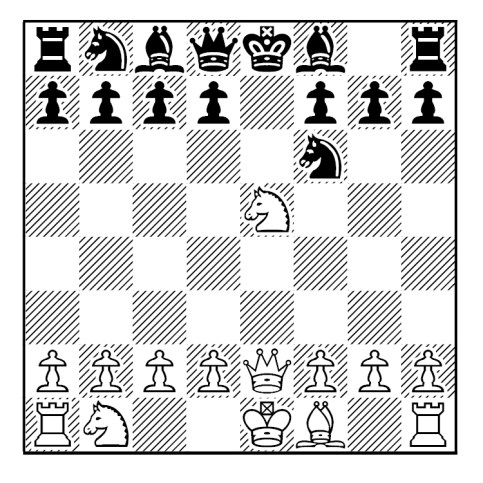
Let’s take a look at a common (at least among beginners) trap from this position and let’s call it “Ancient Chess Trap” (or ACT). The moves that make this (bad) variation are (in case you need review all the move so far) are : 1.e4 e5 2.Nf3 Nf6 3.Nxe5 Nxe4 4.Qe2, and now Black can lose quickly lose with 4…Nf6??

2019_03_28

5.Nc6+! +-


This trap is one worth remembering as it can come up in other openings and is a nice way to end a rated game early enough so you can enjoy playing blitz chess for the rest of the day.


After the better 4…Qe7, the game can continue with 5.Qxe4 d6 6.d4 dxe5 [Black almost has to take the pawn. After 6.d4 Nd7, White won nicely with 6.d4 Nd7 7.f4!? f6?! 8.Be2 fxe5 9.fxe5 dxe5 10.O-O exd4 11.Bh5+ Kd8 12.Bg5 Nf6 13.Rxf6 Qxe4 14.Rd6# 1-0 (Steinkuehler-Horwitz, Manchester 1961).] 7.Qxe5 Qxe5+ 8.dxe5 Bf5, giving Black a decent chance.

 
This was starting point for Hertan’s article in the February 1990 issue of Chess Life. By the way, his article was titled, “The Daring Damiano”. It may the first time anyone has used the term to describe this variation in the Petrov.


The big question here, is how should White continue? The answer is not clear.


9.Bb5+ doesn’t look so good after the obvious 9…c6. In addition, Sapfirov-Yaroslavsev, USSR 1971, continued with 9.Bb5+ Nd7!? 10.O-O Bxc2 11.Bf4 c6 12.Be2 Bf5 13.Nc3 Be7 = (ECO evaluation). So Black can at least equalize.

 
It turns out that 9.Bd3 is an error as Black can continue with 9.Bd3? Bxd3 10.cxd3 Nc6 and his development is no worse than White and Black may already have the advantage.


9.c3 has possibilities. After 9.c3 Nd7 10.f4 O-O-O 11.Be3 f6 (this move deserves either !? or ?!), Black won after 12.Be2 fxe5 13.O-O exf4 14.Rxf4 Re8 15.Rxf5 Rxe3 16.Bg4 h5 17.Kf2 Re4 18.Bh3 g6 19.Nd2 gxf5 0-1 (R. Oosting (1983)-FM S. Muehlenhaus (2199), HZ Open, Netherlands Aug. 6 2017).

 
Other games with 9.c3


Fridthjofsdottir-Canela
Thessaloniki Ol., 1984
1.e4 e5 2.Nf3 Nf6 3.Nxe5 Nxe4 4.Qe2 Qe7 5.Qxe4 d6 6.d4 dxe5 7.Qxe5 Qxe5+ 8.dxe5 Bf5 9.c3 Nd7 10.Bf4 O-O-O 11.Nd2 Bc5 12.Nb3 Bb6 13.Nd4 Bg6 14.O-O-O Rde8 15.Re1 Nc5 16.Bc4 Rhf8 17.Rd1 Re7 18.f3 Rfe8 19.Rhe1 Nd7 20.e6 fxe6 21.Bxe6 Kb8 22.Bxd7 Rxe1 23.Bxe8 Rxe8 24.Bg3 Kc8 25.Re1 Rxe1+ 26.Bxe1 Bxd4 27.cxd4 Kd7 28.Bg3 Bd3 29.Be5 Bf1 30.g3 Be2 31.Bxg7 Bxf3 32.Kd2 Ke6 33.Ke3 Bd5 34.a3 Kf5 35.Be5 c6 36.Bb8 a6 37.Kd3 Ke6 38.Kc3 Kd7 39.Kb4 b6 40.Kc3 Kc8 41.Be5 Kd7 42.Kd3 Ke6 43.Bc7 b5 44.Kc3 Kd7 45.Bb6 Be6 46.Kb4 Kd6 47.Ka5 Bc8 48.Bc5+ Kc7 49.Kb4 Bf5 50.Kc3 Kd7 51.Kd2 Ke6 52.Ke3 h5 53.Kf4 Kf6 54.Be7+ Kg6 55.Ke5 a5 56.Kd6 Be4 57.a4 bxa4 58.Bd8 Bd5 59.Bxa5 Kg5 60.h3 Kf5 61.g4+ 1/2-1/2


Herbrechtsmeier-Duerr
Badenweiler Open
Germany, 1988
1.e4 e5 2.Nf3 Nf6 3.Nxe5 Nxe4 4.Qe2 Qe7 5.Qxe4 d6 6.d4 dxe5 7.Qxe5 Qxe5+ 8.dxe5 Bf5 9.c3 Nd7 10.Bf4 O-O-O 11.Nd2 Re8 12.Nc4 f6 13.O-O-O fxe5 14.Bg3 g6 15.Bd3 Bg7 16.Bc2 h5 17.h4 Nc5 18.Rhe1 e4 19.Bf4 a6 20.Ne3 Rhf8 21.Bg3 Bh6 22.Kb1 Nd3 23.Nxf5 gxf5 24.Bxd3 exd3 25.Rxe8+ Rxe8 26.Rxd3 Re1+ 27.Kc2 Re2+ 28.Kd1 Rxb2 29.Rf3 Rd2+ 30.Ke1 Rxa2 31.Rxf5 Bd2+ 32.Kd1 Bxc3 33.Rf8+ Kd7 34.Rf7+ Ke6 35.Rxc7 Be5 36.Bxe5 Kxe5 1/2-1/2


Jolanta Zawadzka (243200-Ewa Harazinska (2310)
Polish Women’s Ch.
Poznan, Apr. 1 2016
1.e4 e5 2.Nf3 Nf6 3.Nxe5 Nxe4 4.Qe2 Qe7 5.Qxe4 d6 6.d4 dxe5 7.Qxe5 Qxe5+ 8.dxe5 Bf5 9.c3 Nd7 10.Bf4 O-O-O 11.Bc4 Nxe5 12.Bxe5 Re8 13.f4 f6 14.O-O fxe5 15.fxe5 Bc5+ 16.Kh1 Bxb1 17.Raxb1 Rxe5 18.Bd3 h6 19.b4 Be7 20.Bf5+ Kb8 21.Bg4 Bf6 22.Bf3 Re3 23.c4 Rd8 24.a4 c6 25.a5 Kc7 26.b5 cxb5 27.Rxb5 b6 28.c5 bxc5 29.Rxc5+ Kd6 30.Rc6+ Ke7 31.Rb1 Rd6 32.Rc7+ Rd7 33.Rc4 Rd4 34.Rcc1 Ra3 35.Rb7+ Rd7 36.Re1+ Kd8 37.Rb8+ Kc7 38.Rb7+ Kd8 39.Rb5 Bc3 40.Rb8+ Kc7 41.Rb7+ Kd8 42.Rb8+ Kc7 43.Rb7+ 1/2-1/2
White can offer a pawn with 9.Nc3. Black should not take it and play the most reasonable development move; 9…Nc6. The c-pawn is still vulnerable, and Black is free to castle queenside, giving his king safety and his activity to his rook.


Finally, White can sidestep this variation with 6.d4 dxe5 7.dxe5 Nc6. But that is for another post.

Swiss Gambit

Most players know of Froms’ Gambit [1.f4 e5 2.fxe5 d6 3.exd6 Bxd6 4.Nf3), with continuation of either 4…g5 (to drive away the knight) or 4…Nf6 (to defend and ready to redeploy the knight to g4 or e4)].


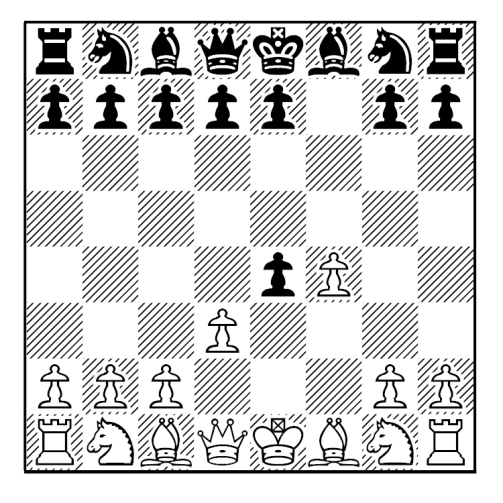
But White can also offer a similar gambit after 1.f4 f5 2.e4 fxe4 3.d3. This gambit is known as the Swiss Gambit. Because of its rarity, most players are not aware of it or it’s thematic ideas.


Let’s take a look the gambit after the opening moves (1.f4 f5 2.e4 fxe4 3.d3).

2019_03_14_a

If Black was to take the pawn, he would be a pawn up in the game. However, it would be hazardous to do so as both of White’s bishops (after 3…exd3 4.Bxd3) would be activated and his own kingside would be vulnerable. There are two things that slow down White’s attack. The first is the f-pawn, which unlike in the From’s Gambit (which does not have such an advanced pawn), blocks the bishop from going to f4 or g5. The second thing is that Black usually plays an early 4…Nf6, to stop the h5 checks.

 
Now, lets look at some games.


First, Black does not have to take the pawn. But such a plan can be risky as the d3-pawn can easily capture the e4-pawn and White has a nice center, without having to sacrifice a pawn.


Ranniku-Karakas
Briansk, 1965
1.f4 f5 2.e4 fxe4 3.d3 g6 4.dxe4 e5 5.Nf3 Nf6 6.Bc4 Qe7 7.Nc3 exf4 8.Qe2 d6 9.Bxf4 Be6 10.O-O-O Nc6 11.Bb5 Bd7 12.Bg5 Bg7 13.Nd5 Qd8 14.e5 dxe5 15.Nxe5 Nxe5 16.Qxe5+ Kf7 17.Nxf6 1-0


Priehoda (2404)-Cyprian
Kubin Open, 1978
1.f4 f5 2.e4 fxe4 3.d3 e3 4.Bxe3 Nf6 5.Nc3 d5 6.d4 Bf5 7.Bd3 e6 8.Nf3 c6 9.O-O Bb4 10.Ne2 Nbd7 11.Ng3 g6 12.Qe2 O-O 13.Bd2 Bxd2 14.Qxd2 Qc7 15.Rae1 Rae8 16.h3 b6 17.Nh1 Nh5 18.Ne5 Nxe5 19.fxe5 c5 20.Bb5 Rc8 21.g4 cxd4 22.gxf5 exf5 23.Qxd4 Rcd8 24.e6 Qe7 25.Bd7 Nf6 26.Qh4 Qc5+ 27.Nf2 Qe7 28.Nd3 Kg7 29.Qd4 Kh6 30.Ne5 Ne4 31.Qe3+ Kg7 32.Nc6 Qh4 33.Nxd8 f4 34.e7 Rf6 35.Qf3 Nd2 36.Qg4 1-0


Petran (2341)-Veselsky (2200)
Slovakia Ch.
Dolny Kubin, 1979
1.f4 f5 2.e4 fxe4 3.d3 Nf6 4.Nc3 e3 5.d4 e6 6.Bd3 Bb4 7.Bxe3 Bxc3+ 8.bxc3 O-O 9.Nf3 d6 10.O-O Nbd7 11.Bd2 Qe8 12.Qe2 Rf7 13.Rae1 Nf8 14.f5 h6 15.Nh4 Bd7 16.Qf3 Qc8 17.Qg3 Nh5 18.Qh3 Nf6 19.Ng6 N6h7 20.fxe6 Bxe6 21.Rxf7 Bxh3 22.Ree7 Nxg6 23.Rxg7+ Kf8 24.Ref7+ Ke8 25.Bxg6 1-0

 
If Black wants to decline the pawn offer, he must play an early …d5.


Heinola-Lehtivaara
Tampere Hervanta, 1987
1.f4 f5 2.e4 fxe4 3.d3 d5 4.dxe4 dxe4 5.Qxd8+ Kxd8 6.Nc3 Nf6 7.Be3 c6 8.Nge2 Bf5 9.O-O-O Nbd7 10.Bd4 Kc7 11.Ng3 e6 12.Be5+ Nxe5 13.fxe5 Ng4 14.Ncxe4 Nxe5 15.Be2 g6 16.h3 h5 17.Kb1 h4 18.Nxf5 gxf5 19.Ng5 Re8 20.Rhe1 Rh6 21.Rd2 Bc5 22.Bf1 Nd7 23.Bc4 e5 24.Red1 Nb6 25.Bb3 Be3 0-1


And he must play it accurately.


R. Oberlin-R. Berggren
US Open
Los Angeles, 1991
1.f4 f5 2.e4 fxe4 3.d3 d5 4.Nh3 Nf6 5.Nf2 exd3 6.Bxd3 Nc6 7.O-O b6? (This setup of the knight on c6 and the bishop going to b7 seems too slow and out of touch with a tactical opening such as this one. Black soon finds himself short of moves.) 8.Nd2 Bb7 9.Nf3 Qd7 10.Ng5 Nd8 11.Bxh7 e6 12.Bg6+ Ke7 13.Re1 Kd6 (Let the King Hunt begin!)

2019_03_14_b

4.f5 exf5 15.Nd3 Qa4 16.Bf4+ Kc6 17.Ne5+ Kc5 18.Qd2 d4 19.b4+! Kd5 20.c4+ 1-0


It is only after 1.f4 f5 2.e4 fxe4 3.d3 exd3 4.Bxd3 Nf6 that the real battle begins.

De Groot-Anderssen
Amsterdam, 1875
1.f4 f5 2.e4 fxe4 3.d3 exd3 4.Bxd3 Nf6 5.Nf3 e6 6.Nc3 Be7 7.Ne4 Nc6 8.c3 d6 9.Nfg5 Nxe4 10.Nxe4? (>Bxe4) 10…g6 11.Qe2 e5 12.O-O Bf5 13.Ng5 Bxd3 14.Qxd3 Bxg5 15.fxg5 Qe7 16.Qh3 Qd7 17.Be3 Qxh3 18.gxh3 0-1


After the moves 1.f4 f5 2.e4 fxe4 3.d3 exd3 4.Bxd3 Nf6 5.Nf3 e6, White has three excellent choices of 6.Ng5 (A brazen attempt at an attack, probably best for a blitz game), 6.Ne5 (a more cautious and shy approach to an attack), and 6.Be3 (a developing move that allows White to castle queenside if the need arises).


Bird+Dobell-Gelbfuhs
Vienna, 1873
1.f4 f5 2.e4 fxe4 3.d3 exd3 4.Bxd3 Nf6 5.Nf3 (a very good move as the knight usually finds itself involved in White’s attack.) 5…e6 (this move is the most common as it allows his bishop to develop and bolsters his defense of his weak point on f7.) 6.Ng5!? g6 (not 6…Bc5? because of 7.Bxh7 Kf8 8.Nxe6+, winning) 7.h4 Bh6 8.h5 Bxg5 9.fxg5 Nd5 10.hxg6 Qe7 11.Rxh7 Rxh7 12.gxh7 Qb4+ 13.Kf1 Qh4 14.Bg6+ Ke7 15.Qh5 1-0


Popp-Jørgensen
corres.
IECC, 2000
1.f4 f5 2.e4 fxe4 3.d3 exd3 4.Bxd3 Nf6 5.Nf3 d6 6.Ng5 c6 7.h4 Bg4 8.Be2 Bxe2 9.Qxe2 g6 10.Qe6 Qa5+ 11.Bd2 Qf5 12.Qf7+ Kd7 13.h5 gxh5 14.Rxh5 Qc5 15.Rh1 Qxc2 16.Ne6 Qe4+ 0-1


Christian Maltais (2134)-Daniel J. Freire (2047)
corres.
DE10A /pr 48
ICCF, 2016
1.f4 f5 2.e4 fxe4 3.d3 exd3 4.Bxd3 Nf6 5.Nf3 e6 6.Ng5 d5 7.Qe2 Bc5 8.Nd2 O-O 9.Ndf3 Qd6 10.h4 Nc6 11.c3 h6 12.Ne5 hxg5 13.hxg5 Ne4 14.Bxe4 dxe4 15.g6 Rf5 16.Nf7 Rxf7 17.Qh5 Qf8 18.Qh8mate 1-0


Ivar Jakobsson-Hakan Johansson
Stockholm, 1974
1.f4 f5 2.e4 fxe4 3.d3 exd3 4.Bxd3 Nf6 5.Nf3 e6 6.Ne5 d6 7.O-O b6 8.Ng4 Ba6 9.Nxf6+ Qxf6 10.Re1 Bxd3 11.Qxd3 Nc6 12.Qf3 Kd7 13.Nd2 d5 14.c4 Bc5+ 15.Kh1 Nd4 16.Qh3 Rae8 17.cxd5 Nc2 18.Ne4 Qh6 19.dxe6+ Kc8 20.Qf3 Kb8 21.Nxc5 bxc5 22.Qb3+ Nb4 23.a3 a5 24.axb4 cxb4 25.Rxa5 1-0


Schirmer-Schleipen, 1956
1.f4 f5 2.e4 fxe4 3.d3 exd3 4.Bxd3 Nf6 5.Nf3 e6 6.Be3 Be7 7.O-O O-O 8.Nbd2 Nd5 9.Ng5 Bxg5 10.fxg5 Rxf1+ 11.Nxf1 Nxe3 12.Bxh7+ Kf8 13.Nxe3 Qxg5 14.Qf3+ Qf6 15.Qh5 Ke7 16.Rf1 Qh6 17.Qf7+ Kd6 18.Rd1+ Kc6 19.Be4+ d5 20.Bxd5+ exd5 21.Qxd5+ Kb6 22.Nc4+ 1-0

A Remarkable Move in the Gruenfeld.

There is a remarkable opening move which looks like a White blunder in the Gruenfeld.


And it goes like this:


1.d4 Nf6 2.c4 g6 3.Nc3 d5 4.cxd5 Nxd5 5.Na4!?


Here’s a diagram.

2019_02_21_A

Bringing up the question, “What benefit(s) does White attain with his knight sitting idly and alone on a4?”


Well, for one, after White gets around with .e4, the Black’s knight has to move. His usual move of …Nxc3 is out of the question as White has no piece or pawn on c3. So where does Black’s knight then move? If …Nf6, then he invites .e5. And …Nb4 puts his knight out of play and is subject to .c3. So …Nb6 is practically forced, where it is partly out of play and but no pawn is threatening it.


The second benefit White has is that with the knight out of the way, his queenside is open for his other pieces, not to mention he can now play .c4 at some point. In fact, most of the action that originates from this bizarre knight move is of a queenside nature.


The earliest master game with this move can be found in the following game.


Ashot Nadanian (2325)-Varuzhan Akobian (2270)
Armenia, 1996
1.d4 Nf6 2.c4 g6 3.Nc3 d5 4.cxd5 Nxd5 5.Na4 e5 6.dxe5 Bb4+ 7.Bd2 Ne3 8.fxe3 Bxd2+ 9.Qxd2 Qh4+ 10.g3 Qxa4 11.Qd4 Qa5+ 12.b4 Qb6 13.Bg2 O-O 14.Rc1 Be6 15.a4 c6 16.Nf3 Rd8 17.Qf4 Na6 18.Rb1 c5 19.b5 Nb4 20.Qh6 Nc2+ 21.Kf2 c4 22.Rbc1 Bf5 23.Rxc2 Bxc2 24.Ng5 Qc7 25.Qxh7+ Kf8 26.Ne6+ 1-0


Here’s some later games showing White’s attacking possibilities.


Alexander Naumann (2385)-Alexander Lytchak (2390)
German U20 Ch.
Apolda, 1997
1.d4 Nf6 2.c4 g6 3.Nc3 d5 4.cxd5 Nxd5 5.Na4 Bg7 6.e4 Nb6 7.Be3 O-O 8.Rc1 f5 9.exf5 Bxf5 10.Nc5 Qd5 11.a4 Nc6 12.Ne2 Nc4 13.Nf4 Nxe3 14.fxe3 Qd6 15.Bc4+ Kh8 16.O-O e5 17.Nfe6 Bh6 18.Rc3 Bxe6 19.Nxe6 Rxf1+ 20.Qxf1 Qe7 21.Ba2 Rc8 22.d5 Nd8 23.d6 1-0


Stepan Lobanov-Leonid Sharikov
Novokuznetsk Open, 1998
1.d4 Nf6 2.c4 g6 3.Nc3 d5 4.cxd5 Nxd5 5.Na4 Bg7 6.e4 Nb6 7.Be3 O-O 8.Nf3 Nxa4 9.Qxa4 c5 10.Rd1 cxd4 11.Nxd4 Qe8 12.Qa3 a6 13.Nb5 Be5 14.Bh6  Bd7 15.Bxf8 Nc6 16.Nc7 Bxc7 17.Bh6 Bd6 18.Qd3 Nb4 19.Qc3 f6 20.Bc4+ +/- Kh8

2019_02_21_B

21.Rxd6! Nc2+ 22.Kd2! b5 23.Rxf6 1-0


Szabolcs Laza, (2173)-Anita Gara (2385)
Hungary Team Ch., Dec. 17 2017
1.d4 Nf6 2.c4 g6 3.Nc3 d5 4.cxd5 Nxd5 5.Na4 Bg7 6.e4 Nb6 7.Be3 O-O 8.Nf3 Bg4 9.Nc5 Nc6 10.Nxb7 Qb8 11.Ba6 e5 12.d5 Nb4 13.Nc5 N6xd5 14.Bb7 Nxe3 15.fxe3 Bxf3 16.gxf3 Rd8 17.Qb3 Bf8 18.Bxa8 Bxc5 19.Bd5 Nxd5 20.exd5 Qxb3 21.axb3 Bxe3 22.Ke2 Bd4 23.Rhd1 Rxd5 24.Rxa7 Rb5 25.Ra8+ Kg7 26.Rd3 c5?! (Black’s bishop is on an overwhelming square overlooking everything in front of it, and because it is supported by two black pawns means it is not forced off going to be driven off its awesome square. Unfortunately, it also means the Bishop can’t move backwards, which make a difference in this endgame.)

2019_02_21_C
27.Ra6 h5 28.h3 Rb7 29.Rc6 Kh6 30.h4 Kg7 31.Rc8 f6 32.Rc6 g5 33.hxg5 fxg5 34.Re6 h4 35.Kf1 Ra7 36.b4 cxb4 37.Rb3 h3 38.Rxb4 g4 39.fxg4 Ra1+ 40.Ke2 h2 41.Rb7+ Kf8 42.Rf6+ Ke8 43.Re6+ Kd8 44.Rg6 Re1+ 45.Kd2 Rd1+ 46.Kc2 Rc1+ 47.Kb3 Rc7 48.Rg8+ Kd7 49.Rxc7+ Kxc7 50.Rh8 Bg1 51.g5 e4 52.g6 e3 53.Kc2 e2 54.Kd2 Bd4 55.Rxh2 Bxb2 56.g7 1-0


However, the move 5.Na4 remained under the radar for years. Until it was played by a three-time challenger of the World Championship who played it a European Zonal Tournament.


GM Korchnoi (2625)-GM Emil Sutovsky (2575)
European Zonal
Dresden, Germany, 1998
1.d4 Nf6 2.c4 g6 3.Nc3 d5 4.cxd5 Nxd5 5.Na4!? Bg7 6.e4 Nb6 7.Be3 O-O 8.Nf3 Nxa4 9.Qxa4 c5 10.Rd1 Qb6 11.Rd2! (This TN is such a good move that it became part of theory.) 12…Bd7 12.Qa3 cxd4 13.Nxd4 Qc7 14.Be2 e5?! 15.Rc2 Qd8 16.Nb5 Nc6(16…Bc6 17.O-O Bxe4 18.Rd2!) 17.Nd6 Qb8 18.Bc4 Nd4 19.Bxd4 exd4 20.O-O Be6 (20…Be5? 21.Nxf7! and White’s attack comes first and fast.) 21.Bxe6 fxe6 22.Rfc1 Be5 23.Rc7 Bxd6 24.Qxd6 Rf7 25.Qxe6 1-0


And now everyone seemed to take notice.


GM T. Gareev (2614)-Ge. Antal (2519)
US Open
Irvine, CA, Aug. 2 2010
1.d4 Nf6 2.c4 g6 3.Nc3 d5 4.cxd5 Nxd5 5.Na4 Bg7 6.e4 Nb6 7.Be3 O-O 8.Nf3 Nxa4 9.Qxa4 c5 10.Rd1 Qb6 11.Rd2 Bd7 12.Qa3 cxd4 13.Nxd4 Qc7 14.Be2 Bc6 15.f3 Be5 16.g3 Bd6 17.Qc3 Rc8 18.Kf2 Na6 19.Nxc6 Qxc6 20.Qxc6 Rxc6 21.Bb5 Rc7 22.a3 Bc5 23.b4 Bxe3+ 24.Kxe3 Rac8 25.Rhd1 Nb8 26.Rd8+ Kg7 27.f4 f6 28.e5 fxe5 29.fxe5 a6 30.Ba4 a5 31.bxa5 Rc3+ 32.Kd2 Rxd8+ 33.Kxc3 Rc8+ 34.Kb4 Na6+ 35.Kb5 Rc6 36.Bb3 Nc7+ 37.Ka4 Rc5 38.Rd7 Kf8 39.Rd8+ Kg7 40.Rc8 g5 41.Bd5 Rxd5 42.Rxc7 Rxe5 43.Rxb7 Re4+ 44.Rb4 Re6 45.Kb5 Re3 46.a4 1-0


GM Hao Wang (2736)-GM F. Caruana (2779)
FIDE GP
Paris, Sept. 23 2013
1.d4 Nf6 2.c4 g6 3.Nc3 d5 4.Nf3 Bg7 5.cxd5 Nxd5 6.Na4 O-O 7.e4 Nb6 8.Be3 Nxa4 9.Qxa4 c5 10.Rd1 Qb6 11.Rd2 Bd7 12.Qa3 cxd4 13.Nxd4 Qc7 14.Be2 Bc6 15.O-O Bxe4 16.Nb5 Qc6 17.f3 Bd5 18.Qxe7 Re8 19.Qg5 Na6 20.Qxd5 Qxd5 21.Rxd5 Rxe3 22.Bc4 Re7 23.Rd2 Bh6 24.f4 Nc5 25.g3 a5 26.Rd5 Ne4 27.Rfd1 Bf8 28.Rd8 Rxd8 29.Rxd8 Kg7 30.Kg2 Nf6 31.Kf3 Rd7 32.Rxd7 Nxd7 33.Nc7 Bc5 34.Bb5 Nf6 35.Ne8+ Nxe8 36.Bxe8 Kf8 37.Bb5 Kg7 38.Be8 Kf8 39.Bb5 Kg7 40.Ke4 1/2-1/2


Saric (2425)-Bo Vujacic (2269)
Serbian Team Ch.
Palic, Sept. 4 2014
1.d4 Nf6 2.c4 g6 3.Nc3 d5 4.cxd5 Nxd5 5.Na4 Bg7 6.e4 Nb6 7.Be3 O-O 8.Nf3 Nxa4 9.Qxa4 c5 10.Rd1 Qb6 11.Rd2 Bd7 12.Qa3 cxd4 13.Nxd4 Qc7 14.Be2 Bc6 15.O-O e5 16.Nb5 Bxb5 17.Bxb5 Nc6 18.Rc1 Rfd8 19.Rdc2 Bf8 20.Qa4 Qd6 21.Bc5 Qf6 22.Bxc6 Bxc5 23.Rxc5 Rd2 24.Rf1 bxc6 25.Rxc6 Qg5 26.Rc2 Rd4 27.Qa5 Qf4 28.Re2 Rxe4 29.Rxe4 Qxe4 30.Re1 Qc4 31.b3 Qc2 32.Rxe5 Rc8 33.h3 Qb2 34.g3 h5 35.Re1 h4 36.g4 Qd4 37.Qe5 Qd2 38.Qe2 Qc3 39.Qe3 Qa5 40.Re2 Rc3 41.Qe8+ Kg7 42.Qe5+ Qxe5 43.Rxe5 Rxh3 44.Ra5 Rf3 45.Kg2 Rf4 46.g5 a6 47.Rxa6 Rg4+ 48.Kh3 Rxg5 49.Kxh4 Rg2 50.f3 f5 51.Kh3 Rg1 52.Kh2 Rb1 53.Kg3 g5 54.Kf2 f4 55.Ke2 Kf7 56.Rd6 Ke7 57.Rd1 Rb2+ 58.Rd2 Rb1 59.Rd1 Rb2+ 60.Rd2 Rb1 61.Kd3 Ke6 62.Ke4 Re1+ 63.Kd4 Rf1 64.Rd3 Kf5 65.a4 Ra1 66.Kc5 g4 67.fxg4+ Kxg4 68.Rd8 f3 69.Rf8 Kg3 70.Rg8+ Kh3 71.Kb5 f2 72.Rf8 Kg2 73.a5 f1=Q+ 74.Rxf1 Kxf1 75.a6 Ke2 76.b4 Kd3 77.Kb6 Kc4 78.b5 Ra2 1/2-1/2


It may be that Black can force a draw. But he has to work for it. Maybe you can find some improvements for White.


A First

My friend, A., started a writing class. Her first assignment was to make a list 10 things of her “firsts”, and then write about them.


Intrigued by this idea, I decided to write about one of my “firsts”.


~~~~~~~~~~~~~~~~~~~~~~~~~~~~~~~~~~


MY FIRST TIME I WON A GAME AT CHESS.


I was in grade school in the early 1970’s and in the fourth grade.


I played a simple Scholar’s Mate [For those who don’t know the moves, they are 1.e4 e5 2.Bc4 Nc6 3.Qf3 Nd4? (played to attack White’ queen and threaten …Nxc2+, but actually loses) 4.Qxf7mate].

scholars_mate

I was joyful. Happy. My dad played it against me and I thought it was the best way to win and why did people need chess books?


Then doubt.


Was this it? Was this the best one could achieve in chess? To win a game in four moves? Was this the only, or at least the best, way to win? Why did Grandmasters Fischer and Spassky take so long to move in their match?


Spassky Fischer


Didn’t they know about Scholar’s Mate?


It was only later I discovered that the game of chess is incredibly complex.


And what I have learned in the last 40+ years of studying this game is;


(1) Black does not have to respond 1…e5 to White’s first move.


(2) There are opening variations that go past the 10th, the 20th moves.


(3) There is usually a middle game.


(4) There are endings to learn.


(5) Books exist to help the beginner, the novice, the merely good player, the experienced player, the expert and the master.


(6) And Grandmasters know Scholar’s Mate.

Dutch Treats

The Dutch is an aggressive response to 1.d4. It is also extremely risky.

Here are some miniatures showing how White (and Black!) can win quickly.


Sorensen-Mortensen
Copenhagen, 1994
1.d4 f5 2.Qd3!? d5 3.g4! (White does well if he can get this move in.) 3…fxg4 4.h3 g3 5.fxg3 Nf6 6.Nc3 c6 7.e4 dxe4 8.Nxe4 Nxe4 9.Qxe4 Qa5+ 10.Bd2 Qd5 11.Bg2 Be6 12.Qe2 Qc4 13.Qe3 Bd5 14.Bxd5 Qxd5 15.Nf3 Nd7 16.b3 O-O-O 17.c4 Qd6 18.Ng5 e5 19.Nf7 Qxd4 20.Qxd4 exd4 21.Nxh8 Ne5 22.O-O 1-0

 
GM W. Browne-GM R. Byrne
US Ch.
Mentor, 1977
1.d4 f5 2.Nc3 Nf6 3.Bg5 (One purpose of this bishop move is to cripple Black’s kingside pawn structure. As in this game.) 3…d5 4.Bxf6 exf6 5.e3 Be6 6.Bd3 g6 7.Qf3 c6 8.Nge2 Nd7 9.h3 Qb6 10.g4 Qxb2 11.Rb1 Qa3 12.gxf5 Bf7 13.Rxb7 Bb4 14.O-O O-O-O 15.Rxb4 Qxb4 16.Ba6+ Kc7 17.Rb1 Qd6 18.Rb7+ Kc8 19.Rb3+ Kc7 20.Rb7+ Kc8 21.e4 Nb8 22.Nb5 cxb5 23.Qc3+ Nc6 24.e5 Qc7 25.e6 1-0


Pomar Salamanca-GM Bent Larsen
Spain, 1975
[GM Larsen was noted for doing well in off-beat openings.]
1.d4 f5 2.Nc3 d5 3.f3 c5 4.e4 e5 5.Bb5+ Bd7 6.Bxd7+ Nxd7 7.Nxd5 cxd4 8.Ne2 fxe4 9.fxe4 Ngf6 10.Bg5 Qa5+ 11.Bd2 Qc5 12.Nxf6+ Nxf6 13.Ng3 h5 14.Qf3 h4 15.Ne2 Qxc2 16.Qf5 Qxe4 17.Qe6+ Be7 18.Bb4 Nd5 19.Bxe7 Nf4 20.Qc4 Kxe7 0-1


Sakaev-Kobalija
Chigorin Memorial
Saint Petersburg, Russia, 1994
1.d4 f5 2.Nc3 d5 3.Bf4 c6 4.e3 Nf6 5.Bd3 g6 6.h4 Be6 7.Nf3 Bg7 8.h5 Nbd7 9.Ng5 Bg8 10.h6 Bf8 11.Qd2 e6 12.O-O-O Qe7 13.f3 e5 14.dxe5 Nxe5 15.Be2 Ned7 16.e4 fxe4 17.fxe4 O-O-O 18.exd5 Bxd5 19.Nxd5 Nxd5 20.Bg4 Qf6 21.Ne6 Ba3 22.Qd4 Qe7 23.bxa3 Qxa3+ 24.Qb2 Qa4 25.Rd4 1-0


Hamilton-J. Scheider
Georgia Ch., 1981
1.d4 f5 2.Nc3 e6 3.e4 fxe4 4.Nxe4 Nf6 5.Bd3 Nc6 6.Nf3 Be7 7.Ne5 O-O 8.Nxf6+! Bxf6 9.Qh5 Nxe5 10.Bxh7+ Kh8 11.Bg6+ 1-0

 
Kupka-Kohout
USSR, 1975
1.d4 f5 2.Nf3 Nf6 3.g3 d6 4.Bg2 c6 5.O-O Qc7 6.Nbd2 e5 7.dxe5 dxe5 8.e4 fxe4 9.Ng5 e3 10.Nde4 Nxe4 11.Bxe4 exf2+ 12.Rxf2 Bc5 13.Qh5+ Ke7 14.Nxh7 Bxf2+ 15.Kxf2 Qa5 16.Bg5+ Kd6 17.Qg6+ Kc5 18.Be3+ Kc4 19.Bd3+ Kd5 20.c4mate 1-0

 
IM Heinz Wirthensohn-IM Lin Ta
Novi Sad. Ol.
Yugoslavia, 1990
1.Nf3 f5 2.g3 Nf6 3.Bg2 d6 4.d4 g6 5.b3 Bg7 6.Bb2 O-O 7.O-O c6 8.Nbd2 Kh8 9.c4 Ne4 10.Qc2 d5 11.Ne5 Nxd2 12.Qxd2 Be6 13.Qb4 b6 14.Rfd1 a5 15.Qd2 Ra7 16.Rac1 dxc4 17.d5 cxd5 18.Nxg6+! 1-0


Hjorth (2502)-A. Wang (2206)
US Open, 1995
1.d4 e6 2.Nf3 f5 3.g3 Nf6 4.Bg2 Be7 5.c4 d5 6.O-O O-O 7.b3 c6 8.Bb2 Ne4 9.Nbd2 Nd7 10.Ne1 Qa5 11.Nxe4 fxe4 12.f3 exf3 13.Nxf3 dxc4 14.bxc4 e5 15.e3 exd4 16.exd4 Nb6 17.c5 Nc4 18.Qe2 Nxb2 19.Qxe7 Rf7 20.Qe2 Qc3 21.Rac1 Qa3 22.Ng5 Rxf1+ 23.Rxf1 Bd7 24.Qe7 h6 25.Qf7+ 1-0


Monacell (2473)-Elburg (2306)
corres.
ICCF, 2002
1.d4 f5 2.g3 Nf6 3.Bg2 g6 4.Nh3 Bg7 5.Nf4 Nc6 6.Nc3 O-O 7.h4 d6 8.d5 Ne5 9.h5 Bd7 10.e4 fxe4 11.Nxe4 Nxh5 12.Ng5 Nxf4 13.gxf4 Nf7 14.Nxh7 Re8 15.Be3 Bxb2 16.Be4 c6 17.Rg1 Bc3+ 18.Bd2 Bg7 19.Rxg6 e5 20.Qh5 exf4 21.O-O-O Re5 22.Rxg7+ 1-0


Krasnov (1955)-Manvelyan (2293) X25
Mechanics’ Summer Tournament
Mechanics’ Institute, San Francisco, June 4 2013
1.d4 g6 2.Nf3 Bg7 3.g3 f5 4.c4 Nf6 5.Nc3 O-O 6.Bg2 d6 7.O-O Qe8 8.e4 fxe4 9.Ng5 Bg4 10.Qb3 Nc6 11.Be3 h6 12.Ngxe4 Nxe4 13.Nxe4? (>13.Bxe4 Bf5 14.Bxf5 Rxf5 15.Nd5) 13…Nxd4 14.Qxb7 Nf3+ 15.Kh1 c5 16.h3 Bd7 17.Nxd6 $4 exd6 18.Bxf3 Rxf3 19.Qxf3 Bc6 0-1


Katt-Emminger
1.d4 f5 2.c4 Nf6 3.Nc3 e5 4.dxe5 Ng4 5.Nf3 Bb4 6.Bd2 Qe7 7.Nd5 Bxd2+ 8.Qxd2 Qc5 9.e3 O-O 10.b4 1-0


Greber (1740)-Curdo (2405)
US Open
Concord, 1995
1.d4 f5 2.c4 Nf6 3.Nc3 g6 4.Nf3 Bg7 5.g3 O-O 6.Bg2 d6 7.O-O c6 8.Re1 Nh5 9.e4 f4 10.Ne2 fxg3 11.fxg3 Na6 12.a3 Bg4 13.Qd3 e5 14.d5 Nc5 15.Qe3 cxd5 16.cxd5 Qb6 17.Nd2 Bh6!
2019_01_02
18.Qxh6 Nd3+ 0-1


An early example

The Internet is full of new analyses in chess opening. Some good, some very good, some strange, some wonderful, and some awful. This game is an early example of good, but not complete.


Escalante-“lord_kapatasan”, Game 2
Blitz Game
Yahoo, Mar. 14 2004
1.e4 e5 2.Nf3 Bc5 3.Nxe5 Bxf2+


(Anything else loses. Here are some examples.

Pantaleoni-Milicia
corres., Italy, 1980
1.e4 e5 2.Nf3 Bc5 3.Nxe5 Nf6 4.d4 Bb6 5.Nc3 O-O 6.Be3 d5 7.exd5 Nxd5 8.Nxd5 Qxd5 9.Bc4 Qxg2 10.Kd2 Bxd4 11.Bxd4 Nc6 12.Rg1 Qe4 13.Nxc6 g6 14.Qh5 Qxc6 15.Rxg6+ 1-0

Pohl-Andre
corres., 1986
1.e4 e5 2.Nf3 Bc5 3.Nxe5 Nc6 4.Nxc6 dxc6 5.Bd3 Bxf2+ 6.Kxf2 Qd4+ 7.Ke1 Qc4 8.Bxc4 1-0)


4.Kxf2 Qh4+


[Not 4…Qf6+ 5.Nf3! +- (White is still ahead in material and Black’s attack is at an end.) 5…Nh6!? 6.d4 O-O 7.Nc3 d6 8.Nd5 Qd8 9.Bxh6 gxh6 10.Qd2 Kh8 11.Qxh6 c6 12.Nf6 Qxf6 13.Qxf8+ 1-0, Viatge-Mitchell, Email, IECC, 2000]


5.g3 Qxe4


(Now Black, with White’s king out outside his protective shell and Black’s queen dominating the center, looks like he is winning. But Black’s queen is vulnerable and it’s White’s turn.) 6.d4 (6.Qe2 also wins, but Black has to get greedy. Here is why it works: 1.e4 e5 2.Nf3 Bc5 3.Nxe5 Bxf2+ 4.Kxf2 Qh4+ 5.g3 Qxe4 6.Qe2 Qxh1 7.Bg2! 1-0, as in Krejcik-Baumgartner, Troppau, 1914. So, is 6.Qe2 or 6.d4 the better move? It turns out there is also theory on 6.Qe2.)


6…Qxh1 7.Qe2 Ne7


[You’ll see this is game #2 between my opponent and myself. Here is the first game: Escalante-“lord_kapatasan”, Game 1, Blitz Game, Yahoo, Mar. 14 2004, 1.e4 e5 2.Nf3 Bc5 3.Nxe5 Bxf2+ 4.Kxf2 Qh4+ 5.g3 Qxe4 6.d4 Qxh1 7.Qe2 Qxh2+ (This move is reckless. You’ll notice he did make an improvement in game 2.) 8.Bg2 Ne7 9.Ng4 Qxg2+ 10.Kxg2 d5 11.Bf4 c6 12.Bd6 Be6 13.Bxe7 Kxe7 14.Nc3 Nd7 15.Re1 Rae8 16.Ne5 Nf6 17.Na4 Kd6 18.Qe3 h6 19.Qa3+ Kc7 20.Nc5 a6 21.Qa5+ b6 22.Qxa6 bxc5 23.Qa7+ Kd6 24.Qxc5mate 1-0. He’s the one who told me about theory I didn’t know existed. At least he was smart enough NOT to tell me before the games.]

8.Bg2!? Qxc1 9.Nc3! (Apparently this move, and the move that follows, busts this variation – I can’t see a way out for Black) 9…Qxa1 10.Nd5!

2018_10_31


10…Na6 11.Nxe7 Kxe7 12.Nc6+ Kf8 13.Qe7+ 1-0

Books I Love

I had a recent discussion with a chess friend of mine. The topic? Chess!, of course.


One interesting topic we covered was answering the question, “What is your favorite chess books you ever read?”


Well, my friend a Dragon junkie, said any book with the Dragon can’t be bad.


I take a slightly different approach about chess books. I love to read and read chess books not so much for instruction, but for enjoyment. So my list is slightly different from most other chess zealots.


First on the list is 1000 Best Short Games of Chess by Chernev, who, with his annotations, make all the miniatures of his book so joyous. One characteristic of Chernev I hope current and future chess writers would seek to emulate is to keep the text and notes to a minimum and let the reader have some space to actually ENJOY the game.


Another book with the same approach is Morphy’s Games of Chess by Sergeant. Notes about the game, and people who played them, are simple and short and they don’t get in the way of the game.


1001 Brilliant Ways to Checkmate by Reinfeld. Isn’t that the preferred goal of playing every game? Also it’s a good primer for Siamese Chess. 

 
Soltis’ Chess to Enjoy, is exactly that. It is at times, hilarious, thought-provoking, and at all times, entertaining.


17140.5f75786a.5000x5000o.0ff78dae4615
The best periodical, IMHO (for all those who don’t speak Internetse, is short for In My Humble Opinion), are the New In Chess Yearbooks. If you ever want to study an opening, or even a minor variation of an opening, in great detail, then these books are for you! The games covered in each opening are plentiful and there is enough space between the games and the individual moves of the game to keep you from getting yourself a major eye strain.


Do you have some favorites in your chess library? Why do you like them? Leave us a message! =)

The Worst Opening?

The opening move, 1.f3, is  one most Black players would welcomed, if for no other reason that he (or she) might secretly wish for 1.f3 e5! 2.g4?? and 2…Qh4mate.

In fact, this opening almost always leads to a lost game for White.

Almost!


Gedult-Seligann
Blitz Game
Paris, 1966
1.f3 f5 2.e4 fxe4 3.Nc3 exf3 4.Nxf3 Nf6 5.Bc4 e6 6.O-O d5 7.Bb3 c6 8.d4 Bd6 9.Bg5 O-O 10.Ne5 Nbd7 11.Qe1 Nb6?! 12.Ng4! Qe7 13.Nxf6+ gxf6 14.Bh6 Rf7 15.Qh4 e5? 16.Ne4! dxe4 17.Rxf6! Nd5 18.Qg5+ Kh8 19.Rxf7 Qxf7 20.Bxd5 cxd5 21.Qd8+ Bf8 22.Rf1 1-0


Gedult-Selmar
Paris, 1966
1.f3 c5 2.e4 (An unusual way of reaching a Sicilian.) 2…g6 3.d4 cxd4 4.c3 dxc3 5.Nxc3 Bg7 6.Bf4 Qa5 7.Qb3 Nc6 8.O-O-O Nf6 9.Nb5 d6 10.Rxd6?! exd6 (a6) 11.Nxd6+ Kd7 12.Qxf7+ Ne7 13.Bb5+ Kd8 14.Qe8+ Rxe8 15.Nf7mate 1-0


Gedult-Melchior
Trouville, 1968
1.f3 f5 2.e4 fxe4 3.Nc3 exf3 4.Nxf3 Nf6 5.Bc4 d5 6.Bb3 Bg4 7.O-O d4 8.Ne5! Bh5 9.Qxh5+ Nxh5 10.Bf7mate 1-0


CHESS 4.6-Nigel Short
Match, 1978
[For the last game of this match Short had the opportunity to decide what would be the computer’s first move. It didn’t help.]
1.f3 e5 2.Nc3 d5 3.d4 exd4 4.Qxd4 Be6 5.Qa4+ Nd7 6.Be3 c5 7.Bf4 a6 8.Bg3 b5 9.Qf4 Ngf6 10.e3 b4 11.Nce2 Be7 12.Qc7 O-O 13.Qxd8 Rfxd8 14.a3 a5 15.axb4 axb4 16.Rxa8 Rxa8 17.Nc1 Ra1 18.Kd2 c4 19.Nge2 Nc5 20.Nd4 c3+ 21.bxc3 bxc3+ 22.Kd1 Na4 23.Bb5 Ba3 24.Ndb3 Nb2+ 25.Ke2 Nc4 26.Nxa1 1-0


Crawford-Black
corres., 1995
1.f3 d5 2.g3 e6 3.Nh3 c5 4.Nf2 Bd6 5.Bg2 Nf6 6.O-O O-O 7.c3 e5 8.Na3 a6 9.Nc2 Nc6 10.e4 d4 11.d3 b5 12.cxd4 Kh8 13.dxe5 Bxe5 14.f4 Bd4 15.e5 Bxf2+ 16.Rfxf2 Nd5 17.Ne3 Nce7 18.Rc2 Bb7 19.Rxc5 Nxe3 20.Bxe3 Bxg2 21.Kxg2 Nf5 22.Bf2 g6 23.d4 h5 24.d5 h4 25.g4 h3+ 26.Kxh3 Nh6 27.d6 Kg7 28.Bh4 Qd7 29.Rc7 Qe6 30.d7 Rh8 31.Bf6+ Kh7 32.f5 gxf5 33.Bxh8 fxg4+ 34.Kg2 Rd8 35.Bf6 Nf5 36.Qd3 Kh6 37.Bxd8 1-0