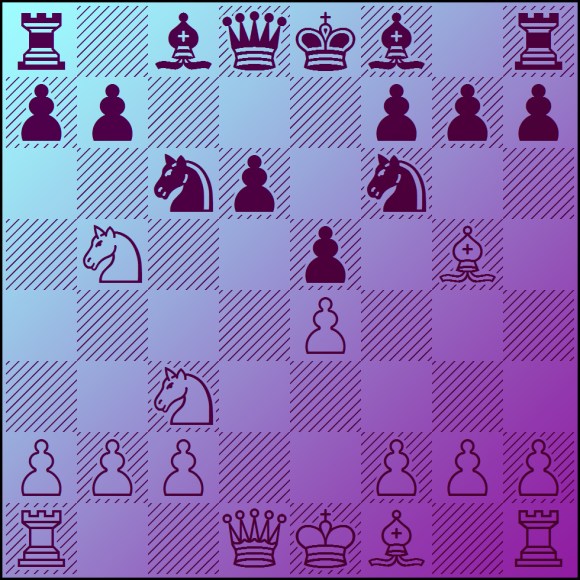
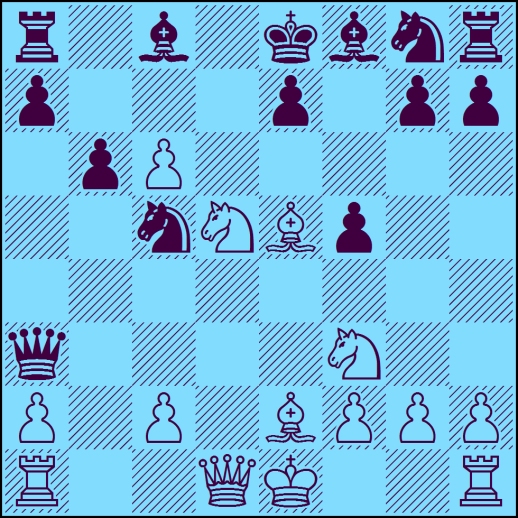
White pawns are working overtime.

From a tournament game I played nearly thirty years ago against a friend.

Escalante-Dr. H. Valery
Labate’s Chess Centre, Apr. 26 1988
[Escalante]
1.e4 c6 2.d4 d5 3.e5 Bf5 4.g4 Be4 {A bit more sane is 4…Bg6 5.h4 as in Golyak (2220)-Fairbairn (2048), corres., Golden Knights, 1997, which continued with 5.h4 h5 6.e6!!? fxe6 7.Bd3 Bxd3 8.Qxd3 hxg4 9.Qg6+ Kd7 10.Qxg4 Nf6 11.Qe2 Kc8 12.Nf3 Nbd7 13.Qxe6 Kc7 14.Bf4+ Kb6 15.c4 dxc4 16.Nc3 a6 17.d5 Ka7 18.dxc6 bxc6 19.Qxc6 Qc8 20.Be3+ Kb8 21.Qe6 Qb7 22.Ke2 Rh5 23.Rhd1 g6 24.b4 Rf5 25.Nd4 Rh5 26.Bf4+ Kc8 27.Qxc4+ 1-0} 5.f3 Bg6 6.f4 e6? 7.Nf3 Be4 8.Bd3 Nd7 9.Bxe4 dxe4 10.Ng5 Qa5+ {10…h6 11.Nxe4 Qh4+ 12.Kf1 Qh3+ 13.Kg1!} 11.Nc3 f5 12.Nxe6 Bb4 13.Nxg7+ Kf7 14.Nxf5 Bxc3+ 15.bxc3 Qd5 16.c4{!} Qa5+ 17.Bd2 Qd8 18.Nd6+ Kf8 19.g5 h5 20.f5 Rh6 {Black sacrifices a Rook for mild counterplay.} 21.gxh6 Qh4+ 22.Kf1 Qh3+ 23.Kg1 e3 24.h7! {24.Bxe3? Qxe3+ 25.Kf1 Qxh6} exd2 25.h8=Q Qe3+ 26.Kg2 Qg5+ 27.Kf3 Qg4+ 28.Ke3 Qg5+ 29.Kd3 Nc5+ 30.dxc5 Rd8 31.Qhxh5 Qe7 32.f6 Qe6 33.f7 Ke7 34.fxg8=Q Qxg8 35.Qh4+ Kd7 36.e6+ Kc7 {If 36…Qxe6, then 37.Qdg4 should win} 37.e7 Rxd6+ {Black sacrifices a second Rook for even a more milder form of counterplay.} 38.cxd6+ Kb8 39.d7 Qg6+ 40.Kc3 Qg7+ 41.Kb3 a6 42.d8=Q+ Ka7 43.e8=Q c5 44.Qhf6

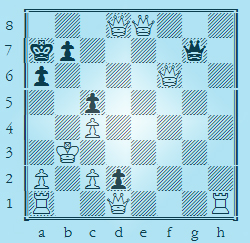
Game_Position_3 copy

{White now has four queens and two rooks against Black’s sole queen. With mate coming Black decided to resign. Note White’s original Queen on d1 and Rooks on a1 and h1 never made a single move in the game. White’s pawns did most of the work!} 1-0


Beating an IM!

This victory is in a PGN format so you need a PGN view to get the best effect.

[Event “Let’s Play!”]
[Site “Chess.com”]
[Date “2017.03.24”]
[White “Barefoot_Player”]
[Black “Cami3”]
[Result “1-0”]
[ECO “C10”]

{WIM Camelia Ciobanu hails from Romania. This is my first game against her. I either got very lucky or she was being nice to me. She should be able crush me in a later game.} 1.e4 e6 2.d4 d5 3.Nc3 dxe4 4.Nxe4 Nd7 5.Nf3 Be7 6.Bd3 Ngf6 7.Qe2 O-O 8.O-O Nxe4 {The chess.com computer suggests 8…b6!?, which opens other possibilities for Black. Although he still has to be careful; Heinrich Wolf-Isisdorf Gunsberg, Monte Carlo, 1902, went as 1.e4 e6 2.d4 d5 3.Nc3 dxe4 4.Nxe4 Be7 5.Nf3 Nd7 6.Bd3 Ngf6 7.O-O b6 8.Qe2 O-O 9.Neg5 Bd6 10.Nxh7 Nxh7 11.Bxh7+ Kxh7 12.Ng5+ Kg6 13.Qe4+ f5 14.Qxa8 Nf6 15.Re1 Ne4 16.Rxe4 Rh8 (16…fxe4 17.Be3) 17.Rxe6+ Bxe6 18.Qxd8 Bxh2+ 19.Kh1 Rxd8 20.Nxe6 1-0} 9.Qxe4 Nf6 10.Qh4 g6 11.Bg5 h5 12.Ne5 {White has a slight edge due to his powerfully posted pony.} Nd5 13.Bxe7 Qxe7 14.Qg3 Qf6 15.c3 Nf4 16.Qf3 Kg7 17.Be4 c6 18.Rfe1 Rd8 19.Re3 Bd7 20.Rae1 g5 21.Bc2 Qh6 22.g3 {Black’s knight is forced to the side. It is debatable if it is on a good square. Meanwhile, Black’s bishop prevents Black’s rooks from participating in any attack on the White king.} Nh3+ 23.Kg2 Be8 24.Bd3 g4 {Oops! White will gain material. I had to play over the position more than once to find if I could actually get away with the sacrifice.} 25.Nxg4 hxg4 26.Qxg4+ Ng5 27.h4 Rd5 28.Re5 Rxe5 29.Rxe5 f5 30.hxg5 Qg6 31.Qe2 Bf7 {Black’s bishop has been doing nothing other than defending. Nevertheless, Black’s rook can come into play.} 32.f4 Rh8 33.Kg1 Rh3 34.Qg2 Qh7 35.Bf1 Rh5 36.Be2 Rh3 37.Bf3 {White is obviously not interested in trading or repeating the position. He just has to defend against the threats and he will have a won game.} Kf8 38.Re2 Qh8 39.Re5 Rh7 40.a4 {White will eventually break through on the queenside and create a passed pawn. Black can’t do the same on the kingside.} a6 41.b4 1-0

Addressing an Issue

Taking a break from the usual gambits and games to address an plague that is affecting everything, the invasion of religion into a chess competition.


Please take a look at the link below. This article has since been published on Facebook and other social news.

 
http://www.msn.com/en-us/news/world/seductive-dress-forces-girl-to-quit-malaysia-chess-tournament-coach-says/ar-BBAAHL2?li=AA4Zpp&ocid=spartanntp

 
Below is an image showing the infamous dress.

Chess-tournament-girl


I question how this knee-length dress can be considered seductive or evil. Is this result of an insecure man or religion? Do young woman now have to wear full burqas in chess competitions for the benefit of an oppressive, insecure, and backwards minority?


To those people who enacted and enforced such a rule – grow up and out of your irresponsible viewpoints about the human body and just let the kids play chess.


Comments from anyone?


A PGN miniature.

From here to eternity,
The White king
Has met his mortality.

~~~~~~~~~~~~~~~~~~~~~~~~~~~~~~~~~

You can just copy and paste this miniature into a PGN Reader.

[Event “Live Chess”]
[Site “Chess.com”]
[Date “2017.03.05”]
[White “obisb”]
[Black “Barefoot_Player”]
[Result “0-1”]
[WhiteElo “1501”]
1.f4 e5 2.fxe5 Nc6 3.Nf3 d6 4.exd6 Bxd6 5.d3 {White has many moves at this point. 5.d4 and 5.g3 are certainly good. But not 5.e4 because of 5…g5!} Nf6 6.e4 Ne5 7.Be2 Bg4 8.O-O Qe7 9.Bf4 O-O-O 10.Bxe5 Bxe5 11.Nxe5 Bxe2 12.Qxe2 Qxe5 13.Nc3 h5  14.Rf5 Qd4+ 15.Kh1 g5 16.Rxg5 Ng4 17.Rxh5 Nf2+ 18.Kg1 Rxh5 19.Qxh5 Nh3+ 20.Kh1 Qg1+ 21.Rxg1 Nf2# 0-1

A Mistake in the Sveshnikov


Escalante”-“julez195” (1564)

Blitz game

chess.com, Feb. 16 2017

[Escalante]

1.e4 c5 2.Nf3 Nc6 3.d4 cxd4 4.Nxd4 e5 5.Nb5 d6 {Both Black and White have used about 5 seconds to make their moves. But now Black slows down. It is obvious that he knew the first part of the opening, but not much more.} 6.N1c3 Nf6 7.Bg5

2017_03_02

7…Be7 {I knew this was a mistake. Now I have to figure it out how to prove it was a mistake. Here are some general ideas about the opening. The Sveshnikov is a risky variation in the Sicilian for Black and has to play very precisely not to be knocked out in the opening. In this position he must play 7…a6 so as to prevent the knights from attacking the vulnerable “c7” square. This game is one example of Black failing to do this. Here’s another: 1.e4 c5 2.Nf3 Nc6 3.d4 cxd4 4.Nxd4 Nf6 5.Nc3 d6 6.Bg5 e5 7.Ndb5 h6 8.Bxf6 gxf6 9.Nd5 Rb8 10.Nbc7+ Kd7 11.Qg4+ 1-0 (C. Chester- S. Salvador, 11th Eastern Ch., New York, 1977).}  8.Bxf6 Bxf6 9.Nd5 O-O {Anything else loses even faster.  But Black’s pieces are a bit unorganized and he still has the weakness on “c7”.} 10.Be2 {White wants to castle before embarking on any attack.} Qa5+ {The “c7” square still needs protection.} 11.Nbc3 {There is no reason to hurry. The almost random sorties of the Black queen give White extra time and targets.} Bd8 {The “c7” square is now completely safe. But Black has used a number of tempi to accomplish this task.} 12.O-O f5 13.a3 Ne7 14.b4 1-0


“CUE” Less

During the big storm we had just before the weekend my wireless keyboard fell from my desk. I guess it was the thunder. But in any case I work up one morning to find my keyboard lying upside down on the floor.


When I turned it over, the CUE key had snapped off and was just gone. I couldn’t and still can’t find it. The CUE key is the first letter of a standard keyboard and is the 17th letter of the alphabet, just in case you didn’t know.


Normally, this might represent a problem, as the letter CUE is a rare one and one can write a letter and even a complete essay without this letter.


However…


Since many things I do write about concern chess, this represents a more serious problem. Here are some chess terms I can’t type due to the missing CUE.


(X)ID [n. Short for (X)ueen’s Indian Defence, a standard defence for Black]

(X)UAD [n. A tournament with four players]

(X)UEEN (S) [n. The strongest piece at the beginning of the game. It combines the moves of a Rook and Bishop]

(X)UEEN (ED, ING, S) [v. To promote a pawn to a (x)ueen]

(X)UEENSIDE (S) [n. All the s(x)uares from the d1 to left and top of board]

(X)UEEN’S GAMBIT (S) [n. [n. A standard opening for White

S(X)UARE (S) [n. The basic unit of a chessboard]


Things are even worse with Descriptive Notation.


Now it is possible to play an entire game of chess without mentioning the (x)ueen.


Borochow-Fine
Pasadena, 1932
1.e4 Nf6 2.e5 Nd5 3.c4 Nb6 4.d4 Nc6? (4…d6) 5.d5 Nxe5 6.c5 Nbc4 7.f4 1-0


Fidlow-I. Mayer
Berlin, 1950
1.d4 d5 2.c4 e6 3.Nc3 c5 4.cxd5 cxd4 5.dxe6 dxc3 6.exf7+ Ke7 7.fxg8=N+ Rxg8 8.Bg5+ 1-0


But such games are (x)uite rare.


I finally found my backup keyboard. It is not wireless, but still very functional. Now I can continue my chess endeavors and not have to worry about batteries.


thhxwb29jx

How Many Moves?

I’ve been playing chess for at least three decades now. By far, the most frequent question I encounter from non-players is, “So how many moves do you see ahead?”


It is a hard question to answer. Do I tell them I know the first 20 moves of an opening? Is that really seeing 20 moves ahead or just memorization?


How about a forced mate? We all know how to force a mate with a lone queen (or at least I hope we do), the smothered mate, and other techniques needed to win the game.


Do I tell skeptics I just know that the move I am playing leads directly to forced mate, without necessarily seeing all the subsequent moves? How then do I know if the move leads to a mate? Should I say that it is mate in less than 10 moves? Sounds awfully vague to me. How about, I who have been playing for a couple of decades, have developed an instinct (or intuition) for what moves leads to mate and what does not lead to mate? Sounds a little egotistical to me. But it is true (both the instinct and the ego). 


A good example is this phone game. Black plays some rather weak moves in the opening. And when Black played his 11th move, I knew I had a mating attack. I just didn’t see everything.


Escalante-“TruthfulT1”
Cell Phone game, Feb. 2017
1.e4 d5 2.exd5 Qxd5 3.Nc3 Qe6+?! 4.Be2 f5 5.d4 b6? 6.d5! Qf6 7.Nf3 c6 8.Bf4 Nd7 9.dxc6 Nc5 10.Nd5! Qxb2 11.Be5! (The attack is merely a decoy. White is after more than a mere queen.) 11…Qa3

2017_02_16-copy

12.Nc7+ Kf7 13.Ng5+ Kg6 14.Bh5+ Kxg5 (Giving up a piece. By the way, 14…Kh6 15.Nf7+ is mate.) 15.h4+ Kh6 16.Qd2+ 1-0 [Black could continue with 16…Qe3+ 17.Qxe3+ f4 18.Qxf4+ g5 (or 18…Kxh5, with White giving up a second piece but still mating Black in the same way.) 19.Qxg5#]


~~~~~~~~~~~~~~~~~~~~

 
It looks like I’ve solved my problems with posting diagrams on this blog. More posts coming! =)

Two from Yahoo

Tomorrow afternoon I am attending the Orange County Chess Meetup Group. Usually a day or so I play over some old games to enjoy and sharpen my game, but mostly to enjoy them.

Tomorrow I just may play the Italian. So many people now just want to respond 1.e4 e5 2.Nf3 Nc6 3.Bc4 with 3..h6?!. Of which the correct response is 4.d4.

So I found a pair of games from when Yahoo! used to let allow chess games on their servers. Both of them were blitz games and I usually do quite well on blitz games.

So here those two games.


Escalante-“kevinairthompson”

Blitz Game, Yahoo, Mar. 24 2006

1.e4 e5 2.Nf3 Nc6 3.Bc4 h6 4.d4 f6 5.dxe5 Nxe5 6.Nxe5 fxe5 7.Qh5+ g6 8.Qxg6+ Ke7 9.Qf7+ Kd6 10.Qd5+ Ke7 11.Qxe5mate 1-0


Escalante-“heliiom”

Blitz Game, Yahoo, June 12 2006

1.e4 e5 2.Nf3 Nc6 3.Bc4 h6 4.d4 exd4 5.Nxd4 Nxd4 6.Qxd4 Nf6 7.e5 Ng8 8.Nc3 d6 9.exd6 cxd6 10.O-O Nf6 11.Re1+ Be7 12.Bf4 O-O 13.Rad1 Qa5? (13…Be6 14.Bxe6 fxe6 15.Rxe6 Qd7 16.Ree1 Rad8 17.Nd5! and Black is still lost.) 14.Bxd6 Bxd6 15.Qxd6 Qg5 16.Qxf8+! Kxf8 17.Rd8+ Ne8 18.Rexe8mate 1-0


More Muzios

I posted a Muzio Gambit in my Miniatures page. It is an exciting gambit with lots of opportunities for Black to go wrong.

Here are four more recent games, with Black still failing to find a way to equality.

And I am still trying to find a better method of adding diagrams.

~~~~~~~~~~~~~~~~~~

Fullum-Hansen
corres.
CCCA, 1953
[Escalante]
1.e4 e5 2.f4 exf4 3.Nf3 g5 4.Bc4 g4 5.O-O gxf3 6.Qxf3 Bc5+?! (The White king doesn’t mind going to h1; it’s safer for him.) 7.Kh1 Qf6 8.Nc3 c6 9.d3 Ne7 10.Qh5 Bd6 11.d4 Qg6 12.Qf3 Bc7 13.e5 d5 14.exd6 Bxd6 15.Ne4 Nf5 16.Bxf4 Bxf4 17.Qxf4 O-O 18.g4! Ng7 19.Nf6+ Kh8 20.Bd3 Ne6 21.Qe5 Qg7 22.Qh5 h6 23.h4 1-0

muzio


With the idea of 24.g5.


Von Buskirk-R. Safdie
Los Angeles, May, 1982
[Escalante]
1.e4 e5 2.f4 exf4 3.Nf3 g5 4.Bc4 g4 5.O-O gxf3 6.Qxf3 Qe7 (A more modern response to the Muzio.) 7.Qxf4 Nh6 8.d4 d6 9.Nc3 c6 10.Bd2 Bg7 11.Ne2 O-O 12.Rf3 Kh8 13.Rg3 f5 14.Rxg7! (This type of sacrifice is known as a clearance sacrifice.) 14…Qxg7 15.d5 (With the obvious threat of 16.Bc3) 15…Ng4 16.Qxd6 Nf6 17.Bc3 h6 18.Rf1 Kh7 19.Ng3 Nbd7 20.Bd3 (Nothing wrong with 20.Nxf5, except the knight is better placed on h5.) 20…Nb6 21.Nh5 Qd7 22.Nxf6+ Rxf6 23.Qxf6 cxd5 24.exf5 Kg8 25.Qh8+ Kf7 26.Qg7+ Ke8 27.Re1+ d8 28.Bf6+ Kc7 29.Re7 1-0


Garrison-Garcia
corres., 1990
1.e4 e5 2.f4 exf4 3.Nf3 g5 4.Bc4 g4 5.O-O gxf3 6.Qxf3 Qf6 7.e5 Qxe5 8.Bxf7+ Kxf7 9.d4 Qxd4+ 10.Be3 (Believe or not, we are still in theory.) 10…Qg7 11.Bxf4 Nf6 12.Be5 Be7 13.Nc3 d6 14.Bxf6 Bxf6 15.Nd5 Nd7 16.Rae1 Qg5 17.Re7+ Kf8 18.Re6 h5 19.Nxf6 Nxf6 20.Rxf6+ Kg7 21.h4 Qc5+ (21…Qxh4 22.Rf7+ Kh6 23.Qe3+ Kg6 24.Qc3 ; 21…Bg4 22.Rf7+ Kg8 23.Rf8+ Kh7 24.Qe4+ Bf5 25.R8xf5 Rae8 26.Rf7+) 22.Kh1 1-0


Don Schultheis (2363)-Robert Miehm (2161)
corres.
2002 Golden Knights final
[Dunne, “All Chess Players Should Have a Hobby”, CL, Mar. 2010, pg. 38/9]
1.e4 e5 2.f4 (Yes, Virginia, such openings do exist, even at the top level. Fischer’s analysis of the King’s Gambit may have chased the grandmasters away from the opening, but 2.f4 hasn’t been refuted yet. But don’t breathe easily. There is more to come, much more.) 2…exf4 (Following sage advice: the only way to refute a gambit is to accept it.) 3.Nf3 g5 4.Bc4 g4 5.O-O (Paging 1860, paging 1860, come in 1860! The Muzio—White’s philosophy is very simple: developed pieces are more potent than undeveloped ones. There were two great periods for the Muzio Gambit—over-the-board (OTB) the gambit was played from 1840 to 1890 by some of the brightest stars of the game—Anderssen, Morphy, Blackburne, Zukertort, Chigorin, Marshall, Spielmann. The Muzio scored about 55% for White in my database.) 5…gxf3 (But around the turn of the century came the spoiler—Black found 5…d5! and suddenly White’s chances dropped to 42% and the Muzio largely disappeared from master play. It would have been interesting to see what Schultheis had prepared in answer to 5…d5. But there are more mysteries to come.) 6.Qxf3 (White’s plan is brutal and simple—open the f-file and play against f7.) 6…Qf6 7.e5 Qxe5 8.Bxf7+ [Schultheis is not content with one Muzio. He opts for the infamous double Muzio. The double Muzio had a reincarnation at correspondence chess (CC) play from the 1980’s to 2000. Although most of the players were not very strong, White scored an amazing 59% in a series of some 200 games. In the double Muzio, White’s strategy is very simple: mate.] 8…Kxf7 9.d4 Qxd4+ 10.Be3 Qg7 (Over the board in the last twenty years 10…Qf6 has been a catastrophe -White has scored 5–1. As an example of White’s resources, witness a young Alexey Shirov vs. J. Lapinski, Daugavpils 1990: 10…Qf6 11.Bxf4 Ke8 12.Nc3 Nc6 13.Nd5 Qg6 14.Rae1+ Be7 15.Bd6 Kd8 16.Qf8+ Bxf8 17.Bxc7 mate. Again, OTB 10…Qg7 is rare—only two examples from master play, both winning for White.) 11.Qxf4+ (This is the choice of Thomas Stock, one of the few masters playing the Muzio by CC. The alternative 11.Bxf4 has been scoring fairly well (54%) but Schultheis’ choice is relatively unexplored territory.) 11…Nf6 12.Nc3 Nc6 (With 12…Nc6 we are out of book. Black has two extra pieces and a badly exposed king. Previously played here has been 12…Rg8 as in Jewell-Hartmann, IECC 1999, which looks OK for Black but needs further exploration.) 13.Nd5 Be7 14.Qh4 Rg8 15.g3 d6 16.Rxf6+! (Now comes retribution—one piece falls prisoner to the White camp. After 16…Bxf6 17.Rf1 White will be down a rook with a winning attack after 17…Bd7 18.Qh5+!) 16…Ke8 17.Raf1 (Black has an extra piece and a difficult game. He is essentially playing without his a8-rook against a completely mobilized army. If he can get his rook into the fight, he has a chance. If not, the Muzio strikes again!) 17…Qg4 18.Qxh7 Rg7 19.Qh6 Kd8 20.Bf4! Rg8 (Black cannot take on f6—20…Bxf6 21.Qh8+ Rg8 22.Qxf6+ is a killer.) 21.Nxe7 Nxe7 22.Re1 Qg7 (It looks like the last chance to hold was 22…Ke8 23.Qh7 Rg7 but now Schultheis’ pressure finally breaks Miehm’s will.) 23.Qh4 Bg4 24.Bh6 Qh7 25.Rf4! (It is said the hardest attacking moves to foresee are the ones involving retreating a piece. Here the rook threatens both Rxg4 and Rfe4, the e7-knight is now pinned by the queen and Bg5 will place further pressure on e7. Black is lost.) 25….Rc8 26.Rfe4 Rg6 27.Bg5! (White avoids the strong-looking 27.Rxe7 Qxh6! in favor of a simply strong move.) 27…Qxh4 28.gxh4 Rxg5 29.hxg5 1-0



This is what happens when a New York street hustler faces a chess Grandmaster.

There are two things you need to know about Maurice Ashley. First of all, he is one of the nicest persons you might ever meet. The second is that he is a Grandmaster.

He took a trip to New York City’s Washington Square Park. A chess hustler there didn’t recognize him and challenged him to a game. That was mistake number one.

Mistake number two was that he tried to distract GM Ashley, who was up to par in banter.

Mistake number three occurred when the hustler tried to cheat at one point.

Mistake number four was not recognizing or congratulating GM Ashley on his win.

It should not be hard to figure out who the hustler and GM are. Even if you never play chess.

See video below

 https://www.yahoo.com/news/happens-york-hustler-faces-chess-042102506.html