A Chess Player’s Favorite Word

No matter if it is a miniature, a King-Hunt, a long endgame, or even a casual game, there is a word that every chess player would love to speak, and conversely, hate hearing it.


That word, so much loved and feared, is MATE.


But if it is a word much beloved in the chess world, why don’t we speak it more in normal conversations?


Well, it turns out that four letters, arranged in a M-A-T-E sequence, do not occur often in English, and even less in other languages.


Let’s look at words with the letters M-A-T-E in them.


ACCLIMATE
ACOELOMATE
AGEMATE [n. one who is about the same age as another.]
AMALGAMATE
AMATE [n. a Central American timber tree with lustrous foliage and edible fruits.]
AMATEUR
ANIMATE
ANTEPENULTIMATE
APPROXIMATE
AUTOMATE
BANDMATE
BEDMATE
BICHROMATE
BREGMATE [n. a junction point of the skull.]
BROMATE
BUNKMATE
CABINMATE
CARBAMATE
CASEMATE
CHECKMATE
CHROMATE
CLASSMATE
CLIMATE
COELOMATE [adj. having a coelom (the main body cavity in most animals).]
COINMATE
COLLIMATE
COMATE
CONSUMMATE
COPEMATE
CREMATE
CREWMATE
CYCLAMATE [n. a salt of cyclamic acid formerly used as an artificial sweetener.]
CYCLOSTOMATE
DECIMATE
DEPHLEGMATE
DESPUMATE [v. to clarify or purify a liquid by skimming a scum from its surface.]
DESQUAMATE
DICHROMATE
DIPLOMATE
DISANIMATE
DITHIOCARBAMATE [n. any salt or ester of dithiocarbamic acid, commonly used as fungicides.]
ECOCLIMATE
ESTIMATE
EXANIMATE
EXHUMATE
FERMATE
FISSIPALMATE [adj. having lobed or partially webbed separated toes, as in the feet of certain birds.]
FLATMATE
FORMATE
GEMMATE [adj. (1) having buds, (2) adorned with gems or jewels.]
GLUTAMATE
GUESSTIMATE
GUESTIMATE
HAMATE [n. a bone on the inner side of the second row of the carpus in mammals.]
HELPMATE
HIEROGRAMMATE [n. a writer of hierograms (sacred symbols or records, esp. hieroglyphics).]
HOUSEMATE
HUMATE
ILLEGITIMATE
IMAMATE [n. the office of an imam]
IMPOSTHUMATE
IMPOSTUMATE
INANIMATE [adj. not alive.]
INCREMATE [v. to cremate]
INHUMATE
INMATE
INTIMATE
LEGITIMATE
LITTERMATE
MACROCLIMATE
MAMMATE
MATE [n. a companion ; v. (1) to checkmate an opponent in chess, (2) to produce offspring.]
MATELOTE [n. a fish stew that is cooked in a wine sauce.]
MATER [n. an informal use of the Latin word for mother; adj. not reflecting light; not glossy.]
MATERIAL [n. the elements, constituents, or substances of which something is composed or can be made.]
MATERNAL [adj. relating to or characteristic of a mother or motherhood.]
MEPROBAMATE [n. a bitter-tasting drug used as a mild tranquilizer.]
MESSMATE
MICROCLIMATE
MIDSHIPMATE
MISESTIMATE
MISESTIMATE
MISMATE
MONOCHROMATE
NIZAMATE
OPTIMATE
OSMATE
OSTOMATE
OVERESTIMATE
PALAEOCLIMATE
PALAMATE
PALMATE
PENULTIMATE
PLAYMATE
PLUMATE
PRIMATE [n. any mammal of the order Primates (defined as having an up-right appearance, large brains relative to body size, body hair, and giving live birth). This group, with over 300 mammals, includes lemurs, lorises, gibbons, tarsiers, gorillas, monkeys, apes, and humans.]
PROXIMATE
PSEUDOCOELOMATE
RACEMATE
RAMATE [adj. having branches; branched.]
REANIMATE
REESTIMATE
REFORMATE
REMATE
ROOMMATE
SCHOOLMATE
SEATMATE
SEMIPALMATE
SHIPMATE
SIGMATE
SOULMATE
SQUAMATE
STABLEMATE
STALEMATE
STEARSMATE [n. same as STEERSMATE.]
STEERSMATE [n. one who steers; steersman.]
STOMATE [n. a minute opening in the epidermis of a plant organ.]
SUBLIMATE
SUBPRIMATE
SUMMATE
TABLEMATE
TEAMMATE
TOTIPALMATE [adj. having webbing that connects each of the four anterior toes, as in water birds.]
ULTIMATE
UNDERESTIMATE
WORKMATE
YOKEMATE


It doesn’t seem fair that we can mostly say MATE in the chess world. So, what to do if we want to say MATE more often? It’s easy! Play more chess!
Meanwhile, let’s indulge in a few more MATES.


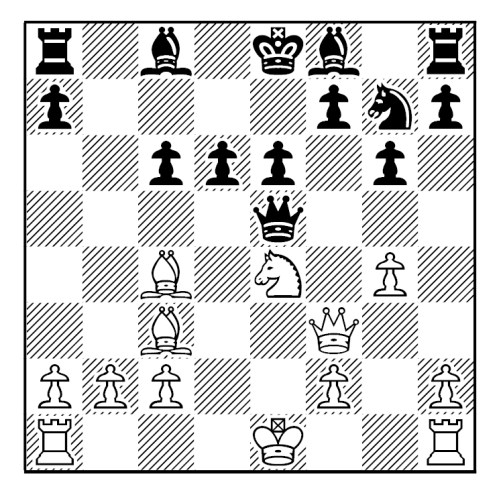
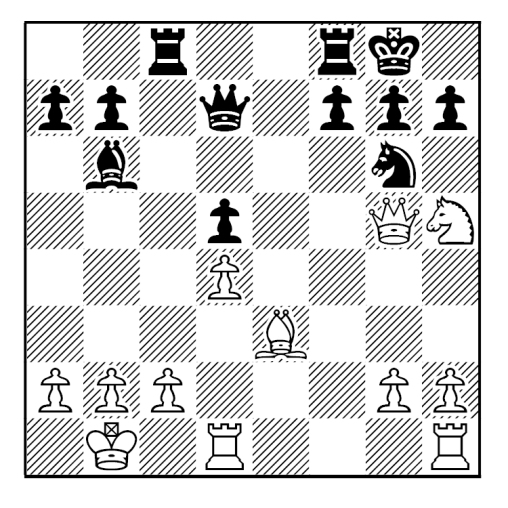
Rudolf-N.N., 1912
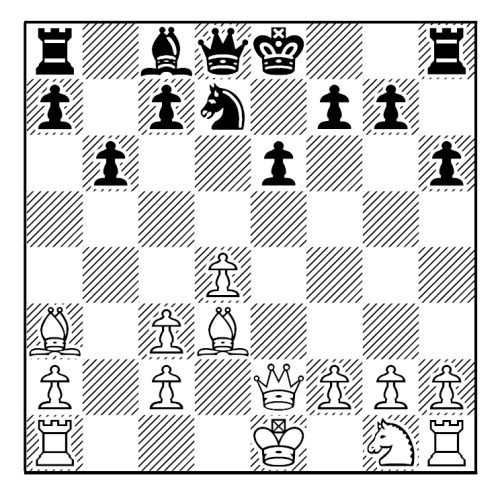
1.e4 e5 2.f4 exf4 3.Bc4 Bc5 4.d4 Qh4+ 5.Kf1 Bb6 6.Nf3 Qd8 7.Bxf4 Ne7 8.Ng5 O-O 9.Qh5 h6 10.Bxf7+ Kh8
2019_10_17_A
11.Qxh6+! gxh6 12.Be5mate 1-0


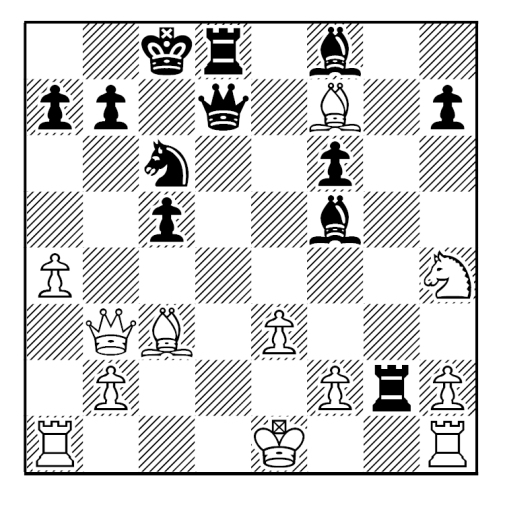
Alekhine-Vasic
Graz, 1931
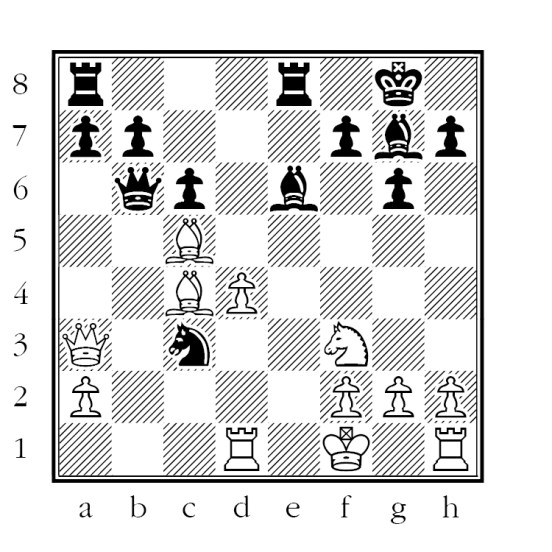
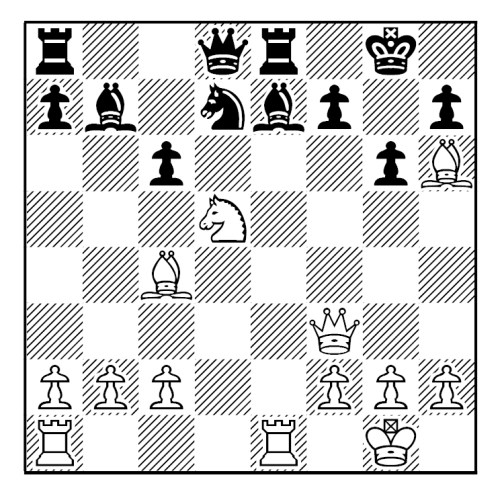
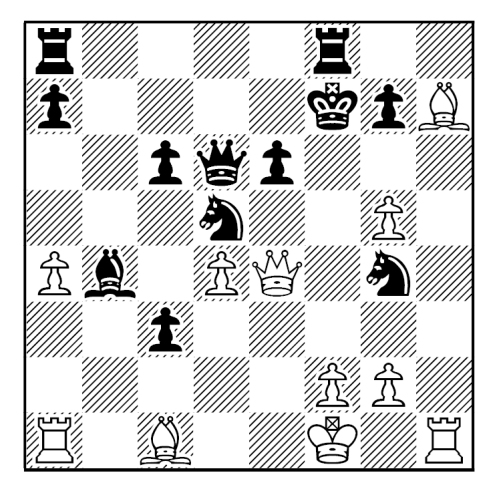
1.e4 e6 2.d4 d5 3.Nc3 Bb4 4.Bd3!? Bxc3+ 5.bxc3 h6 6.Ba3 Nd7 7.Qe2 dxe4 8.Bxe4 Ngf6 9.Bd3 b6
2019_10_17_B
10.Qxe6+!! fxe6 11.Bg6mate 1-0


Savanto-Molder
Helsinki, 1950
1.e4 e5 2.f4 exf4 3.Nf3 Be7 4.Bc4 Bh4+ 5.g3 fxg3 6.O-O gxh2+ (Believe it or not, this is all theory. It is mostly known by the name, “Three Pawns Gambit”.) 7.Kh1 Be7 8.Bxf7+ Kxf7 9.Ne5+ Ke6 10.Qg4+ Kxe5 11.Qf5+ Kd6 12.Qd5mate 1-0


Joe Ei-Ken Scott
corres.
Golden Knights, USCF, 1982
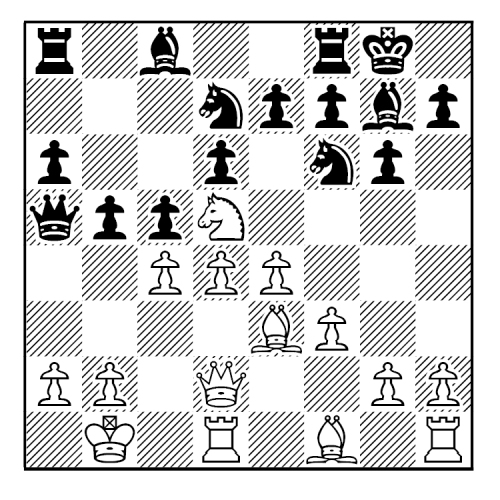
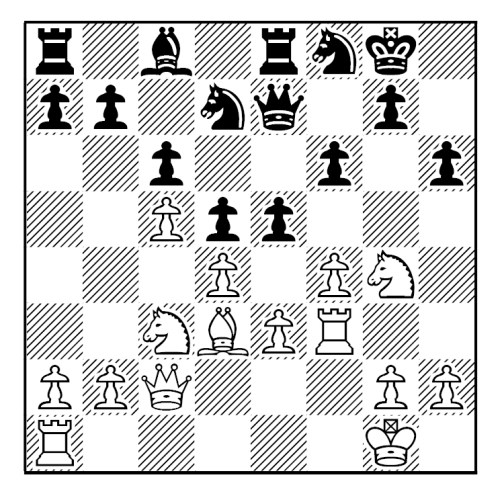
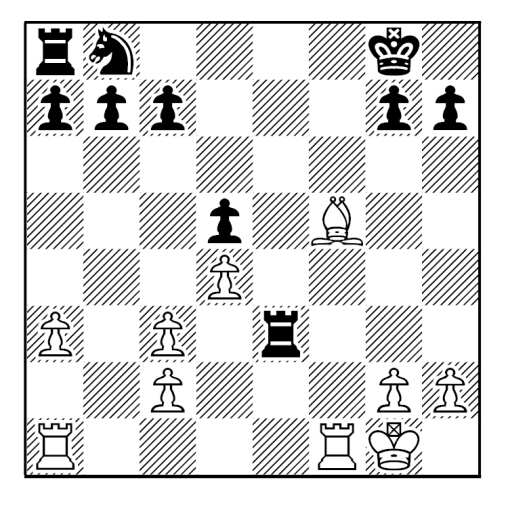
1.e4 d5 2.exd5 Qxd5 3.Nc3 Qa5 4.d4 Nf6 5.Nf3 Bg4 6.h3 Bxf3 7.Qxf3 c6 8.Bd2 Qd8 9.Bc4 e6 10.O-O-O Qb6?! 11.Ne4 Qxd4? 12.Ba5 Qxc4
2019_10_17_C
13.Qxf6! gxf6 14.Nxf6+ Ke7 15.Bd8mate 1-0


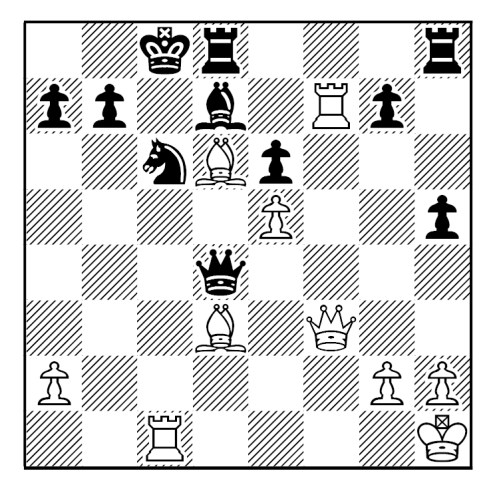
L. Bohne (2025)-J. Adamski (2400)
Hassloch, 1999
1.d4 Nf6 2.c4 e6 3.Nc3 Bb4 4.Qc2 c5 (Other adequate responses include 4…d5, 4…O-O, and 4…Nc6.) 5.dxc5 Qc7 6.a3 Bxc5 7.Nf3 a6 8.e3 Be7 9.Be2 d6 10.O-O Nbd7 11.b3 b6 12.Bb2 Bb7 13.Rac1 Rc8 14.Nd4 O-O 15.Bf3 Bxf3 16.Nxf3 Qb7 17.Qe2 Rc7 18.Nd2 Rfc8 19.e4 Ne8 20.Rc2 Ne5 21.f4 Nc6 22.Nf3 Na5 23.Nd4 Nc6 24.Nxc6 Rxc6 25.Rcc1 Qb8 26.f5 Nf6 27.g4 Nd7 28.fxe6 fxe6 29.Nd5 Bg5 30.Nf4 Re8 31.Rcd1 Bf6 32.Bxf6 Nxf6 33.h3 b5 34.cxb5 axb5 35.Rc1 Rxc1 36.Rxc1 Qa7+ 37.Kg2 Qxa3 38.Rc7 Qb4 39.Rb7 h6 40.Rxb5 Qd4 41.Rb7 Nxe4 42.Ng6 Kh7 43.Qf3 Kxg6 44.Qf7+ Kh7 45.Qxe8 Qf2+ 46.Kh1 Ng3mate 0-1

TAL’S SACRIFICES

Mikhail Tal (1936-1992), was a tsunamic and torrential tactical player. Known for his surprising speculative sacrifices and brilliant follow-ups, he made a name for himself even as a young player.


His style of sacrificial play introduced a new and novel way of creating play for one’s own pieces.


But exactly what is this new style? What type of pieces are used in this new style?


The second question is easy to answer; “All of them”.


As to the first question, let his games demonstrate this style.


~~~~~~~~~~~~~~~~~~~~~~~~~~~~~


Kliavinsh-GM Tal
Latvian Ch., 1958
1.e4 c5 2.Nf3 d6 3.d4 cxd4 4.Nxd4 Nf6 5.Nc3 a6 6.Bc4 e6 7.Bb3 Be7 8.O-O O-O 9.f4 b5 10.a3 Nbd7 11.Be3 (If you are thinking about 11.Bxe6, please remember there are three type of sacrifices; there are good sacrifices, bad sacrifices and Tal-like sacrifices. This move is neither a Tal-like, or even a good sacrifice, as after 11.Bxe6?! fxe6 12.Nxe6 Qb6+ 13.Kh1 Rf7 Black is a little better. Black can also play 12.Nxe6 Qe8. In either case White is down material with very little compensation.) 11…Bb7 12.Bxe6?! fxe6 13.Nxe6 Qe8! (This, however, is a Tal-like sacrifice. The Black rook will stay en prise for the next few moves until White takes it. For that, Tal will get exactly what he wants – very active pieces.) 14.Qd4 Rc8 15.Rae1 Rc4 16.Qa7 Qc8 17.Nxf8 Bxf8 18.Bd4 d5 19.Kh1 dxe4 20.Rd1 Qc6 21.b3 Rxc3 22.Bxc3 e3 23.Rf3 e2!
2019_09_25_A
[This is just a good move and nothing special. However, a good sacrifice is just around the corner. We would like to see it on the scoresheet. But White resigned so we’ll have to see it in the analysis. After 24.Re1, Black has 24…Qxf3! (It’s both a good sacrifice and a Tal-like sacrifice for sure!) 25.gxf3 Bxf3+ 26.Kg1 Bc5+ 27.Qxc5 Nxc5 28.Kf2 Bh5, and Black wins!] 0-1


Isaak Birbrager-Tal
Kharkov, 1953
[Notes based on NM SamCopeland’s excellent article, “Mikhail Tal’s Most Spectacular Queen Sacrifice – Birbrager vs. Tal, 1953”, chess.com, Sept. 9 2019]
1.d4 Nf6 2.c4 c5 3.d5 e6 4.Nc3 exd5 5.cxd5 d6 6.e4 g6 7.Nf3 Bg7 8.Bd3 (White has several alternatives here; 8.Nf3, 8.Bg5, 8.Nd2, and even 8.h3.) 8…O-O 9.O-O Na6?! 10.Nd2 Nb4 11.Be2 {11.Bb1! +/-. This would have contained the knight more effectively and kept an eye on possible kingside actions.) 11…Re8 12.a3 Na6 13.Re1 Nc7 14.Qc2 Rb8 15.a4 b6 16.Nb5? a6 17.Nxc7 (17.Na7!?. The text move practically forces Black’s response.) 17…Qxc7 18.Ra2 Qe7 19.f3? Nh5! (Getting ready to steamroll the kingside pawns with the knight providing cover.) 20.Nf1 f5! 21.Bd3 f4! (The plan of …Be5, and …g5-g4 with a mating attack is deadly.) 22.g4! Bd4+ 23.Kh1 (23.Kg2? Qh4 24.Re2 Bxg4! 25.fxg4 Qxg4+ 26.Kh1 Qg1#.) 23…Qh4 24.Re2 Qh3? 25.Rg2 Qxf3 26.Nd2 (26.gxh5 Rxe4! -+ is a beautiful and punishing blow.) 26…Qe3 27.Nf1 Qf3 28.Nd2 (draw?)
2019_09_25_B
28…Bxg4!! (No draw! Tal chooses to sacrifice his queen instead! This is a perfect example of a “Tal” sacrifice; there is not a clear idea to regain the material, but Tal’s pieces are alive and crackling with energy while White’s pieces struggle to find meaning in the position. Objectively, MAYBE White can defend, but there’s no clear refutation, and White collapses almost immediately.) 29.Nxf3 Bxf3 30.h4 Rf8 31.Be2?? Ng3+ 32.Kh2 Bxg2 33.Kxg2 Nxe2 34.Qxe2 f3+ 35.Qxf3 Rxf3 36.Kxf3 Rf8+ 37.Kg3 Be5+ 38.Kg2 Bf4 […Rf4 (before or after trading on c1) wins another pawn and the game.] 0-1


GM Tal-GM Velimirovic
USSR vs. Yugoslavia
Teslic, 1979
[A30]
[A complete analysis by Tal can be found in Informant 27, game #64]
1.c4 c5 2.b3 Nc6 3.Bb2 e5 4.g3 d6 5.Bg2 Be6 6.Nc3 Qd7 7.Nf3 Bh3 8.Bxh3 Qxh3 9.Nd5! Qd7 10.e3 Nce7 11.Nc3! Nf6 12.0-0 e4 (12…Ng6 13.d4 +/-) 13.Ng5!? d5!? 14.cxd5 Qf5

2019_09_25_C
15.Nxf7! Kxf7 16.f3! Nexd5 17.fxe4 Nxc3 18.Bxc3 Qxe4 19.Qh5+ Ke6 20.Qh3+ Kd6 (20…Kf7! 21.Rf5! is unclear but the advantage probably lies with White.) 21.b4!! Kc7 22.Rac1 +/- Rc8 23.Rf5!! Qg4 24.Be5+ Kd7 25.Qf1 Qe4?  26.Rc4 Qc6 27.Qh3 (27.Bxf6 gxf6 28.Rxf6 Qd5 29.Qh3 Kc7 30.Rf8 +-) 27…Qe6 (27…Kd8 28.bxc5+-) 28.Bxf6 gxf6 29.Re4! +- Qa2 30.Rxc5+ 1-0


Bobotsov-Tal
World Junior Team Ch.
Varna, 1958
[E81]
1.d4 Nf6 2.c4 g6 3.Nc3 Bg7 4.e4 d6 5.f3 O-O 6.Nge2 c5 7.Be3 Nbd7 (Another move is 7…Nc6!?) 8.Qd2 a6 9.O-O-O Qa5!? (Aggressive, provocative, and encourages piece play by Black.) 10.Kb1 b5 11.Nd5
2019_09_25_D
11…Nxd5! (Not only is it unexpected, it is also among of his most sound sacrifices. Tal’s pieces really come alive!) 12.Qxa5?

[Tal’s sacrifice is so well known that IM and GM players avoid taking the offered queen and instead play 12.cxd5 to liquefy the possibilities, but apparently not necessarily the stress brought on by Black’s active piece play.

Here are two games for future study of this game.

Abraham Neumann-Israel Gelfer (2340)
Israel Ch., Dec., 1967
1.d4 Nf6 2.c4 g6 3.Nc3 Bg7 4.e4 d6 5.f3 O-O 6.Be3 Nbd7 7.Qd2 c5 8.Nge2 a6 9.O-O-O Qa5 10.Kb1 b5 11.Nd5 Nxd5 12.cxd5 Qxd2 13.Bxd2 f5 14.e5 Bb7 15.Bg5 Rfe8 16.dxc5 Nxc5 17.e6 Na4 18.Bc1 Nb6 19.Nf4 Be5 20.Be3 Na4 21.Rd2 Rac8 22.Ne2 Rc7 23.f4 Bf6 24.g3 Rec8 25.Rg1 b4 26.Rg2 Bxb2 27.Rxb2 Nxb2 28.Kxb2 Rc2+ 29.Kb1 Bxd5 30.Rf2 Bxa2+ 31.Ka1 Bc4 32.Nd4 Rxf2 33.Bxc4 Rxh2 34.Bd5 Rc3 35.Nf3 Rh1+ 0-1

Cicirone Spulber (2326)-Boris Itkis (2474)
Homorod, Romania, 1993
1.d4 Nf6 2.c4 g6 3.Nc3 Bg7 4.e4 d6 5.f3 O-O 6.Be3 Nbd7 7.Qd2 c5 8.Nge2 a6 9.O-O-O Qa5 10.Kb1 b5 11.Nd5 Nxd5 12.cxd5 Qxd2 13.Rxd2 f5 14.dxc5 Nxc5 15.Bxc5 dxc5 16.Nc3 c4 17.Be2 Bd7 18.exf5 gxf5 19.f4 b4 20.Nd1 Rfc8 21.Rc2 c3 22.b3 a5 23.Ne3 a4 24.Bc4 Rxc4 25.Nxc4 axb3 26.axb3 Bb5 27.Rhc1 Rd8 28.Ne3 Bd3 29.Rd1 Be4 30.g3 Ra8 31.d6 exd6 32.Rxd6 Re8 33.Nd5 Bxc2+ 34.Kxc2 Re2+ 35.Kc1 Bf8 36.Rd8 Kf7 37.Rb8 Rxh2 38.Nxb4 Bc5 0-1.

Back to the Tal game.]

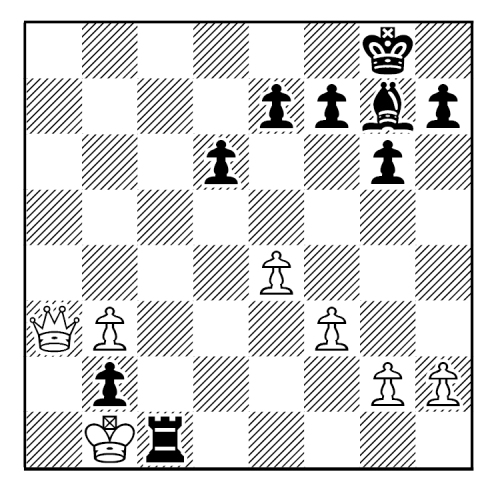
12…Nxe3 13.Rc1 Nxc4! (The strong knight threatens the queen and she doesn’t have good square to move.) 14.Rxc4 bxc4 15.Nc1 (White, despite giving back some of the material, finds his king stripped of defensive pieces and pawns and sitting on an semi-open file.) 15…Rb8 16.Bxc4 Nb6 17.Bb3 Bxd4 (Among other threats, the move …c4! wins at once.) 18.Qd2 Bg7 19.Ne2 c4 20.Bc2 (Not 20.Bd1? as White may need to move his rook to the queenside.) 20…c3 21.Qd3 (Winning for Black is 21.Nxc3? Nc4! 22.Qc1 Bxc3 -+.) 21…cxb2 22.Nd4 Bd7 23.Rd1 Rfc8! (There is no escape for White’s king.) 24.Bb3 Na4 25.Bxa4 Bxa4 26.Nb3 Rc3 27.Qxa6 Bxb3 28.axb3 Rbc8 29.Qa3 Rc1+ 30.Rxc1 Rxc1+ (This position deserves a diagram.)
2019_09_25_E
0-1

AN INTRODUCTION TO THE ART OF QUEEN SACRIFICES


phpWZYMqS


Perhaps the most popular games ever published are those in which a player sacrifices his one and only Queen. Bravery is required for that player who thrusts his most valuable piece into the fight, sometimes with no hope of ever seeing her alive again.


In the over 500 years of chess, fewer topics have been more exciting, more spectacular, and more aesthetically pleasing to the player than when he freely sacrifices his powerful Queen. In all cases, the desired result, whether immediately or indirectly, is to gain something more valuable; the enemy King.


Basically, there are three types of tactical Queen sacrifices. The first type is the one made for material gain. Sometimes called a pseudo-sacrifice, the Queen is given up and won back a few moves later.


Doroshkevich-Astashin
USSR, 1967 (D24)
1.d4 d5 2.c4 dxc4 3.Nf3 Nf6 4.Nc3 a6 5.e4 b5 6.e5 Nd5 7.a4 Nxc3 8.bxc3 Bb7 9.e6 fxe6 10. Be2 Qd5 11.Ng5 Qxg2 12.Rf1 Bd5 13.axb5 Qxh2?! 14.Bg4 h5 15.Bxe6 Bxe6 16.Qf3 c6 17.Nxe6 Qd6 18.Qf5 g6 19.Qxg6+ Kd7 20.Nc5+ Kc8 21.Qe8+ Qd8 22.b6! 1-0


The Queen pseudo-sacrifice sacrifice for gain may turn into a mate if the opponent tries to hold on the extra female material.


Muller-Calderone
Compuserve, 1996 (B57)
1.e4 c5 2.Nf3 d6 3.d4 cxd4 4.Nxd4 Nf6 5.Nc3 Nc6 6.Nxc6 bxc6 7.Bc4 g6 8.e5 Nd7 (Certainly not 8…dxe5?? 9.Bxf7+. Best is 8…Ng4) 9.exd6 exd6 10.O-O Nf6 11.Re1+ Be7 12.Qf3 O-O 13.Qxc6 Bf5 14.Bh6 Re8 15.Nd5 Rc8

2019_09_18_A

16.Qxe8+! Qxe8 17.Nxe7+ Kh8 18.Nxf5 Ne4 19.Nxd6 Qc6 20.Nxf7+ (20…Kg8 21.Ne5+) 1-0


Levitzky-Marshall
Breslau 1912 (C10)
[Chernev says that spectators showered the board with gold pieces after Black’s 23rd move. Soltis says it was bettors who lost the wager on the outcome.]
1.d4 e6 2.e4 d5 3.Nc3 c5 (The Marshall Gambit, as played by its inventor.) 4.Nf3 Nc6 5.exd5 exd5 6.Be2 Nf6 7.O-O Be7 8.Bg5 O-O 9.dxc5 Be6 10.Nd4 Bxc5 11.Nxe6 fxe6 12.Bg4 Qd6 13.Bh3 Rae8 14.Qd2 Bb4 15.Bxf6 Rxf6 16.Rad1 Qc5 17.Qe2 Bxc3 18.bxc3 Qxc3 19.Rxd5 Nd4 20.Qh5 Ref8 21.Re5 Rh6 22.Qg5 Rxh3 23.Rc5 Qg3!!

2019_09_18_B

[O.K. Here are the variations: 24.Qxg3 Ne2+ 25.Kh1 Nxg3+ 26.Kg1 Nxf1 27.gxh3 Nd2 and extra piece wins. If White tries to hold onto the Queen, he tries loses his King. 24.hxg3 Ne2#, or 24.fxg3 Ne2+ 25.Kh1 Rxf1#.] 0-1


A second popular Queen sacrifice is made solely for to checkmate an opponent. The mate may be immediate as these short games show.


De Legal-Saint Brie
Paris, 1750? (C40)
1.e4 e5 2.Nf3 d6 3.Bc4 (3.d4 is now considered to be the best move when facing Philidor’s Defence. But then we would miss all the fun of this classical trap!) 3…Bg4? 4.Nc3 g6 5.Nxe5! Bxd1 6.Bxf7+ Ke7 7.Nd5mate 1-0


Greco-N.N.,
Rome, 1620?
(B20)
1.e4 b6 2.d4 Bb7 3.Bd3 f5 4.exf5 Bxg2 5.Qh5+ g6 6.fxg6 Nf6? (If Black plays 6..e5?, then White has the beautiful 7.g7+ Ke7 8.Qxe5+ Kf7 9.gxh8=N#!) 7.gxh7+! Nxh5 8.Bg6mate 1-0

 
Paul Morphy-Duke of Brunswick and Count Isouard
Paris, 1858 (C41)
[A short classic that displays all the qualities that make up a great game; rapid development, pins, sacrifices, and slightly inferior moves by the opponent.]
1.e4 e5 2.Nf3 d6 3.d4 Bg4? 4.dxe5 (Simple enough. White threatens 4…dxe5 5.Qxd8+ Kxd8 6.Nxe5, netting a pawn.) 4…Bxf3 5.Qxf3 dxe5 6.Bc4 Nf6 7.Qb3 Qe7 8.Nc3 c6 9.Bg5 b5 10.Nxb5! (The whole mating sequence begins with a Knight sacrifice.) 10…cxb5 11.Bxb5+ Nbd7 12.O-O-O! Rd8 13.Rxd7 Rxd7 14.Rd1 Qe6 15.Bxd7+ Nxd7 16.Qb8+! (And ends with a Queen deflection sacrifice!) 16…Nxb8 17.Rd8mate 1-0


Queen sacrifices for the checkmate may also be slightly more involved and take longer to execute the mate.


Maryasin-Kapengut
Minsk, 1969 (D01)
1.d4 Nf6 2.Nc3 d5 3.Bg5 (The often neglected Veresov’s Opening.) 3…Nbd7 4.Nf3 g6 5.e3 Bg7 6.Bd3 c5 7.Ne5 O-O 8.Qf3 Qb6 9.O-O-O e6 10.h4 Nxe5 11.dxe5 Nd7 12.h5 Nxe5 13.Qh3 f5 14.hxg6 hxg6 15.Be2 d4 16.Na4 Qb4 17.f4 Qxa4 18.fxe5 Qxa2 19.Qh7+ Kf7 20.Bf6 Qa1+ 21.Kd2 Qa5+ 22.c3 Rg8
2019_09_18_C

23.Qxg6+! Kxg6 24.Bh5+ Kh7 25.Bf7+ Bh6 26.Rxh6+ (with the idea of Rh1#) 1-0

 
The third type of Queen sacrifices are those initiating King hunts. The Queen is given up so that the enemy King is brought out into the open. The checkmate, if there, comes many moves later.

 
These sacrifices differ from the mating sacrifices in that, while a mating sacrifice can be usually calculated out to the end, a King Hunt is made on a player’s belief that he can find a mate somewhere down the line. In other words, a King Hunt is made more on intuition rather than calculation.


D. Byrne-Fischer
Rosenwald Memorial
New York 1956 (D97)
1.Nf3 Nf6 2.c4 g6 3.Nc3 Bg7 4.d4 O-O 5.Bf4 d5 6.Qb3 dxc4 7.Qxc4 c6 8.e4 Nbd7 9.Rd1 Nb6 10.Qc5 Bg4 11.Bg5 Na4 12.Qa3 Nxc3 13.bxc3 Nxe4 14.Bxe7 Qb6 15.Bc4 Nxc3 16.Bc5 Rfe8+ 17.Kf1 Be6!!
2019_09_18_D

18.Bxb6 Bxc4+ 19.Kg1 Ne2+ 20.Kf1 Nxd4+ 21.Kg1 Ne2+ 22.Kf1 Nc3+ 23.Kg1 axb6 24.Qb4 Ra4 25.Qxb6 Nxd1 26.h3 Rxa2 27.Kh2 Nxf2 28.Re1 Rxe1 29.Qd8+ Bf8 30.Nxe1 Bd5 31.Nf3 Ne4 32.Qb8 b5 33.h4 h5 34.Ne5 Kg7 35.Kg1 Bc5+ 36.Kf1 Ng3+ 37.Ke1 Bb4+ 38.Kd1 Bb3+ 39.Kc1 Ne2+ 40.Kb1 Nc3+ 41.Kc1 Rc2mate 0-1

 
Averbakh-Kotov
Zurich, 1953 (A55)
1.d4 Nf6 2.c4 d6 3.Nf3 Nbd7 4.Nc3 e5 5.e4 Be7 6.Be2 O-O 7.O-O c6 8.Qc2 Re8 9.Rd1 Bf8 10.Rb1 a5 11.d5 Nc5 12.Be3 Qc7 13.h3 Bd7 14.Rbc1 g6 15.Nd2 Rab8 16.Nb3 Nxb3 17.Qxb3 c5 18.Kh2 Kh8 19.Qc2 Ng8 20.Bg4 Nh6 21.Bxd7 Qxd7 22.Qd2 Ng8 23.g4 f5 24.f3 Be7 25.Rg1 Rf8 26.Rcf1 Rf7 27.gxf5 gxf5 28.Rg2 f4 29.Bf2 Rf6 30.Ne2
2019_09_18_E

30…Qxh3+!! 31.Kxh3 Rh6+ 32.Kg4 Nf6+ 33.Kf5 Nd7 34.Rg5 Rf8+ 35.Kg4 Nf6+ 36.Kf5 Ng8+ 37.Kg4 Nf6+ 38.Kf5 Nxd5+ 39.Kg4 Nf6+ 40.Kf5 Ng8+ 41.Kg4 Nf6+ 42.Kf5 Ng8+ (These last few moves were apparently played to reach adjournment.) 43.Kg4 Bxg5 44.Kxg5 Rf7 45.Bh4 Rg6+ 46.Kh5 Rfg7 47.Bg5 Rxg5+ 48.Kh4 Nf6 49.Ng3 Rxg3 50.Qxd6 R3g6 51.Qb8+ Rg8 0-1

 
Mating threats may occur more than once in a game. Which also means a player can sometimes a player can offer his original Queen more than once.

 
Nigmadzianov-Kaplun
USSR 1977 (B05)
1.e4 Nf6 2.e5 Nd5 3.d4 d6 4.Nf3 Bg4 5.Be2 c6 6.c4 Nb6 7.Nbd2 N8d7? (ECO suggests 7…dxe5.) 8.Ng5! Bxe2 9.e6!! (White offers his Queen for the first time. This offer can be turned down.) 9…f6 (9…Bxd1? fails to 10.exf7#) 10.Qxe2 fxg5 11.Ne4 +/- Nf6 12.Nxg5 Qc7 13.Nf7 Rg8 14.g4 h6 15.h4 d5 16.c5 Nc8 17.g5 Ne4 18.gxh6 gxh6 19.Qh5 Nf6 20.Nd6+ Kd8 21.Qe8+ (The second offer cannot be refused.) 1-0


Gonssiorovsky-Alekhine
Odessa 1918 (C24)
1.e4 e5 2.Bc4 Nf6 3.d3 c6 4.Qe2 Be7 5.f4 d5 6.exd5 exf4 7.Bxf4 O-O 8.Nd2 cxd5 9.Bb3 a5 10.c3 a4 11.Bc2 a3 12.b3?! (12.Rb1 is better. Lusin-Morgado, corres.1968 continued with 12…Bd6 13.Qf2 Ng4 14.Qg3 Re8+ 15.Kd1 Ne3+ 16.Kc1 Nf5 17.Qf2 Bxf4 18.Qxf4 Re1+ 19.Bd1 Ne3 20.Ngf3 Rxh1 21.Qxe3 axb2+ 22.Rxb2 Nc6 23.a4 Rxa4 24.Qe2 Ra1+ 25.Rb1 Rxb1+ 26.Nxb1 h6 27.Nbd2 Qe7 28.Kb2 Qxe2 29.Bxe2 g5 30.Nf1 Bg4 31.Ng3 Bxf3 32.Bxf3 Rxh2 33.Bxd5 h5 34.Kc1 Kg7 35.Kd2 Ne5 36.d4 Ng4 37.Ke2 h4 38.Nf1 Rh1 39.Bxb7 h3 40.gxh3 Rxh3 41.c4 f5 42.c5 Kf6 43.c6 Rc3 1/2-1/2) 12…Re8 13.O-O-O Bb4 14.Qf2 Bxc3 15.Bg5 Nc6 16.Ngf3 d4 17.Rhe1 Bb2+ 18.Kb1 Nd5! (The Queen is offered for the first time.)
2019_09_18_F

19.Rxe8+ (Naturally 19.Bxd8 fails to 19…Nc3#) 19…Qxe8 20.Ne4 Qxe4! (The second offer!) 21.Bd2 Qe3 (The third offer!) 22.Re1 (Now White gets into the act!) 22…Bf5 23.Rxe3 dxe3 24.Qf1 exd2 25.Bd1 Ncb4! (And White finally realizes that he cannot stop Nc3#.) 0-1


E. Z. Adams-C. Torre
New Orleans 1920 (C62)
1.e4 e5 2.Nf3 d6 3.d4 (Ah!, there is the better move in Philidor’s Defence) 3…exd4 4.Qxd4 Nc6 5.Bb5 Bd7 6.Bxc6 Bxc6 7.Nc3 Nf6 8.O-O Be7 9.Nd5 Bxd5 10.exd5 O-O 11.Bg5 c6 12.c4 cxd5 13.cxd5 Re8 14.Rfe1 a5 15.Re2 Rc8 16.Rae1 Qd7 17.Bxf6 Bxf6
2019_09_18_G

18.Qg4! (The first offer) 18…Qb5 19.Qc4! (The second offer) 19…Qd7 20.Qc7! (The third!) 20…Qb5 21.a4! Qxa4 22.Re4 Qb5 23.Qxb7 (This, the fourth offer, is too much for Black to handle.) 1-0

Chess Computers in 1977

Before we start, I capitalize the name of chess playing computers to clarify who (or what?) is playing White or Black. Now let’s get to the main event.


~~~~~~~~~~~~~~~~~~~~~~~~~~~~~~~~~~~~~~~~~~~


computerchess1


Chess computers, of course, had been in development for a couple of decades before 1977. But in that year, several notable events brought the chess computer to the public’s attention.


But let’s first mention that the International Computer Chess Association was established, which is important to this article, even if the public was not aware of it.


More worthy for public interest was the first microcomputer chess playing machines, CHESS CHALLENGER and BORIS, were created and sold to the general public. You could now buy a computer to play chess. Even better was the fact they were not too strong and existed more of a novelty than a challenge, making them easy prey to most players. Nevertheless, I heard many people brag how they “beat the computer”, or they were “better than a computer”. What they sometimes forget to mention they played the same opening repeatedly, until they got the result they wanted. Not exactly cheating, but not entirely honest either! (I must pause and smile here, as I the only reason I didn’t do such things was that I couldn’t afford these machines).


Also, in 1977, CHESS 4.6, a stronger machine than either CHESS CHALLENGER or BORIS, became the first chess computer to win a major chess tournament. That occurred at 84th Minnesota Open in February of 1977. It achieved an Expert USCF rating.


In August, SNEAKY PETE played in the U.S. Open. It was the first machine to do so, was promoted and gathered much attention, but its results were not impressive.

The December 1977 issue of Chess Life and Review had this to say;


“Computers were everywhere during the U.S. Open. A major attraction for the entire tournament was SNEAKY PETE. The poor machine had to stick it out on Board 69 for the entire two weeks and was constantly surrounded and scrutinized by Class As and Experts. SNEAKY rated 1209, was so nervous he lost seven games in a row. And every back-rank mate was immortalized in the daily games bulletins.”


In 1977, Michael Stean, who earlier in the year earned the GM title, became the first Grandmaster to lose a computer program.


CHESS 4.6-GM Michael Stean
Blitz Game
London, 1977
1.e4 b6 2.d4 Bb7 3.Nc3 c5 4.dxc5 (This does not seem best. 4.d5!? is probably better.) 4…bxc5 5.Be3 d6 6.Bb5+ Nd7 7.Nf3 e6 8.O-O a6 9.Bxd7+ Qxd7 10.Qd3 Ne7 11.Rad1 Rd8 12.Qc4 Ng6 13.Rfe1 Be7 14.Qb3 Qc6 15.Kh1 O-O 16.Bg5 Ba8 17.Bxe7 Nxe7 18.a4 Rb8 19.Qa2 Rb4 20.b3 f5 21.Ng5 fxe4 22.Ncxe4 Rxf2 23.Rxd6 Qxd6 24.Nxd6 Rxg2 25.Nge4 Rg4 26.c4 Nf5 27.h3 Ng3+ 28.Kh2 Rxe4 29.Qf2 h6 30.Nxe4 Nxe4 31.Qf3 Rb8 32.Rxe4 Rf8 33.Qg4 Bxe4 34.Qxe6+ Kh8 35.Qxe4 Rf6 36.Qe5 Rb6 37.Qxc5 Rxb3 38.Qc8+ Kh7 39.Qxa6 1-0

 
But this was a blitz game. Chess computers still could not compete against World Champions, either current or past, in blitz games, or under tournament conditions.


Fischer (yes, that one!) play three games against a chess computer. The first one is the most well-known and perhaps his best effort.


Greenblatt was the name of the programmer. I do not know the name of his computer, or if it even had one, so I’ll just use his name.


Here are the three games Fischer was known to have played after his 1972 World Championship win.


GM Fischer-GREENBLATT
Cambridge, 1977
1.e4 e5 2.f4 exf4 3.Bc4 d5 4.Bxd5 Nf6 5.Nc3 Bb4 6.Nf3 O-O 7.O-O [Fischer liked to experiment with the Bishop’s Gambit, probably as a result of publishing an article titled, The King’s Gambit is Busted, where he showed how Black should win after 1.e4 e5 2.f4 exf4 3.Nf3 d6. Here’s a game from his simul tour of 1964: GM Fischer-Nyman, Simul, Cicero, May 20 1964, 7.O-O Bxc3 8.dxc3 c6 9.Bc4 Qb6+ 10.Kh1 Nxe4 11.Qe1 Re8 12.Bxf4 Nd6 13.Bxd6 Rxe1 14.Raxe1 Bd7 15.Ng5 Na6 16.Rxf7 1-0.] 7…Nxd5 8.Nxd5 Bd6 9.d4 g5 10.Nxg5 Qxg5 11.e5 Bh3 12.Rf2 Bxe5 13.dxe5 c6

2019_08_22_A
14.Bxf4 +- Qg7 15.Nf6+ Kh8 16.Qh5 Rd8 17.Qxh3 Na6 18.Rf3 Qg6 19.Rc1 Kg7 20.Rg3 Rh8 21.Qh6mate 1-0


GREENBLATT-GM Fischer
Cambridge, 1977
1.e4 c5 2.Nf3 g6 3.d4 Bg7 4.Nc3 cxd4 [Black tried the original 4…b6 in GM Božidar Ivanović-Grigic, Vinkovic, 1982 and lost after the spectacular 5.dxc5! bxc5 6.Qd5 Bxc3+ 7.bxc3 Qa5 8.Qxa8 Qxc3+ 9.Kd1! 1-0.] 5.Nxd4 Nc6 6.Be3 Nf6 7.Nxc6 bxc6 8.e5 Ng8 9.f4 f6 10.exf6 Nxf6 11.Bc4 d5 12.Be2 Rb8 13.b3 Ng4 14.Bd4 e5 15.fxe5 O-O 16.Bxg4 Qh4+ 17.g3 Qxg4 18.Qxg4 Bxg4 19.Rf1 Rxf1+ 20.Kxf1 c5 21.Bf2 Bxe5 22.Be1 Rf8+ 23.Kg2 Rf3 24.h3 Rxc3 25.Bxc3 Bxc3 26.Rf1 Bf5 27.Rf2 h5 28.Re2 Kf7 29.Re3 Bd4 30.Rf3 Ke6 31.c3 Be5 32.Re3 d4 33.cxd4 cxd4 34.Re1 d3 35.h4 d2 36.Rd1 Bc3 37.Kf2 Bg4 38.Rh1 Bd4+ 39.Kg2 [Any player would automatically see that promoting the pawn would force White to part with his rook for bishop (winning the exchange and eventually win the game). Fischer, however, wants the rook for free.]
2019_08_22_B
39…Kd5! 40.a3 Ke4 41.Rf1 Kd3 42.Kh2 Ke2 43.Kg2 Bh3+ 44.Kxh3 Kxf1 45.b4 d1=Q 46.Kh2 Qe2+ 47.Kh3 Qg2mate 0-1


GREENBLATT-GM Fischer
Cambridge, 1977
1.e4 c5 2.Nf3 d6 3.d4 cxd4 4.Nxd4 Nf6 5.Nc3 a6 6.Be2 e5 7.Nb3 Be7 8.Be3 O-O 9.Qd3 Be6 10.O-O Nbd7 11.Nd5 Rc8 12.Nxe7+ Qxe7 13.f3 d5 14.Nd2 Qb4 15.Nb3 dxe4 16.Qd1 Nd5 17.Ba7 b6 18.c3 Qe7 19.fxe4 Ne3 20.Qd3 Nxf1 21.Qxa6 Ne3 22.Bxb6 Qg5 23.g3 Ra8 24.Ba7 h5 25.Qb7 h4 26.Kf2 hxg3+ 27.hxg3 f5 28.exf5 Rxf5+ 29.Ke1 Raf8 30.Kd2 Nc4+ 31.Kc2 Qg6 32.Qe4 Nd6 33.Qc6 Rf2+ 34.Kd1 Bg4 35.Bxf2 Qd3+ 36.Kc1 Bxe2 37.Nd2 Rxf2 38.Qxd7 Rf1+ 39.Nxf1 Qd1mate 0-1


It would take another two decades for chess computers to score a win against World Champion.

An Introduction to the Magnus Smith Trap.

An early …Nc6 in the Sozin Dragon (1.e4 c5 2.Nf3 d6 3.Nc3 Nf6 4.d4 cxd4 5.Nxd4 g6 6.Bc4 Nc6?!) is not particularly useful, or even safe, for Black. White has a forceful reply with after 7.Nxc6 bxc6 8.e5. It’s now more commonly known as the Magnus Smith trap.


The trap was well known before the 20th century. A 19th century example is given below.


Blackburne-Paulsen
Vienna, 1882
1.e4 c5 2.Nf3 Nc6 3.Nc3 Nf6 4.d4 cxd4 5.Nxd4 d6 6.Bc4 g6 7.Nxc6 bxc6 8.e5 Ng4 9.exd6 Qxd6 10.Qe2 Bg7 11.Ne4 Qc7 12.h3 Ne5 13.Bf4 Nd3+ 14.cxd3 Qxf4 15.O-O O-O 16.Rac1 Rb8 17.Rc2 Rb6 18.a3 Be5 19.g3 Qf5 20.g4 Qf4 21.Ng3 Qd4 22.Qf3 Rxb2 23.Ne2 Qb6 24.Rxb2 Qxb2 25.d4 Bd6 26.a4 Bb7 27.Qd3 Qb6 28.Rb1 Qc7 29.h4 Qd7 30.Qf3 Bc8 31.g5 Qh3 32.Qxh3 Bxh3 33.Rb3 Bc8 34.Nc3 Kg7 35.Ne4 Bc7 36.d5 cxd5 37.Bxd5 Rd8 38.Bc6 Bb6 39.Kg2 f5 40.gxf6+ exf6 41.h5 f5 42.Ng5 Rd2 43.Nh3 Rd6 44.Bf3 Rd2 45.hxg6 hxg6 46.Bc6 Kh6 47.Kg3 g5 48.Rc3 g4 49.Be8 Bb7 50.Bc6 Ba6 51.Bg2 gxh3 52.Rc6+ Kg7 53.Bxh3 Bb7 54.Re6 Bxf2+ 55.Kh2 Bh4+ 56.Kg1 Bd5 57.Rd6 Bf2+ 0-1

 
So why is this trap known as the Magnus Smith trap, and not the Blackburne trap?


For at least two reasons. One is that Blackburne didn’t play the best moves and lost the game, so most players did not notice how powerful White’s attack could be.


Secondly, the first known player to properly analyze the trap and have it published was the Canadian player, Magnus Smith (1869–1934). A player of master strength, he played this now well-known trap against Kreymborg in the sixth round of the 1911 New York Masters Open and won in 49 moves.


This game, plus a related article by Smith, was published in the March 1911 issue of the American Chess Bulletin. The game can be found on page 59 and the article on pages 62-63.


Magnus Smith-Alfred Kreymborg
New York Masters Open, 1911
1.e4 c5 2.Nf3 Nc6 3.d4 cxd4 4.Nxd4 Nf6 5.Nc3 d6 6.Bc4 g6 7.Nxc6 bxc6 8.e5 Ng4 (Of course not, 8…dxe5?? because of 9.Bxf7+, winning the queen. A trap not easy to see, but only if you have seen it played before. Many beginners have been on the wrong side of it.) 9.Bf4 (This is perhaps White’s best move.) 9…d5 (The text move, along with 9…Qb6 10.Qf3, are the two main responses to 9.Bf4.) 10.Nxd5 cxd5 11.Bxd5 Be6 12.Bc6+ Bd7 13.Bxa8 Qxa8 14.O-O Bg7 15.Re1 h5 16.Qd2 Bc6 17.Rad1 Nh6 18.c4 Nf5 19.f3 O-O 20.Qc2 e6 21.b4 a6 22.a4 Qa7+ 23.Kh1 Rc8 24.b5 Be8 25.Qe4 Bf8 26.Re2 Be7 27.g4 hxg4 28.fxg4 Ng7 29.Be3 Qa8 30.Qxa8 Rxa8 31.Rc1 axb5 32.axb5 Rc8 33.Kg2 Kf8 34.Kf3 Bd7 35.Rd1 Be8 36.Rc1 Bd7 37.Ra2 Bd8 38.Rd2 Be8 39.Rb2 Rb8 40.Ke2 Bc7 41.Bd4 Bd7 42.Rcb1 Ne8 43.c5 f6 44.c6 fxe5 45.Be3 Bc8 46.b6 Bd6 47.b7 e4 48.Ba7 Be5 49.Bxb8 1-0


The Magnus Smith trap has been named after him for his game, commentary, and publication of this now well-known trap.

 
Let’s look at some other games with this trap.


After 8.e5 Black has 8…Nh5, but this is not recommended as White has 9.Qf3!, which is almost winning.


GM Fischer-N.N.
Simul
New York, 1963
1.e4 c5 2.Nf3 Nc6 3.d4 cxd4 4.Nxd4 Nf6 5.Nc3 d6 6.Bc4 g6 7.Nxc6 bxc6 8.e5 Nh5 9.Qf3 e6 (9…d5? 10.Nxd5! cxd5 11.Bxd5) 10.g4 Ng7 11.Ne4 Qa5+ (11…d5? 12.Nf6+ Ke7 13.Qa3+ Qd6 14.Qxd6#) 12.Bd2 Qxe5 13.Bc3 (trapping the Queen.)
2019_08_15_A
1-0


Bilek-Bachtiar
Beverwijk, 1966
1.e4 c5 2.Nf3 Nc6 3.d4 cxd4 4.Nxd4 Nf6 5.Nc3 d6 6.Bc4 g6 7.Nxc6 bxc6 8.e5 Nh5 9.Qf3 e6 10.exd6 Qxd6 11.O-O Bb7 12.Rd1 Qc5 13.Qd3 (with the threat of 14.Qd7#) 13…Qe7 (13…Nf6 14.Ne4!) 14.Bg5! f6 15.Be3 Kf7 16.Qd7 (threatening 17.Bxe6 Qg7 18.Qxe7+ Bxe7 19.Rd7 ; 16…Ng7 17.Bc5) 1-0


Sarapu-Cornford
New Zealand Ch.
Christchurch, 1967
1.e4 c5 2.Nf3 Nc6 3.d4 cxd4 4.Nxd4 Nf6 5.Nc3 d6 6.Bc4 g6 7.Nxc6 bxc6 8.e5 Nh5 9.Qf3 e6 10.exd6 Qxd6 11.g4 Ng7 12.Bf4 e5 13.Bxf7+ Kd7 14.Rd1 exf4 15.O-O Ba6 16.Ne4 Bxf1 17.Nxd6 Bxd6 18.Qxf4 1-0

 
Black also has the better 8…Nd7, but White again gets the advantage.


GM Fischer-Wilkerson
Clock Simul
Davis, Apr. 16 1964
1.e4 c5 2.Nf3 Nc6 3.d4 cxd4 4.Nxd4 Nf6 5.Nc3 d6 6.Bc4 g6 7.Nxc6 bxc6 8.e5 Nd7 9.exd6 exd6 10.O-O d5 11.Nxd5 +/- Nc5 (11…cxd5 12.Qxd5! +-) 12.Qd4 cxd5 13.Bb5+ Bd7 14.Bxd7+ Qxd7 15.Qxh8 f5 16.Re1+ Ne6 17.Qf6 1-0


Imannuel Guthi-E. O’Hare
Tel Aviv Ol.
Israel, 1964
1.e4 c5 2.Nf3 Nc6 3.d4 cxd4 4.Nxd4 Nf6 5.Nc3 d6 6.Bc4 g6 7.Nxc6 bxc6 8.e5 Nd7 9.exd6 exd6 10.O-O d5 11.Nxd5 Nc5 12.Qf3 (with the idea of Nf6+) 12…f5 (better is 12…Bg7) 13.Re1+ Kd7 (13…Ne4 14.Rxe4+ fxe4 15.Qxe4+ +-; 13…Kf7 14.Nc7+ and Ne8+ +-) 14.Bf4 Ne4 15.Rad1 Nd6 16.Nb4 Qb6 17.Qc3 Bb7 18.Be6+ (18.Rxd6+ Bxd6 19.Qe7+ +-) 18…Kc7 19.Nd5+ 1-0


Rhee-Hinrichsen
El Segundo, CA, 1969
1.e4 c5 2.Nf3 Nc6 3.d4 cxd4 4.Nxd4 d6 5.Nc3 Nf6 6.Bc4 g6 7.Nxc6 bxc6 8.e5 Nd7 9.exd6 exd6 10.O-O Be7 11.Re1 O-O 12.Bh6 Re8 13.Qf3 d5 14.Nxd5 Bb7

2019_08_15_B
15.Qxf7+!! Kxf7 16.Ne3+ Kf6 17.Ng4+ Kf5 18.Be6mate 1-0


Silva-Sosonko
Lucerne Ol., 1982
1.e4 c5 2.Nf3 Nc6 3.d4 cxd4 4.Nxd4 Nf6 5.Nc3 d6 6.Bc4 g6 7.Nxc6 bxc6 8.e5 Nd7 9.exd6 Qxd6 10.Qxd6 exd6 11.Bf4 Be6 12.Bb3 d5 13.h3 Nf6 14.Be5 Be7 15.O-O O-O 16.Rhe1 Nd7 17.Bf4 Nc5 18.Ne2 a5 19.Nd4 Rfc8 20.c3 Bf6 21.Bc2 Bd7 22.Be5 Kg7 23.Bxf6+ Kxf6 24.Re3 Re8 25.Rde1 Rxe3 26.Rxe3 Ne6 27.Ba4 Rc8 28.Nf3 Ra8 29.Nd4 Ra6 30.Nf3 Ke7 31.c4 Rb6 1/2-1/2


Ladic (2195)-Mutapcic
Croatia U20 Team Ch.
Medulin, 1997
1.e4 c5 2.Nf3 d6 3.d4 cxd4 4.Nxd4 Nf6 5.Nc3 Nc6 6.Bc4 g6 7.Nxc6 bxc6 8.e5 Nd7 9.exd6 e5?! 10.Qf3 Nf6 11.Bg5 Bg7 12.Ne4 Bf5 13.Nxf6+ Bxf6 14.Bxf6 e4 15.Qc3 Qxd6 16.Bxh8 O-O-O 17.Ba6+ 1-0


Which brings us back to 9…Ng4, which as mentioned before, is Black’s best move as he has some counterplay. But it’s not an easy thing to discover, especially with the clock ticking in a rated OTB game.


White has two good responses here; 9.e6 and 9.Bf4.


Let’s see games from both.


Schlechter-Lasker
World Ch.
Berlin, 1910
1.e4 c5 2.Nf3 Nc6 3.d4 cxd4 4.Nxd4 Nf6 5.Nc3 d6 6.Bc4 g6 7.Nxc6 bxc6 8.e5 Ng4 9.e6 f5 10.O-O Bg7 11.Bf4 (It seems White has the advantage and should win. But Lasker was at his best when facing an uphill battle.) 11…Qb6 12.Bb3 Ba6 13.Na4 Qd4 14.Qxd4 Bxd4 15.c4 O-O 16.Rad1 Bf6 17.Rfe1 g5 18.Bxd6 exd6 19.Rxd6 Be5 20.c5 Rfe8 21.g3 Bf6 22.Rxc6 Bb7 23.Rc7 Be4 24.Nc3 Bxc3 25.bxc3 Ne5 26.Rd1 Nf3+ 27.Kf1 Nxh2+ 28.Ke1 Nf3+ 29.Ke2 Ne5 30.Rdd7 f4 31.Rg7+ Kh8 32.Rxg5 Bd3+ 33.Kd1 fxg3 34.fxg3 Ng6 35.Rd5 Be4 36.Rd6 Bf5 37.Bd5 Rab8 38.c6 Nf8 39.Rb7 Rbc8 40.e7 Ng6 41.Bf7 Rxe7 42.Bxg6 Bg4+ 43.Kc1 Re1+ 44.Kb2 hxg6 45.Rxg6 Bf5 46.Rf6 Be4 47.Rxa7 Rb1+ 48.Ka3 Bxc6 1/2-1/2


Blatny-Dasek
Chocen, 1950
1.e4 c5 2.Nf3 Nc6 3.d4 cxd4 4.Nxd4 Nf6 5.Nc3 d6 6.Bc4 g6 7.Nxc6 bxc6 8.e5 Ng4 9.e6 f5 10.Bf4 d5
2019_08_15_C
11.Nxd5 cxd5 12.Bb5+ (A tactic worth remembering.) 1-0


M. Costa-Saltzberg
US Open, 1972
1.e4 c5 2.Nf3 Nc6 3.d4 cxd4 4.Nxd4 Nf6 5.Nc3 d6 6.Bc4 g6 7.Nxc6 bxc6 8.e5 Ng4 9.e6 f5 10.Qe2 Bg7 11.h3 Nf6 12.h4 d5 13.Ba6 Bxa6 14.Qxa6 Qd6 15.Qe2 O-O 16.Bd2 Rab8 17.O-O Rxb2 18.Kxb2 Ne4 19.Rb1 Qb4+ 20.Kc1 Qa3+ 21.Kd1 Bxc3 22.Rb3 Qxa2 23.Bxc3 Qxb3 24.Qxe4 Qxc3 25.Qa4 Rb8 26.Ke2 Rb4 27.Qxa7 Qxc2+ 28.Ke3 f4+ 29.Kf3 Qe4+ 0-1


Reijnen-Marino
corres.
IECG 1995
1.e4 c5 2.Nf3 Nc6 3.d4 cxd4 4.Nxd4 Nf6 5.Nc3 d6 6.Bc4 g6 7.Nxc6 bxc6 8.e5 Ng4 9.e6 f5 10.Bb3 Bg7 11.O-O Ba6 12.Re1 Be5 13.h3?
2019_08_15_D
13…Bh2+ (14.Kh1 Nxf2+) 0-1


And now for 9.Bf4, which is best approach as it activates a piece and keeps pressure on some key squares. Here’s another reason to think it’s the best move. Any move that is preferred in correspondence chess is usually the best, as correspondence players have days, and even longer, to decide on their next move.


Flykt-Johansson
corres., 1947
1.e4 c5 2.Nf3 Nc6 3.d4 cxd4 4.Nxd4 Nf6 5.Nc3 d6 6.Bc4 g6 7.Nxc6 bxc6 8.e5 Ng4 9.Bf4 Qb6 10.Qf3 e6 11.exd6 Bg7 12.O-O-O Ne5 13.Bxe5 Bxe5 14.d7+ Bxd7 15.Rxd7 1-0


Beach-Graham
corres.
Great Britain, 1975
1.e4 c5 2.Nf3 Nc6 3.d4 cxd4 4.Nxd4 Nf6 5.Nc3 d6 6.Bc4 g6 7.Nxc6 bxc6 8.e5 Ng4 9.Bf4 Qb6 10.Qf3 Bf5 11.exd6 e5 12.d7+ Kxd7 13.Rd1+ Bd6 14.Bc1 Rhf8 15.h3 Nf6 16.g4 Qb4 17.Bb3 Be4 18.Qxf6 Bxh1 19.a3 Qb7 20.Bg5 Bd5 21.Nxd5 cxd5 22.Bxd5 Qxb2 23.Bxa8 1-0


Kapic-Movre
corres.
Yugoslavia Ch., 1978
1.e4 c5 2.Nf3 Nc6 3.d4 cxd4 4.Nxd4 Nf6 5.Nc3 d6 6.Bc4 g6 7.Nxc6 bxc6 8.e5 Ng4 9.Bf4 Qb6 10.Qf3 dxe5 11.Bxf7+ Kd8 12.Bg3 Bg7 13.O-O Kc7 14.Qe2 Rf8 15.h3 Ne3 16.Bb3 Nxd1 17.Bxe5+ Bxe5 18.Qxe5+ Kd8 19.Rxd1+ Ke8 20.Re1 Qb4 21.Re4 Qb7 22.Nd5 1-0

Markotic-Tomkowicz
corres., 1980
1.e4 c5 2.Nf3 Nc6 3.d4 cxd4 4.Nxd4 Nf6 5.Nc3 d6 6.Bc4 g6 7.Nxc6 bxc6 8.e5 Ng4 9.Bf4 Bh6 10.e6 Bxf4 11.Qxg4 Be5 12.exf7+ Kf8 13.Qf3 d5 14.Bb3 Kg7 15.O-O e6 16.h4 Rf8 17.Ne2 Qf6 18.Qxf6+ Bxf6 19.f4 Rxf7 20.c3 a5 21.Ba4 c5 22.g3 Rb8 23.Rhe1 Rfb7 24.Rd2 Rb6 25.Ng1 Bxc3 0-1


Hentzgen-Melzer
corres.
E. Germany, 1988
1.e4 c5 2.Nf3 Nc6 3.d4 cxd4 4.Nxd4 Nf6 5.Nc3 d6 6.Bc4 g6 7.Nxc6 bxc6 8.e5 Ng4 9.Bf4 d5 10.Nxd5 Bg7 11.e6 cxd5 12.exf7+ Kf8 13.Qxd5 Bf5 14.h3 Nf6 15.Qxd8+ Rxd8 16.c3 h5 17.Ke2 e6 18.Be3 a5 19.f3 Kxf7 20.Rhd1 Nd5 21.Bxd5 exd5 22.Kf2 Rb8 23.Rd2 Be6 24.Re1 Rhe8 25.Bf4 Rb7 26.g4 hxg4 27.hxg4 Bf6 28.g5 Bxg5 29.Bxg5 Reb8 30.Ree2 Rb5 31.Kg3 Rh8 32.Rd4 Rh5 33.Bf4 Rh1 34.Bd6 g5 35.a4 Rb3 36.Bc7 Rb1 37.Rdd2 Ra1 38.Bxa5 Rxa4 39.Bb4 Ra2 40.f4 gxf4+ 41.Kxf4 d4 42.Rf2 dxc3 43.Ke5+ Kg6 44.Bxc3 Ra4 45.Kxe6 1-0


Vayrynen-Ullrich
corres., 1990
1.e4 c5 2.Nf3 Nc6 3.d4 cxd4 4.Nxd4 Nf6 5.Nc3 d6 6.Bc4 g6 7.Nxc6 bxc6 8.e5 Ng4 9.Bf4 d5 10.Nxd5 cxd5 11.Bxd5 Bf5 12.f3 Nh6 13.Bxa8 Qxa8 14.Qd2 Ng8 15.O-O h5 16.Be3 Bg7 17.Qa5 Nh6 18.Qa4+ 1-0


Rezan-Kuraja
Croatian Cup
Pula, 1996
1.e4 c5 2.Nf3 Nc6 3.d4 cxd4 4.Nxd4 d6 5.Nc3 Nf6 6.Bc4 g6 7.Nxc6 bxc6 8.e5 Ng4 9.Bf4 d5 10.Nxd5 cxd5 11.Qxd5 Qxd5 12.Bxd5 Rb8 13.h3 Nh6 14.Bc6+ Kd8 15.e6 Rb6
2019_08_15_E
16.O-O-O+ Bd7 17.Rxd7+ Kc8 1-0


So the main line of the Magnus Smith is 1.e4 c5 2.Nf3 Nc6 3.d4 cxd4 4.Nxd4 Nf6 5.Nc3 d6 6.Bc4 g6 7.Nxc6 bxc6 8.e5 Ng4 9.Bf4. There are many alternate moves to the games above. And I’ll let you explore them on your own.

The Thematic Pawn Move – Pushing the “e” Pawn

Generally, in an Indian Defence, if White can get his king pawn to e4, he gains the advantage. Preventing that should be one of Black’s chief concerns.

 
We’ll start with the Nimzo-Indian to illustrate some ideas with short games.

 
In the Classical Variation of the Nimzo-Indian (1.d4 Nf6 2.c4 e6 3.Nc3 Bb4 4.Qc2) Black sometimes plays …b6. This move allows Black to play …Bb7, preventing White’s pawn from moving to e4. Unfortunately, he is a move too slow.

 
Rubinstein-Chwojnik
Lodz, 1927
1.d4 Nf6 2.c4 e6 3.Nc3 Bb4 4.Qc2 b6 5.e4 Bxc3+ 6.bxc3 d6 7.f4 Bb7 8.e5 Ne4 9.Nf3 f5 10.exf6 Nxf6 11.Ng5 Qe7 12.Bd3 Nbd7 13.O-O O-O-O 14.Re1 e5 15.Bf5 Kb8 16.Ba3 g6 17.dxe5 gxf5 18.exd6 Qxe1+ 19.Rxe1 cxd6 20.Bxd6+ Ka8 21.Qxf5 1-0


Euwe-Colle
Amsterdam, 1928
1.d4 Nf6 2.c4 e6 3.Nc3 Bb4 4.Qc2 b6 5.e4 Bb7 6.Bd3 (White’s bishop is on a great diagonal and is supported by the Queen on c2. Black should be wary of castling kingside as the h7 pawn is vulnerable.) 6…Bxc3+?! 7.bxc3 d6 8.Ne2 h6 9.O-O O-O 10.f4 Nbd7 11.e5 Ne8 12.Ng3 c5 13.Qe2 Qh4 14.f5 cxd4 15.Rf4 Qd8 16.cxd4 dxe5 17.dxe5 Nc7 18.Rg4 Qe7 19.Rxg7+ 1-0


Noteboom-Flohr, 1930
[ECO, E32]
1.d4 Nf6 2.c4 e6 3.Nc3 Bb4 4.Qc2 b6 5.e4 Bxc3+ 6.bxc3 d6 7.f4 e5 8.Bd3 Qe7 9.Nf3 Nc6 10.O-O Bb7 11.Re1 +/- (Of course White wants the “e” file to be opened soon.)


Dunne (2183)-R. Hughes (2046)
corres.
Golden Knights, 1996
1.d4 Nf6 2.c4 e6 3.Nc3 Bb4 4.Qc2 b6 5.e4 Bb7 6.Bd3 O-O 7.e5 Bxg2 8.exf6 Bxh1 9.Bxh7+ (Of course, this is the main reason White plays .Bd3 in the first place!) 9…Kh8 10.Be4 Bxe4 11.Qxe4 Bxc3+ 12.bxc3 Nc6 13.Bg5 Kg8 14.Qh4 Re8 15.fxg7 f6 16.Bxf6 1-0


We’ll now take a look at the Queen’s Gambit Declined.


Eugenio Torre (2520)-Yukio Miyasaki (2200)
Malta Ol., Nov. 1980
[D61]
1.c4 Nf6 2.Nc3 e6 3.Nf3 d5 4.d4 Be7 5.Bg5 O-O 6.e3 (Black is doing quite well here in stopping .e4.) 6…Nbd7 7.Qc2 c6 8.Bd3 h6 9.Bh4 Re8 10.O-O Nf8 11.Rad1

[11.Ne5 also worked well in Belen Miguel Fernandez-Esteban Ignacio Gonzalez de Cima, Asturias Ch. Primera B, Norena, Apr. 7 2001: 11…N6d7 12.Bxe7 Qxe7 13.f4 f6 14.Ng4 Nb6 15. c5 Nbd7 16.Rf3 e5 (On deciding on a candidate move or threat, a player should also ask if his proposed move has depth (long-term gain), a follow up plan, or if such a move also provides defense as well as attacking possibilities. Black’s threat of 17…e4 is obvious, but this move has no depth, does not provide any type of defense, and as far as we know, Black had no follow up plan.)

2019_07_18_A

17.Rg3! e4 (Black’s idea of getting HIS pawn to e4, should make equal sense as White getting his to e4. But chess is not that simple.) 18.Nxh6+! +- Kh7 19.Nf5 Qe6 20.Nxg7 Qe7 21.Nxe8 (And now White can play 22.Nxe4 and more tactics will follow.) 1-0]


11…Nh5 12.Bxe7 Qxe7 13.e4 (Didn’t we tell Black not to allow this move a few games back?) 13…Nf4 14.Rfe1 Nxd3 15.Qxd3 dxc4 (Just about forced as …exd5 opens lines in White’s favor.) 16.Qxc4 Bd7 17.e5 (Now if e4 is a good move for White, then e5 is even stronger.) 17…Red8 18.Nd2 b5 19.Qe2 c5 20.d5 exd5 21.Nxd5 Qh4 22.Ne4 (We’ve going to give the position a +/-, but White’s advantage is probably stronger than that evaluation.) 22…c4 23.Nd6 Ng6 24.Nxf7! Bg4?

2019_07_18_B

25.Qxg4!! (Black is lost. The game could have continued with 25…Qxg4 26.Nxh6+ gxh6 27.Nf6, but you probably figured it out.) 1-0


Interesting enough, in the Queen’s Gambit Accepted, White can also get the advantage with .e3 instead of .e4. An old trap goes like this: 1.d4 d5 2.c4 dxc4 3.e3 b5 4.a4 (White could also play 4.Qf3 c6 5.a4, and merely get his pawn back with the advantage.) 4…c6 (or 4…a6 5.axb5!) 5.axb5 cxb5 6.Qf3!, winning.

This trap will catch beginners and even computers.

GM Kasparov-ELITE A/S EXPERIMENTAL
Simul
Hamburg, 1985
1.d4 d5 2.c4 dxc4 3.e3 b5 4.a4 Ba6 5.axb5 Bxb5 6.Nc3 c6 7.b3 e6 8.bxc4 Ba6 9.Nf3 Nf6 10.Bd3 Bd6 11.O-O O-O 12.e4 Bb4 13.Qc2 Nh5 14.e5 f5 15.exf6 Nxf6 16.Re1 Bc8 17.Bb2 a5 18.Rad1 Ra7 19.Ne5 a4 20.Re3 a3 21.Ba1 Bb7 22.Ne2 Nbd7 23.Nf4 Re8 24.Rh3 Nf8 25.g4 h6 26.g5 hxg5 27.Nfg6 N8h7 28.Nh8 g6 29.Bxg6 Nf8 30.Nhf7 Qe7 31.d5 cxd5 32.Nh6+ Kg7 33.Bxe8 Qxe8 34.Neg4 Be7 35.Ng8 Kxg8 36.Bxf6 Ng6 37.Bxe7 1-0

Black, even with a better third move, still lost in this game:

Tarrasch-Kurschner
Nuremburg, 1889
1.d4 d5 2.c4 dxc4 3.e3 Bf5!? 4.Bxc4 e6 5.Qb3 Be4 6.f3 Bc6 7.Ne2 Nf6 8.e4 Be7 9.Nbc3 Qc8 10.d5 exd5 11.exd5 Bd7 12.d6 Bxd6 13.Bxf7+ Kd8 14.Bg5 Nc6 15.Ne4 Be7 16.Bxf6 gxf6 17.O-O-O Ne5 18.Nf4 Qb8 19.Qe6 Rf8 20.Nxf6 Bd6 21.Nxd7 Nxd7 22.Rhe1 1-0


Maybe someone will get the bright idea, of when playing Black against a known 1.d4 player, to glue the e4 pawn to the board before the start of the game, so White can’t play his king pawn to e3, e4, e5, or any other square!

BODEN’S MATE

Boden’s Mate, also known as a Criss-Cross Mate, occurs when the two bishops mate the enemy king, with each bishop coming from an opposite diagonal from the other. What makes this sacrifice even more delightful is that is frequently preceded by a queen sacrifice.

 
The name Boden is used as he is the first player of master strength to have used this mating pattern. Or at the first to have it well-known.


Schulder-Samuel Standidge Boden
London, 1860
1.e4 e5 2.Nf3 d6 3.c3 f5 4.Bc4 Nf6 5.d4 fxe4 6.dxe5 exf3 7.exf6 Qxf6 8.gxf3 Nc6 9.f4 Bd7 10.Be3 O-O-O 11.Nd2 Re8 12.Qf3 Bf5 13.O-O-O d5 14.Bxd5 Qxc3+! (There’s the queen sacrifice.) 15.bxc3 Ba3mate

2019_06_26_A

 
But he is not the first. Both Morphy and Horwitz predate him.


Paul Morphy-James Thompson
New York, 1859
1.e4 e5 2.Nf3 Nc6 3.Bc4 Bc5 4.b4 Bxb4 5.c3 Ba5 6.O-O Bb6 7.d4 d6 8.dxe5 Nxe5 9.Nxe5 dxe5 10.Bxf7+ Ke7 11.Qb3 Nf6 12.Ba3+ c5 13.Rad1 Qc7 14.f4 Rf8 15.Bc4 Rd8 16.Rde1 Bd7 17.Bc1 Rf8 18.fxe5 Qxe5 19.Bf4 Qh5 20.Rd1 Kd8 21.e5 Ne8 22.Qa4 Qg4 23.e6 Nf6 24.Rxd7+ Kc8 25.Qc6+! bxc6 26.Ba6mate 1-0


And now the ending of one of Horwitz’s games.


cn7364_chess3_A


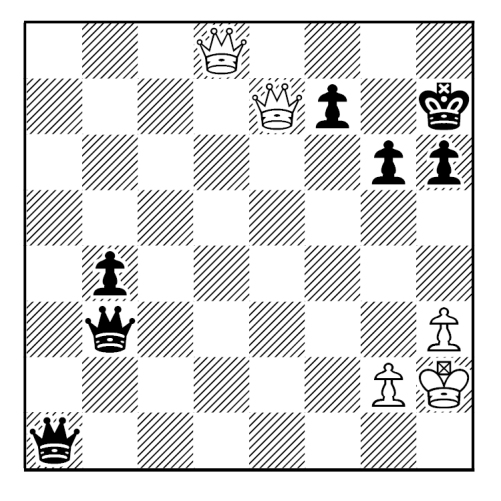
It has proven fruitless to discover the complete score of Horwitz’s game. Can someone find the moves leading up to the mate?


~~~~~~~~~~~~~~~~~~~~~~~~~~

 
A Center Counter victory by Canal is perhaps the best well-known game of Boden’s Mate.


Canal-N.N.
Simul
Budapest, 1934
1.e4 d5 2.exd5 Qxd5 3.Nc3 Qa5 4.d4 c6 5.Nf3 Bg4 6.Bf4 e6 7.h3 Bxf3 8.Qxf3 Bb4 9.Be2 Nd7 10.a3 O-O-O

2019_06_26_B
11.axb4! Qxa1+ 12.Kd2 Qxh1 13.Qxc6+! bxc6 14.Ba6mate 1-0


Other famous games include the following:


Alekhine–Vasic
Banja Luka, 1931
1.e4 e6 2.d4 d5 3.Nc3 Bb4 4.Bd3 Bxc3+? 5.bxc3 h6? 6.Ba3 Nd7 7.Qe2 dxe4 8.Bxe4 Ngf6 9.Bd3 b6?? 10.Qxe6+! fxe6 11.Bg6mate 1-0


Elyashov–N.N.
Paris, 1948
1.f4 e5 (From’s Gambit – a good opening to discover many miniatures.) 2.fxe5 d6 3.exd6 Bxd6 4.Nf3 g5 5.d4 g4 6.Ng5?! f5 7.e4 Be7? 8.Nh3! gxh3 9.Qh5+ Kf8 10.Bc4 Qe8 11.Qh6+! Nxh6 12.Bxh6mate 1-0

 
This one should be better known. White sacrifices his queen AND his rook.


Philip Corbin-Othneil Harewood
Friendly Game
Barbados, 1979
1.e4 c5 2.d4 cxd4 3.c3 (The Smith-Morra, another good opening to find miniatures.) 3…dxc3 4.Nxc3 Nc6 5.Nf3 e6 6.Bc4 Bb4!? (A relatively new move. Black doesn’t seem to get much from this move. More common are 6…a6, 6…e6 and 6..Nf6.) 7.O-O Bxc3 8.bxc3 Na5 9.Bd3 Qc7 10.Qe2 Nc6 11.Ba3 Ne5 12.Nxe5 Qxe5 13.f4 Qc7 14.e5 Qxc3 15.Bd6 Ne7 16.Rac1 Qd4+ 17.Kh1 Nc6 18.f5 h5 19.fxe6 dxe6 20.Rxf7! Bd7 21.Qf3 O-O-O

2019_06_26_C
22.Qxc6+! Bxc6 23.Rxc6+ 1-0


~~~~~~~~~~~~~~~~~~~~

 
But as you might have expected, a queen sacrifice is not needed to effect the mate.


Zukertort–Anderssen
Breslau, 1865
1.e4 e5 2.Nf3 Nc6 3.Bb5 Nge7 4.c3 d6 5.d4 Bd7 6.0-0 Ng6 7.Ng5 h6 8.Nxf7 Kxf7 9.Bc4+ Ke7 10.Qh5 Qe8 11.Qg5+! (11.Bg5+ hxg5 12.Qxg5# would work just as well.) 11…hxg5 12.Bxg5mate 1-0


Reshevsky-Duncan
Simul
Nugent’s Dept. Store, St Louis, Aug. 25 1921
[C40]
1.e4 e5 2.Nf3 d5 3.exd5 e4 4.Qe2 Nf6 5.Nc3 Bc5 6.Nxe4 O-O 7.Nxf6+ Qxf6 8.c3 Bd7 9.d4 Bd6 10.Be3 Bf5 11.Nd2 Nd7 12.g3 Rfe8 13.Bg2 Qg6 14.O-O-O c5 15.dxc6 bxc6 16.Bxc6 Rac8 17.Bxd7 Rxc3+ (Only the rook is given up.) 0-1


And on rare occasions, no sacrifice is needed.


Pandolfini – N.N., 1970
1.e4 e5 2.Nf3 Nc6 3.Bb5 a6 4.Ba4 Nf6 5.0-0 Nxe4 6.d4 exd4 7.Re1 d5 8.Nxd4 Bd6 9.Nxc6 Bxh2+ 10.Kh1 Qh4 11.Rxe4+ dxe4 12.Qd8+ Qxd8 13.Nxd8+ Kxd8 14.Kxh2 f5?? 15.Bg5mate 1–0

A Four Queen Opening.

Many players dream of playing with four queens on the board. They admire the complications and the overall tactical possibilities.


Most of the know that endgames produce the most four-queen games. And yet, it is still not that common and the tactically-gifted usually don’t have their dreams transformed into reality.

 
But is there an opening that will let the players have the four queens.


The opening is from a Semi-Slav and the Encyclopedia of Chess Openings (ECO) classifies it as D47.


The opening moves to this multi-queen game are 1.d4 d5 2.c4 e6 3.Nc3 Nf6 4.Nf3 c6 (In case you are interested, these moves define the Semi-Slav), 5.e3 Nbd7 6.Bd3 dxc4 7.Bxc4 b5. Now White’s bishop is under attack, so he moves to e2. Now after 8.Be2 a6 9.e4 b4 10.e5! bxc3 11.exf6 cxb2 12.fxg7 bxa1=Q 13.gxh8=Q, we have four queens, with two of them on their original squares and the other two are far off on corner squares.


Here are all the moves and a diagram to help you.

 
1.d4 d5 2.c4 e6 3.Nc3 Nf6 4.Nf3 c6 5.e3 Nbd7 6.Bd3 dxc4 7.Bxc4 b5 8.Be2 a6 9.e4 b4 10.e5! bxc3 11.exf6 cxb2 12.fxg7 bxa1=Q 13.gxh8=Q.
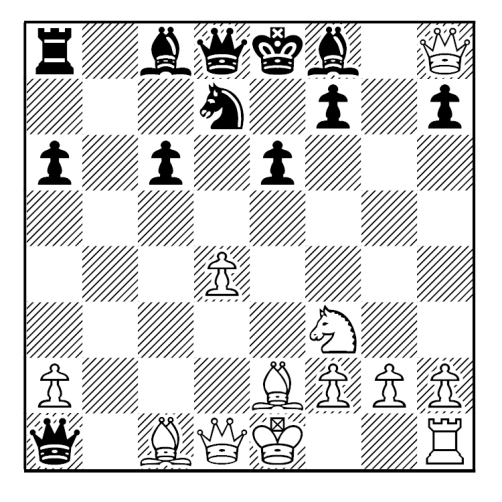
 

2019_06_05_A


Now let’s get to some games and analysis.


~~~~~~~~~~~~~~~~~~~~~~~~~~~~~

 
Black best response, after 13.gxh8=Q is to activate his second queen with 13…Qa5+. Anything else puts his game into jeopardy.


J. Kjeldsen-T. Christensen
Arhus, 1995
1.d4 d5 2.c4 e6 3.Nc3 Nf6 4.Nf3 c6 5.e3 Nbd7 6.Bd3 dxc4 7.Bxc4 b5 8.Be2 a6 9.e4 b4 10.e5 bxc3 11.exf6 cxb2 12.fxg7 bxa1=Q 13.gxh8=Q c5?! 14.O-O Bb7 15.Qxh7 Qxa2 16.Ng5 Qf6 17.Nxf7 Qg7 18.Qxg7 1-0


CM Asmund Hammerstad (2205)-Pavol Sedlacek (2233)
European Club Cup
Rogaska Slatina, Slovenia, Sept. 28 2011
1.d4 Nf6 2.Nf3 d5 3.c4 c6 4.Nc3 e6 5.e3 Nbd7 6.Bd3 dxc4 7.Bxc4 b5 8.Be2 a6 9.e4 b4 10.e5 bxc3 11.exf6 cxb2 12.fxg7 bxa1=Q 13.gxh8=Q Qxa2 (A little more active than 13…c5, but not by much.) 14.O-O Qf6 15.Qxh7 Qg7 16.Qhc2 Qd5 17.Ng5 Bb7 18.Bf3 Qb5 19.Bh5 O-O-O 20.Be2 Qa5 21.Bd2 Qa3 22.Bf3 Nb8 23.Be3 Be7 24.Ne4 f5 25.Nd2 Qb4 26.Qe2 Qb5 27.Nc4 a5 28.Rb1 Bb4 29.Nd6+ Rxd6 30.Qxb5 Qd7 31.Qe5 Qe8 32.Rxb4 1-0


After Black’s 13…Qa5+, White must block the check and he has two main ways to do so. One is 14.Bd2, the other 14.Nd2. The move 14.Bd2 would seem to be the best, but only superficially. 14.Nd2 allows for more freedom for White’s pieces. That’s why White wants to enter these complications – to use his tactical abilities.


Here are a few games with 14.Bd2.


Benko-Pytel
Hastings, 1973
[ECO]
1.d4 d5 2.c4 e6 3.Nc3 Nf6 4.Nf3 c6 5.e3 Nbd7 6.Bd3 dxc4 7.Bxc4 b5 8.Be2 a6 9.e4 b4 10.e5 bxc3 11.exf6 cxb2 12.fxg7 bxa1=Q? 13.gxh8=Q Qa5+ 14.Bd2 Qxd1+ 15.Bxd1 Qf5 (15…Qb5 16.Qxh7 +/-) 16.O-O Bb7 17.d5 Qxd5 18.Qxh7 c5 19.Ba4 O-O-O 20.Bg5 Ne5 21.Ne1 c4 22.Bxd8 Qxd8 23.Qh8 f6 24.Qg8 Qd6 25.Nc2 Kc7 26.Ne3 Be7 27.Rd1 Qb6 28.Qe8 Bc5 29.Qd8mate 1-0


Lauber (2380)-Mosquera
World U20 Ch.
Medellin, 1996
1.d4 d5 2.c4 e6 3.Nc3 Nf6 4.Nf3 c6 5.e3 Nbd7 6.Bd3 dxc4 7.Bxc4 b5 8.Be2 a6 9.e4 b4 10.e5 bxc3 11.exf6 cxb2 12.fxg7 bxa1=Q 13.gxh8=Q Qa5+ 14.Bd2 Qxd1+ 15.Bxd1 Qxa2 16.O-O c5 17.dxc5 Bb7 18.Bg5 h6 19.Bxh6 O-O-O 20.c6 Bxc6 21.Bxf8 Qa5 22.Be2 Rxf8 23.Qb2 Bb5 24.Rc1+ Kd8 25.Ne5 Nxe5 26.Qxe5 Qb4 27.Qc7+ Ke8 28.Qb7 Qd6 29.Rc8+ Qd8 30.Rxd8+ Kxd8 31.Bxb5 axb5 32.Qxb5 1-0


Fletcher Baragar (2305)-Daniel Fernandez (2057)
Financial Concept Open
North Bay, Canada, Aug. 7 1999
1.d4 d5 2.c4 e6 3.Nc3 Nf6 4.Nf3 c6 5.e3 Nbd7 6.Bd3 dxc4 7.Bxc4 b5 8.Be2 a6 9.e4 b4 10.e5 bxc3 11.exf6 cxb2 12.fxg7 bxa1=Q 13.gxh8=Q Qa5+ 14.Bd2 Q5xa2 15.O-O Qxd1 16.Rxd1 h6 17.Ne5 Nxe5 18.dxe5 Bd7 19.Qf6 Be7 20.Qh8+ Bf8 21.Qf6 Be7 22.Qxh6 O-O-O 23.Qe3 c5 24.Qf3 Kb8 25.Be3 Bb5 26.Rxd8+ Bxd8 27.Bxb5 axb5 28.g3 b4 29.Qc6 b3 30.Bxc5 b2 31.Bd6+ Ka7 32.Bc5+ Kb8 1/2-1/2


Kamil Klim (2108)-Krzysztof Bulski (2396)
Lasker Memorial
Barlinek, June 2 2007
1.d4 d5 2.c4 c6 3.Nf3 Nf6 4.Nc3 e6 5.e3 Nbd7 6.Bd3 dxc4 7.Bxc4 b5 8.Be2 a6 9.e4 b4 10.e5 bxc3 11.exf6 cxb2 12.fxg7 bxa1=Q 13.gxh8=Q Qa5+ 14.Bd2 Qxd1+ 15.Bxd1 Qf5 16.O-O Bb7 17.d5 Qxd5 18.Qxh7 c5 19.Ba5 Bc6 20.Nh4 Qe4 21.Qxe4 Bxe4 22.Re1 Bd3 23.Nf3 Bg7 24.Ng5 Bf6 25.Ne4 Bd4 26.Bc7 Nf6 27.Ba4+ Bb5 28.Bc2 Kd7 29.Bb6 Nxe4 30.Bxe4 Bc6 31.Rd1 Bd5 32.Bc2 Rb8 33.Ba4+ Kd6 34.Ba5 Rb2 35.Rd2 Rb1+ 36.Rd1 Bxa2 37.h4 Rxd1+ 38.Bxd1 c4 0-1

 
Now for the stronger, and more fluid, 14.Nd2.


Krogius-Kamyshov
USSR, 1949
[ECO]
1.d4 d5 2.c4 e6 3.Nc3 Nf6 4.Nf3 c6 5.e3 Nbd7 6.Bd3 dxc4 7.Bxc4 b5 8.Be2 a6 9.e4 b4 10.e5 bxc3 11.exf6 cxb2 12.fxg7 bxa1=Q? 13.gxh8=Q Qa5+ 14.Nd2 Qf5 15.O-O Bb7 16.Qb3 Nc5 17.Ba3 Nxb3 18.Qxf8+ Kd7 19.Qe7+ Kc8 20.Nxb3 +- Qxf1+ 21.Bxf1 Qd5 22.Bd6 1-0


Krogius-Shvedchikov
Calimanesti, 1993
1.d4 d5 2.c4 e6 3.Nc3 Nf6 4.Nf3 c6 5.e3 Nbd7 6.Bd3 dxc4 7.Bxc4 b5 8.Be2 a6 9.e4 b4 10.e5 bxc3 11.exf6 cxb2 12.fxg7 bxa1=Q 13.gxh8=Q Qa5+ 14.Nd2 Bb7 15.O-O Q1xa2 16.Nc4 Qd5 17.Bh6 O-O-O 18.Bxf8 c5 19.Nd6+ Qxd6 20.Bxd6 Rxh8 21.dxc5 Qd5 22.Qxd5 exd5 23.Rc1 1-0


De Guzman (2407)-Bhat (2410)
Michael Franett Memorial
San Francisco, 2005
1.d4 d5 2.c4 e6 3.Nf3 c6 4.e3 Nf6 5.Nc3 Nbd7 6.Bd3 dxc4 7.Bxc4 b5 8.Be2 Bb7 9.e4 b4 10.e5 bxc3 11.exf6 cxb2 12.fxg7 bxa1=Q 13.gxh8=Q Qa5+ 14.Nd2 Qf5 15.O-O O-O-O 16.Qb3 Nc5 17.Qb4 Nd7 18.Qb3 Nc5 19.Qb4 Be7 20.Qg7 Bf8 21.Qh8 Be7 1/2-1/2


Emil Klemanic (2257)-Peter Palecek (2254)
Slovakia Team Ch.
Košice, Jan. 16 2011
1.d4 d5 2.Nf3 Nf6 3.c4 c6 4.e3 e6 5.Nc3 Nbd7 6.Bd3 dxc4 7.Bxc4 b5 8.Be2 a6 9.e4 b4 10.e5 bxc3 11.exf6 cxb2 12.fxg7 bxa1=Q 13.gxh8=Q Qa5+ 14.Nd2 c5 15.O-O Qxd4 16.Qxh7 Qxa2 17.Bc4 Nf6 18.Qh8 Qa5 19.Qf3 Nd5 20.Qhh5 Qc7 21.Re1 Nf4 22.Qh7 Bb7 23.Ne4 Qa5 24.Rd1 O-O-O 25.Rxd4 Qe1+ 26.Bf1 Rxd4 27.Qxf4 Bxe4 28.Qhxf7 Bd6 29.Q4f6 Bc7 30.Q6xe6+ Kb7 31.Qxa6+ Kb8 32.Qe8+ Rd8 33.Qeb5+ 1-0

 
If 14.Nd2 Q5xa2?!, then White gets an advantage after the simple 15.O-O.


Shumiakina-Mihai
Timisoara, 1994
1.d4 d5 2.c4 e6 3.Nc3 Nf6 4.Nf3 c6 5.e3 Nbd7 6.Bd3 dxc4 7.Bxc4 b5 8.Be2 a6 9.e4 b4 10.e5 bxc3 11.exf6 cxb2 12.fxg7 bxa1=Q 13.gxh8=Q Qa5+ 14.Nd2 Q5xa2 15.O-O Bb7 16.Bc4 Qa4 17.Nb3 Qc3 18.Bxe6 fxe6 19.Bg5 Nf6 20.Qxf6 1-0


Fernando Peralta (2315)-Carlos Gonzalez
Villa Ballester Open, 1996
1.d4 d5 2.c4 e6 3.Nc3 Nf6 4.Nf3 c6 5.e3 Nbd7 6.Bd3 dxc4 7.Bxc4 b5 8.Be2 a6 9.e4 b4 10.e5 bxc3 11.exf6 cxb2 12.fxg7 bxa1=Q 13.gxh8=Q Qa5+ 14.Nd2 Q5xa2 15.O-O Qa4 16.Ne4 Qb4 17.Bd2 Qaxd4 18.Nf6+ Qxf6 19.Qxf6 Nxf6 20.Bxb4 Bxb4 21.Qa4 1-0

 
~~~~~~~~~~~~~~~~~~~~~~~~~~~~~

 
There is a sister variation with 8…Bb7 instead of 8…a6. And although there are similarities between the two variations, Black is more active and scores better in this variation.

 
Again, here are the opening moves and a diagram to help.

 
1.d4 d5 2.c4 e6 3.Nc3 Nf6 4.Nf3 c6 8.Be2 Bb7 9.e4 b4 10.e5! bxc3 11.exf6 cxb2 12.fxg7 bxa1=Q 13.gxh8=Q.
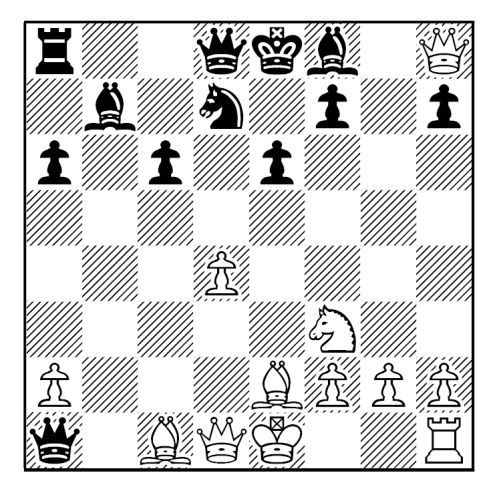
2019_06_05_B

 
And again, Black does best to activate his second queen with 13…Qa5+. Two games in which he does not and loses the game.


Z. Polgar-V. Dimitrov
Bulgaria, 1984
1.d4 d5 2.c4 e6 3.Nc3 Nf6 4.Nf3 c6 5.e3 Nbd7 6.Bd3 dxc4 7.Bxc4 b5 8.Be2 Bb7 9.e4 b4 10.e5 bxc3 11.exf6 cxb2 12.fxg7 bxa1=Q 13.gxh8=Q Qb1 14.O-O (White’s best.) 14…Qf6 15.Qxf6 Nxf6 16.Ne5 Qxa2 17.Bc4 Qa5 18.Qf3 Be7 19.Bg5 Qd8 20.Bxe6! fxe6 21.Bxf6 +- Qxd4 22.Qh5+ 1-0


Rassmussen-Domosud, 1984
[I am not sure who annotated this game. If the reader knows, please email me with the information. Thanks!]
1.d4 d5 2.c4 e6 3.Nc3 Nf6 4.Nf3 c6 5.e3 Nbd7 6.Bd3 dxc4 7.Bxc4 b5 8.Be2 Bb7 9.e4 b4 10.e5 bxc3 11.exf6 cxb2 12.fxg7 bxa1=Q 13.gxh8=Q Qb1 14.O-O Qf6 15.Qxf6 Nxf6 16.Ne5 Qxa2 17.Bc4 (17.Bh5 Qd5 18.Bxf7+ Kd8 19.Bh5) 17…Qa5 (Qb1) 18.Qf3 Be7 19.Bg5 [19.Nxc6 Qb6 20.d5 exd5 21.Nxe7 dxc4 (21…Kxe7 22.Re1+ Kd7 23.Qf5+ Kd8 24.Bg5)] 19…Qd8 20.Bxe6 [20.Nxc6 Qb6 21.d5 Bxc6 (21…Nxd5 22.Bxd5 <22.Nxe7 Nxe7 23.Qf6 Ng6> 22…Bxg5 23.Ne5) 22.dxc6 Nd5 23.Bxd5 Bxg5] 20…fxe6 21.Bxf6 Qxd4 (21…Qc8 22.Rb1 Bxf6 23.Qxf6 Qc7 24.Qh8+ Ke7 25.Qxh7+ Kd6 26.Nc4+ Kd5 27.Qxc7 Kxc4 28.Qe5 Kc3 29.Qc5+ Kd2 30.Rc1 Kd3 31.Rd1+ Ke4 32.Qe5#) 22.Qh5+ (22…Kd8 23.Nf7+ Kc8 24.Bxd4) 1-0

 
And here is the 14.Bd2 block. Not as good as 14.Nd2, but you probably already knew that already.


Chekover-Suetin
Leningrad, 1951
[ECO]
1.d4 d5 2.c4 e6 3.Nc3 Nf6 4.Nf3 c6 5.e3 Nbd7 6.Bd3 dxc4 7.Bxc4 b5 8.Be2 Bb7 9.e4 b4 10.e5 bxc3 11.exf6 cxb2 12.fxg7 bxa1=Q 13.gxh8=Q Qa5+ 14.Bd2 Qxd1+ 15.Bxd1 Qf5 16.O-O O-O-O 17.Qg8 Be7 18.Qg7 Qg6 19.Qxg6 hxg6=


Pliester-Dreev
New York Open, 1989
1.d4 d5 2.c4 e6 3.Nc3 Nf6 4.Nf3 c6 5.e3 Nbd7 6.Bd3 dxc4 7.Bxc4 b5 8.Be2 Bb7 9.e4 b4 10.e5 bxc3 11.exf6 cxb2 12.fxg7 bxa1=Q 13.gxh8=Q Qa5+ 14.Bd2 Qxd1+ 15.Bxd1 Qf5 16.O-O O-O-O 17.d5 Bd6 18.Qd4 c5 19.Qa4 Qxd5 20.Be2 Rg8 21.Rd1 Qe4 22.Qxe4 Bxe4 23.Ng5 Bd5 24.f3 f5 25.Nxh7 Be7 26.Ba6+ Kc7 27.Bf4+ Kd8 28.h4 Bxh4 29.g3 Bxg3 30.Bg5+ Kc7 31.Kg2 Bf4 0-1

 
After 13.gxh8=Q Qa5+ 14.Nd2, Black has three reasonable tries. Here are some minor ones just to lay some ground work.


Barshauskas-Kholmov
Latvian Ch., 1955
1.d4 d5 2.c4 e6 3.Nc3 Nf6 4.Nf3 c6 5.e3 Nbd7 6.Bd3 dxc4 7.Bxc4 b5 8.Be2 Bb7 9.e4 b4 10.e5 bxc3 11.exf6 cxb2 12.fxg7 bxa1=Q 13.gxh8=Q Qa5+ 14.Nd2 Q5xa2 15.O-O Ba6 (unclear – ECO) 16.Bxa6 Qxa6 17.Nb3 Qb1 18.Nc5 Qab5 19.Bh6 Qxd1 20.Rxd1 O-O-O 21.Nxd7 Bxh6 22.Qxh7 Qh5 23.Rb1 Kxd7 24.Rb7+ Kc8 25.Qb1 Bf4 26.g3 Rxd4 (with the idea of Rd1+) 0-1


Blackstock-Crouch
London, 1980
1.d4 d5 2.c4 e6 3.Nc3 Nf6 4.Nf3 c6 5.e3 Nbd7 6.Bd3 dxc4 7.Bxc4 b5 8.Be2 Bb7 9.e4 b4 10.e5 bxc3 11.exf6 cxb2 12.fxg7 bxa1=Q 13.gxh8=Q Qa5+ 14.Nd2 Qd5 15.O-O Qaxd4 16.Qxh7 Nf6 17.Qb1 Qb6 18.Bb2 Be7 19.Nc4 Qc7 20.Be5 Qcd7 21.Bxf6 Bxf6 22.Bf3 Qd4 23.Qa4 (+- ECO ; 23…Qf4!?)


Hansen-Muir
Aarus, 1990
1.d4 d5 2.c4 e6 3.Nc3 Nf6 4.Nf3 c6 5.e3 Nbd7 6.Bd3 dxc4 7.Bxc4 b5 8.Be2 Bb7 9.e4 b4 10.e5 bxc3 11.exf6 cxb2 12.fxg7 bxa1=Q 13.gxh8=Q Qa5+ 14.Nd2 Ba6 15.O-O Bxe2 16.Qxe2 Q5xa2 17.Qxh7 Qxd4 18.Qeh5 O-O-O 19.Q5xf7 Bc5 20.Qe4 Rf8 21.Qxd4 Bxd4 22.Qh7 Qd5 23.Nf3 Rxf3 24.gxf3 Ne5 25.Qg8+ Kb7 26.Qg7+ Kb6 27.Qg2 Nxf3+ 28.Kh1 a5 29.Be3 c5 30.Rb1+ Kc6 31.Rc1 a4 32.Bxd4 Nxd4 33.Qxd5+ exd5 34.h4 c4 35.h5 Nf5 36.Kg2 Kc5 37.Kf3 d4 38.Kf4 Nd6 39.h6 c3 40.h7 Nf7 41.Ra1 Kc4 0-1


Sadler-Neverov
Hastings, 1991
1.d4 d5 2.c4 e6 3.Nc3 Nf6 4.Nf3 c6 5.e3 Nbd7 6.Bd3 dxc4 7.Bxc4 b5 8.Be2 Bb7 9.e4 b4 10.e5 bxc3 11.exf6 cxb2 12.fxg7 bxa1=Q 13.gxh8=Q Qa5+ 14.Nd2 O-O-O 15.O-O Qf5 16.Qb3 Nc5 17.Qb4 Nd7 18.Qb3 1-0


Now for the main lines.


Black’s main choices here;


(1) 13.gxh8=Q Qa5+ 14.Nd2 Q5c3


(2) 13.gxh8=Q Qa5+ 14.Nd2 c5 15.O-O Qxd4


The next two originate from 14.Nd2 Qf5, one with 15.O-O O-O-O 16.Qb3, the other without all these moves.


(3) 13.gxh8=Q Qa5+ 14.Nd2 Qf5


(4) 13.gxh8=Q Qa5+ 14.Nd2 Qf5 15.O-O O-O-O 16.Qb3

 
~~~~~~~~~~~~~~~~~~~~~~~~~~~~~

 
(1) 13.gxh8=Q Qa5+ 14.Nd2 Q5c3


Lazarev-Goldstein
USSR Ch., 1962
1.d4 d5 2.c4 e6 3.Nc3 Nf6 4.Nf3 c6 5.e3 Nbd7 6.Bd3 dxc4 7.Bxc4 b5 8.Be2 Bb7 9.e4 b4 10.e5 bxc3 11.exf6 cxb2 12.fxg7 bxa1=Q 13.gxh8=Q Qa5+ 14.Nd2 Q5c3 15.O-O Qxd4 16.Qxh7 Qxa2 17.Bc4 Qa5 18.Bxe6 O-O-O 19.Qxf7 Qg7 20.Qxg7 Bxg7 21.Nc4 Qc7 22.Qg4 Be5 23.Bxd7+ Rxd7 24.Qg8+ Rd8 25.Qe6+ 1-0


Bikov-Filipenko
Moscow, 1983
1.d4 d5 2.c4 e6 3.Nc3 Nf6 4.Nf3 c6 5.e3 Nbd7 6.Bd3 dxc4 7.Bxc4 b5 8.Be2 Bb7 9.e4 b4 10.e5 bxc3 11.exf6 cxb2 12.fxg7 bxa1=Q 13.gxh8=Q Qa5+ 14.Nd2 Q5c3 15.Bc2 Ba6 16.h4 Qxd4 17.Qxd4 Qxd4 18.Rh3 O-O-O 19.Qf3 Ne5 20.Qc3 Bb4 21.Qxd4 Rxd4 22.h5 Nd3+ 23.Bxd3 Bxd3 24.h6 c5 25.a3 Ba5 26.Rh5 Rd5 27.Rxd5 exd5 28.Kd1 Bg6 29.Nb3 Bb6 30.a4 c4 31.a5 Bxf2 32.Ke2 Bg1 33.Kf1 Bh2 34.Nd4 Kd7 35.Bb2 Bf4 36.Bc3 a6 37.Ke2 Bxh6 0-1

 
(2) 13.gxh8=Q Qa5+ 14.Nd2 c5 15.O-O Qxd4


Lukov-Conquest
Tbilisi, 1988
1.d4 d5 2.c4 e6 3.Nc3 Nf6 4.Nf3 c6 5.e3 Nbd7 6.Bd3 dxc4 7.Bxc4 b5 8.Be2 Bb7 9.e4 b4 10.e5 bxc3 11.exf6 cxb2 12.fxg7 bxa1=Q 13.gxh8=Q Qa5+14.Nd2 c5 15.O-O Qxd4 16.Qxh7 Qc7 17.Bf3 Nf6 18.Qh3 Nd5 19.Ne4 Qxd1 20.Rxd1 O-O-O 21.Bg5 Be7 22.Bxe7 Qxe7 23.Qh6 Kb8 24.Rc1 Rc8 25.Qg7 e5 26.Bg4 f5 27.Qxe7 Nxe7 28.Nd6 fxg4 29.Nxc8 Bxc8 30.Rxc5 Ng6 31.f3 gxf3 32.gxf3 Be6 33.a3 Kb7 34.Kf2 Kb6 35.Rc3 Bf5 36.Kg3 e4 37.Re3 exf3 38.Rxf3 Ne7 39.Kf4 Bc8 40.Kg5 Kc5 41.h4 Bb7 42.Rf7 Kd6 43.Kf6 Nd5+ 44.Kg7 Nc7 45.h5 Be4 46.h6 a5 47.Rf1 Ke5 48.Rc1 Ne6+ 49.Kg8 Kd4 50.Rg1 Nc5 51.Kf7 Bc2 52.Kf6 Nd7+ 53.Kg7 Nc5 54.Kf7 Bh7 55.Ke7 Bf5 56.Rg5 Bc2 57.Rh5 Bh7 58.Kd6 Nb3 59.Kc6 Kc3 60.Kb5 Bd3+ 61.Ka4 1-0


Sadler-Payen
Hastings, 1990
1.d4 d5 2.c4 e6 3.Nc3 Nf6 4.Nf3 c6 5.e3 Nbd7 6.Bd3 dxc4 7.Bxc4 b5 8.Be2 Bb7 9.e4 b4 10.e5 bxc3 11.exf6 cxb2 12.fxg7 bxa1=Q 13.gxh8=Q Qa5+14.Nd2 c5 15.O-O Qxd4 16.Qxh7 Qxa2 17.Bc4 Qaa1 18.Bxe6 O-O-O 19.Qxf7 Bd6 20.Nc4 Bc7 21.Bd5 Ba6 22.Qxd4 Qxd4 23.Bb2 Qd3 24.Qe6 Bb5 25.Re1 Kb8 26.Ne3 Qd2 27.Rb1 Nb6 28.Be5 Qd3 29.Be4 Qe2 30.Bxc7+ Kxc7 31.Qe5+ Kc8 1-0


Chatalbashev-Sveshnikov
USSR, 1991
1.d4 d5 2.c4 e6 3.Nc3 Nf6 4.Nf3 c6 5.e3 Nbd7 6.Bd3 dxc4 7.Bxc4 b5 8.Be2 Bb7 9.e4 b4 10.e5 bxc3 11.exf6 cxb2 12.fxg7 bxa1=Q 13.gxh8=Q Qa5+14.Nd2 c5 15.O-O Qxd4 16.Nb3 Qxh8 (16…Qxd1 17.Rxd1 Qa4 18.Qxh7) 17.Nxa5 Bd5 18.Qc2 (18.Bf3!? Qd4 19.Qxd4 cxd4 20.Bxd5 exd5 21.Re1+ Kd8 22.Nc6+) 18…Qe5 19.Bd3 Bg7 20.Nc4 Qc3 21.Qe2 Ne5 22.Nxe5 Qxe5 23.Be3 Rc8 24.Ba6 Rc7 25.Qb5+ Ke7 26.Bxc5+ Kf6 27.Qb4 Qg5 28.f3 Kg6 29.Bd3+ f5 30.a3 Be5 31.Bd4 a5 32.Qb6 Rb7 33.Qc5 Qe7 34.Bf2 Qxc5 35.Bxc5 Rc7 36.Rc1 Rxc5 0-1

 
(3) 13.gxh8=Q Qa5+ 14.Nd2 Qf5


Pliester-Nikolic
Purmerend, 1993
1.d4 d5 2.c4 e6 3.Nc3 Nf6 4.Nf3 c6 5.e3 Nbd7 6.Bd3 dxc4 7.Bxc4 b5 8.Be2 Bb7 9.e4 b4 10.e5 bxc3 11.exf6 cxb2 12.fxg7 bxa1=Q 13.gxh8=Q Qa5+ 14.Nd2 Qf5 15.Nc4 O-O-O 16.O-O Qxa2 17.Bd3 Qd5 18.Ne3 Qg5 19.Qxh7 Qg7 20.Qdh5 Qxh7 21.Qxh7 e5 22.Bc4 Qa5 23.Qxf7 exd4 24.Nf5 Bc5 25.Bg5 Rf8 26.Qe6 Qc7 27.g3 Qe5 28.Qxe5 Nxe5 29.Be6+ Nd7 30.Rb1 Ba6 31.Rc1 Re8 32.Ng7 Rxe6 33.Nxe6 Bb6 34.h4 Kb7 35.h5 c5 36.Be7 d3 37.h6 c4 38.h7 d2 39.Ra1 c3 40.h8=Q c2 41.Qh1+ Kc8 42.Qc6+ 1-0


Carnic-Vlatkovic, 1995
1.d4 d5 2.c4 e6 3.Nc3 Nf6 4.Nf3 c6 5.e3 Nbd7 6.Bd3 dxc4 7.Bxc4 b5 8.Be2 Bb7 9.e4 b4 10.e5 bxc3 11.exf6 cxb2 12.fxg7 bxa1=Q 13.gxh8=Q Qa5+ 14.Nd2 Qf5 15.O-O O-O-O 16.Nc4 Be7 17.Qg7 Qxa2 18.Bd3 Qf6 19.Qg3 Nb6 20.Nxb6+ axb6 21.Be3 Qd5 22.Qc2 Bd6 23.Qh3 c5 24.f3 Bf4 25.Bf2 Qd6 26.Rd1 Kb8 27.dxc5 bxc5 28.Bxc5 Qc7 29.Qh5 Rd5 30.Qxd5 exd5 31.g3 0-1


Shumiakina-Zakurdjaeva
Moscow, 1999
1.d4 d5 2.c4 e6 3.Nc3 Nf6 4.Nf3 c6 5.e3 Nbd7 6.Bd3 dxc4 7.Bxc4 b5 8.Be2 Bb7 9.e4 b4 10.e5 bxc3 11.exf6 cxb2 12.fxg7 bxa1=Q 13.gxh8=Q Qa5+ 14.Nd2 Qf5 15.O-O O-O-O 16.Nc4 Qxa2 17.Bd3 Qf6 18.Qxh7 Nb6 19.Nxb6+ axb6 20.Be3 Bd6 21.Qdh5 Rd7 22.Be4 Qd8 23.Q7h6 Qa4 24.Bf3 Kc7 25.Qh8 Qxh8 26.Qxh8 Qa5 27.Qf6 Qa8 28.Rb1 b5 29.Rc1 Qd8 30.Qh6 Qf8 31.Qh5 f5 32.Bd2 b4 33.Qg6 Qh8 34.g3 Qxd4 35.Be3 Qe5 36.Rd1 Rg7 37.Qh6 Rd7 38.Bd4 Qb5 39.Qxe6 f4 40.Be2 Qg5 41.Bb6+ Kxb6 42.Qxd7 Bc7 43.Bf3 fxg3 44.hxg3 Qc5 45.Kg2 Qc3 46.Rh1 b3 47.Rh7 Qe5 48.Re7 Qd6 49.Qxd6 Bxd6 50.Re3 Kb5 51.Rxb3+ Bb4 52.Rb1 Kc4 53.Be4 1-0

 
(4) 13.gxh8=Q Qa5+ 14.Nd2 Qf5 15.O-O O-O-O 16.Qb3


Koziak-Vidoniak
Russia, 1991
1.d4 d5 2.c4 e6 3.Nc3 Nf6 4.Nf3 c6 5.e3 Nbd7 6.Bd3 dxc4 7.Bxc4 b5 8.Be2 Bb7 9.e4 b4 10.e5 bxc3 11.exf6 cxb2 12.fxg7 bxa1=Q 13.gxh8=Q Qa5+ 14.Nd2 Qf5 15.O-O O-O-O 16.Qb3 Bd6 17.Nc4 Be7 18.Qg7 Nc5 19.Qb4 Bh4 20.Be3 Qxa2 21.dxc5 Qxe2 22.Nd6+ Rxd6 23.cxd6 Qxf1+ 24.Kxf1 Qd3+ 25.Ke1 Qxe3+ 26.Kd1 Qd3+ 27.Kc1 Qf1+ 28.Kb2 Qxf2+ 29.Ka3 Qe3+ 30.Ka4 Qd3 31.Qxh4 Qd1+ 32.Ka3 Qd3+ 33.Ka2 Qa6+ 34.Kb3 1-0


Sadler-Kaidanov
Andorra, 1991
1.d4 d5 2.c4 e6 3.Nc3 Nf6 4.Nf3 c6 5.e3 Nbd7 6.Bd3 dxc4 7.Bxc4 b5 8.Be2 Bb7 9.e4 b4 10.e5 bxc3 11.exf6 cxb2 12.fxg7 bxa1=Q 13.gxh8=Q Qa5+ 14.Nd2 Qf5 15.O-O O-O-O 16.Qb3 Nc5 17.Qb4 Qc2 18.Qf6 Qcc3 19.Qxc3 Qxc3 20.Nf3 Ne4 21.Qxf7 c5 22.Bf4 Bd6 23.Qxe6+ Kb8 24.Bxd6+ Nxd6 25.Qe7 Qa5 26.dxc5 Nc8 27.Qe5+ Qc7 28.Qxc7+ Kxc7 29.Rd1 Re8 30.Bb5 Rg8 31.Rd7+ Kb8 32.c6 Ba8 33.Ne5 a5 34.Rxh7 1-0


Gil Capape-San Segundo
Saragossa, 1992
1.d4 d5 2.c4 e6 3.Nc3 Nf6 4.Nf3 c6 5.e3 Nbd7 6.Bd3 dxc4 7.Bxc4 b5 8.Be2 Bb7 9.e4 b4 10.e5 bxc3 11.exf6 cxb2 12.fxg7 bxa1=Q 13.gxh8=Q Qa5+ 14.Nd2 Qf5 15.O-O O-O-O 16.Qb3 Nc5 17.Qa3 Qxd4 18.Qxd4 Rxd4 19.Nc4 Qc2 20.Qf3 Nd7 21.Be3 c5 22.Qxf7 Qxe2 23.Bxd4 Qe4 24.Qxf8+ 1-0


~~~~~~~~~~~~~~~~~~~~~~~~~~~~~~~


And now you, the extremely tactically inclined player, can analyze these preceding games, and perhaps even use the ideas you can find, for your future games.

A Rarely Used Opening

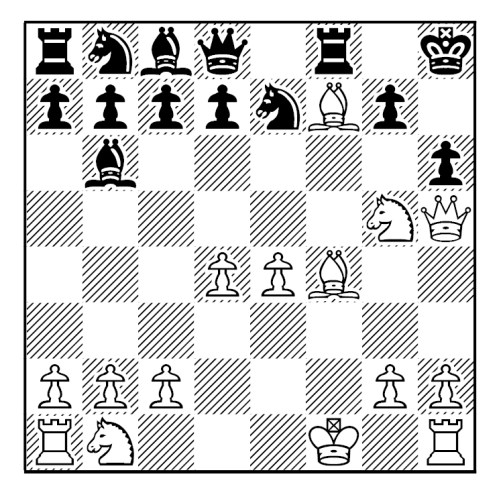
The moves defining Alapin’s Opening are 1.e4 e5 2.Ne2. It is an opening not regularly seen in tournament play. In fact, I have seen only one book that covers this exclusively cover this opening, Alapin’s Opening by Denis Druash, published in 1984.


This rarity of this opening is due to its several shortcomings. One is the inability of the King’s Knight to threaten, or even take a pawn or piece, on e5. Whites’ King Bishop also cannot immediately travel to e2, d3, c4, or b5 Instead White must lose a tempo (usually Ng3), in order to free his bishop. Finally, a personal observation. This move, for an artist, of which I do part-time work, looks atheistically unpleasing, and lacking in both tension and drama. You don’t want to use this diagram if you wish to promote chess with awe-inspiring images.

Let’s get back to the opening.
Black has at least two reasonable (and good) responses to 2.Ne2.


One is the simple 2…d5, a move that both occupies and threatens the center. After all, the reasoning goes, if White doesn’t want to control the center, then perhaps Black should do it.


Black could also try 2…Nf6, which often gives Black the advantage. But Black still has to be careful; White seems to do very well with a very weird King’s Gambit after 1.e4 e5 2.Ne2 Nf6 3.f4.


We’ll take a brief look at other Black responses before proceeding with 2…d5 and 2…Nf6 just to whet your appetite.


ALAPIN
1.e4 e5 2.Ne2

 
1) 2.Ne2
2) 2.Ne2 d5
3) 2.Ne2 Nf6
4) 2.Ne2 Nf6 3.f4


~~~~~~~~~~~~~~~~~~~~~~~~~~~~~~~~~~~~~~~~~~~~

Alapin – 1
2.Ne2


Mieses-Janowski
Match
Paris, 1895
1.e4 e5 2.Ne2 Bc5 3.d4 exd4 4.Nxd4 Nf6 5.Nc3 O-O 6.Be3 Re8 7.Bc4 Bb4 8.f3 d5 9.Bd3 c5 10.O-O cxd4 11.Bxd4 dxe4 12.Bxf6 Qxf6 13.fxe4 Qh6 14.e5 Nc6 15.Nd5 Bc5+ 16.Kh1 Rxe5 17.Nc7 Rb8 18.Bc4 Bf5 19.Qf3 Bd6 20.Rae1 Rxe1 21.Rxe1 Qxh2mate 0-1


Alapin-Albin
Berlin International
Germany, 1897
1.e4 e5 2.Ne2 Qh4 3.Nbc3 Bc5 4.g3 Qf6 5.d4 exd4 6.Nd5 Qe5 7.Bg2 Na6 8.Bf4 Qh5 9.Nxd4 Qxd1+ 10.Rxd1 Bxd4 11.Rxd4 d6 12.Bf1 Ne7 13.Bxa6 Nxd5 14.Bb5+ c6 15.Rxd5 cxb5 16.Rxb5 O-O 17.O-O b6 18.Rd1 Bg4 19.Rd2 Bf3 20.Bxd6 Rfe8 21.e5 g5 22.h3 h5 23.Rb3 g4 24.Rxf3 gxf3 25.Rd3 f6 26.Rxf3 fxe5 27.Rf5 e4 28.Rg5+ Kf7 29.Rxh5 e3 30.fxe3 Rxe3 31.Kf2 Rae8 32.Rh7+ Kg6 33.Rxa7 Re2+ 34.Kf3 Rxc2 35.b3 Kf5 36.Rc7 Rd2 37.Bf4 Rd3+ 38.Kf2 Ra8 39.Ke2 Rd5 40.Rc2 Rh8 41.h4 Kg4 42.Rd2 Re8+ 43.Kd1 Rc5 44.Rd6 b5 45.Rd4 Kf3 46.b4 Rc3 47.Kd2 Rc6 48.Rd3+ Kg4 49.Rd5 Kf3 50.Rc5 Ra6 51.Rxb5 Ra3 52.Re5 Rd8+ 53.Kc2 Rxa2+ 54.Kb3 Rh2 55.h5 1-0


City of London C.C.-Anthenaeum
corres., 1897
1.e4 e5 2.Ne2 Nc6 3.Nbc3 Bc5 4.Ng3 d6 5.d3 Nf6 6.Bg5 Be6 7.Nh5 O-O 8.Nd5 Nxe4 9.Bxd8 Bxf2+ 10.Ke2 Bg4mate 0-1


Manko-Jankovic
Germany, 1900
1.e4 e5 2.Ne2 Bc5 3.f4 Qf6 4.c3 Nc6 5.g3 Nh6 6.Bg2 Ng4 7.Rf1 Nxh2 8.fxe5 Qxf1+ 9.Bxf1 Nf3mate 0-1


Hannes Reinup-D. Ross (2291)
NATO Ch.
Rynia, Poland, Aug. 16 2013
1.e4 e5 2.Ne2 Nc6 3.Nbc3 Nf6 4.g3 Bc5 5.f3 a6 6.a4 d6 7.b3 Be6 8.Ba3 Ba7 9.h3 h5 10.f4 exf4 11.Nxf4 Nd4 12.d3 Qd7 13.Bg2 O-O-O 14.Bb2 h4 15.g4 Rde8 16.Nce2 Nxe2 17.Qxe2 Nd5 18.Nxd5 Bxd5 19.O-O-O f6 20.Rhf1 Rhf8 21.Rf5! Bc6 22.Qf3 Qe6 (One big problem in Black’s position are his bishops. They are on ineffective diagonals. Better for him, for his bishop placement and other problems, is 22…Qe7 with the idea of Bd7 and advancing his queen-side pawns as he has enabled his c7-pawn to also move forward and his queen can invade White’s castled position in the future.) 23.g5 Re7 24.gxf6 gxf6 25.Qh5 Be3+ 26.Kb1 Bg5 27.Rg1 Be8 28.Qf3 Bc6 29.c4 b5?! 30.Bc1 bxa4? 31.Bxg5 axb3 32.Rxf6 1-0


M. Alihodzic (2074)-A. Hadzovic (2212)
Sarajevo, June 19 2013
1.e4 e5 2.g3 Nc6 3.Bg2 Bc5 4.Ne2 d6 5.h3 f5 6.d3 Nf6 7.Nbc3 O-O 8.O-O Qe8 9.exf5 Bxf5 10.Be3 Qh5 11.Bxc5 dxc5 12.Nc1 Qg6 13.g4 Bxg4 14.hxg4 Nxg4 15.f3 Ne3 16.Qe2 Nxf1 17.Kxf1 Nd4 18.Qe4 Qh5 19.N3e2 Nxf3 20.Ng3 Nd4+ 21.Kg1 Qd1+ 22.Kh2 Nxc2 23.Rb1 Rf2 24.Nge2 Ne1 25.Nc3 Qh5+ 0-1


Jens Ove Fries Nielsen (2359)-Adrien Demuth (2551)
GRENKE Chess Open
Karlsruhe, Germany, Mar. 31 2018
1.e4 e5 2.Ne2 d6 3.f4 Nc6 4.d4 Nf6 5.Nbc3 exd4 6.Nxd4 Nxe4 7.Nxe4 Qe7 8.Bb5 Qxe4+ 9.Kf2 Bg4 10.Qxg4 Qxd4+ 11.Be3 Qxb2 12.Rab1 Qxc2+ 13.Be2 f5 14.Qf3 O-O-O 15.Rhc1 Qe4 16.Qxe4 fxe4 17.Bg4+ Rd7 18.a4 a5 19.Rb5 Be7 20.Rcb1 b6 21.Bxb6 Rf8 22.Ba7 Bh4+ 23.g3 Kd8 24.Rb8+ Ke7 25.Rxf8 1-0


Alapin – 2
2.Ne2 d5

Gratzsch,Tanicaud, Schellenberg – Hennenberg, Scholl
Dresden Chess Club, 1893
1.e4 e5 2.Ne2 Bc5 3.c3 Nf6 4.d4 exd4 5.cxd4 Bb4+ 6.Bd2 Qe7 7.e5 Ne4 8.Nbc3 Nxd2 9.Qxd2 O-O 10.a3 Bxc3 11.bxc3 d6 12.exd6 Qxd6 13.Ng3 Nd7 14.Be2 Nf6 15.O-O c5 16.Bd3 Be6 17.Be4 Rab8 18.f4 Rfd8 19.f5 Bd5 20.Bc2 Qc6 21.Rae1 Rbc8 22.Rf2 cxd4 23.cxd4 Qa6 24.a4 Bc6 25.Qd1 Rd7 26.Rd2 Rcd8 27.Qa1 Qc4 28.Red1 Nd5 29.Be4 Qxa4 30.Ra2 Qb4 31.Rxa7 Nc3 32.Bxc6 Nxd1 33.Qxd1 (33.Bxd7 Qe1+ 34.Nf1 Qf2+) 33…Rxd4 0-1


Alapin-Caro
Berlin, 1895
1.e4 e5 2.Ne2 Bc5 3.f4 d6 4.c3 Bg4 5.d4 exd4 6.cxd4 Bb6 7.Nbc3 Nf6 8.h3 Bxe2 9.Bxe2 d5 10.exd5 (10.e5 Ne4) 10…Nxd5 11.Nxd5 Qxd5 12.Bf3 Qb5 13.a4 Qb4+ 14.Bd2 Qxd4 15.Qe2+ Kd8 16.O-O-O Nd7 17.Rhe1 c6 18.Qe7+ Kc7 19.Bc3! Qxf4+ 20.Kb1 Qf5+ 21.Be4 Qe6 22.Bc2! Qxe7 23.Rxe7 Rad8 24.Bf5 1-0


N.N.-Canal
Blindfold Game
New York, 1935
1.e4 e5 2.Ne2 d5 3.exd5 Qxd5 4.Nbc3 Qa5 5.d4 Nc6 6.d5 Nb4 7.Bd2 Bf5 8.Rc1 Bxc2 9.Rxc2 Nd3mate 0-1


J. Phillips-S.P. Johnston
Chicago, n.d.
1.e4 e5 2.Ne2 d5 3.exd5 Nf6 4.c4 c6 5.dxc6 Nxc6 6.a3 Bc5 7.b4 Bd4 8.Nxd4 Nxd4 9.Be2 Bf5 10.d3 O-O 11.O-O Nxe2+ 12.Qxe2 Bxd3 13.Qxe5 Re8 (14.Qc3 Bxf1 15.Kxf1 Qd1+) 0-1


Bo Jacobsen (2269)-IM Ljubomir Ljubojevic (2565)
Groningen
Netherlands, 1970
1.g3 e5 2.Bg2 Nc6 3.e4 Bc5 4.Ne2 (A roundabout way of reaching the Alapin.) 4…Nf6 5.c3?! d5 6.b4 Bb6 7.exd5 Nxd5 8.Ba3 Bg4 9.O-O Nf4! 10.gxf4 Qd3! 11.Re1 O-O-O! 12.b5 Na5 13.Bb4 Nc4 14.a4 exf4 15.a5 Bxf2+ 16.Kxf2 Ne3 17.Na3 Nxd1+ 18.Raxd1 f3 19.Nc1 Qf5 20.Bh1 Qf4 0-1


Robert G. Hartoch-Gert Ligterink
IBM II
Amsterdam, July 19 1975
1.g3 e5 2.Bg2 Nf6 3.e4 Bc5 4.Ne2 Nc6 5.c3 d5 6.exd5 Nxd5 7.d4 exd4 8.cxd4 Bb6 9.Nbc3 Be6 =/+ 10.O-O O-O 11.Na4 Re8 12.h3 Qf6 13.Nxb6 axb6 14.b3 Ndb4 15.Bb2 Bd5 16.Nf4 Bxg2 17.Kxg2 Rad8 18.Qf3 Nc2 19.Rad1 N2xd4 20.Bxd4 Rxd4 21.Rxd4 Qxd4 22.Rd1 Qf6 23.Nd5 Qxf3+ 24.Kxf3 Rd8 25.Ke2 Rc8 26.Ne3 Kf8 27.f4 b5 28.Nd5 Re8+ 29.Kd3 Rd8 30.Kc3 Ne7 31.Ne3 Rxd1 32.Nxd1 Nc6 33.Ne3 Ke7 34.g4 Ke6 35.Nf5 g6 36.Ne3 Ne7 37.Kd4 b6 38.b4 f5 39.a3 c5+ 40.bxc5 Nc6+ 41.Kd3 bxc5 42.gxf5+ gxf5 43.a4 Nb4+ 44.Kc3 bxa4 45.Kc4 a3 46.Kb3 a2 47.Kb2 Nd3+ 48.Kxa2 Nxf4 49.h4 0-1


Jason S. Davies (2048)-Shaun R. Willenberg
Commonwealth and South African Open
South Africa, June 25 2011
1.e4 e5 2.g3 Nc6 3.Bg2 Nf6 4.Ne2 Bc5 5.O-O d6 6.c3 Bg4 7.d3 Qd7 8.a4 a5 9.Na3 Bh3 10.Nc4 h5 11.Bg5 Nh7 12.Be3 h4 13.f4 Bxe3+ 14.Nxe3 hxg3 15.hxg3 Nf6 16.f5 Ng4 17.Nxg4 Bxg4 18.Qd2 f6 19.Rad1 Qf7 20.Kf2 Qb3 21.Rh1 O-O-O 22.Ra1 Qb6+ 23.Qe3 Qxb2 24.Bf3 Bxf3 25.Qxf3 Rxh1 26.Rxh1 Qa2 27.Qg4 Qf7 28.Rh7 Rg8 29.Ke3 Ne7 30.d4 c6 31.Kd3 b5 32.axb5 cxb5 33.d5 Kb7 34.Kc2 Nc8 35.Nc1 Nb6 36.Qe2 Ka6 37.g4 0-1


GM V. Ivanchuk (2738)-GM M. Carlsen (2832)
Blitz Game, July 2 2017
GCT Blitz YourNextMove
Leuven, Belgium, July 2 2017
1.e4 e5 2.Ne2 d5 3.exd5 Nf6 4.d4 exd4 5.Qxd4 Qxd5 6.Nbc3 Qxd4 7.Nxd4 Bc5 8.Ndb5 Na6 9.Bf4 O-O 10.f3 Re8+ 11.Be2 Be6 12.O-O-O Bxa2 13.Rhe1 Nh5 14.Bd2 Be6 15.Ne4 Be7 16.Nd4 Bd7 17.Bxa6 bxa6 18.Bg5 Bxg5+ 19.Nxg5 Nf6 20.Nb3 h6 21.Ne4 Nxe4 22.Rxd7 Nf6 23.Rdd1 Kf8 24.Nc5 Rxe1 25.Rxe1 Re8 26.Rxe8+ Kxe8 27.Nxa6 Kd7 28.Nc5+ Kd6 29.Nd3 c5 30.Kd2 c4 31.Nf4 Kc5 32.h4 a5 33.g4 Nd5 34.Ne2 g6 35.c3 Kd6 36.f4 h5 37.g5 a4 38.Ke1 Ne3 39.Ng3 Ng2+ 0-1 (And yes, Black is the current World Champion.)


Alapin – 3
2.Ne2 Nf6

Taubenhaus-Hanham
New York, 1893
1.e4 e5 2.Ne2 Nf6 3.Ng3 Bc5 4.Bc4 d6 5.c3 Qe7 6.O-O Nc6 7.d3O-O 8.Nd2 Bb6 9.Nf3 Nd8 10.Nh4 g6 11.Bg5 Ne6 12.Qd2 Nxg5 13.Qxg5 Nd5 14.Qh6 Nf4 15.Ngf5 gxf5 16.exf5 Rd8 17.Rae1 Rd7 18.Ng6 Qd8 19.Nxf4 Qf8 20.Qxf8+ Kxf8 21.Nd5 Rd8 22.g4 c6 23.Nxb6 axb6 24.Bb3 Kg7 25.d4 exd4 26.cxd4 Kf6 27.Kg2 Rg8 28.Kf3 Bd7 29.Kf4 h6 30.Re3 Rae8 31.Rfe1 Rxe3 32.fxe3 d5 33.e4 dxe4 34.Rxe4 b5 35.h4 b6 36.Re1 Rg7 37.d5 c5 38.d6 c4 39.Bc2 Rg8 40.Re7 Bc6 41.g5+ hxg5+ 42.hxg5+ Rxg5 43.Rxf7+ Kxf7 44.Kxg5 b4 45.Bd1 b5 46.Bh5+ Kf8 47.Kf4 Bd5 48.Bd1 c3 49.bxc3 bxc3 50.a3 Ke8 51.Bc2 Kd7 52.Ke5 1/2-1/2


H.G. Daniel-John Levi Clark
New York State Chess Association
Rochester, Aug. 24 1910
1.e4 e5 2.Ne2 Nc6 3.Ng3 Nf6 4.Nc3 d5 5.exd5 Nxd5 6.Be2 Nxc3 7.bxc3 Be7 8.O-O O-O 9.Bb2 Be6 10.d4 f5 11.f4 exf4 12.Rxf4 Bg5 13.Rf3 Na5 14.Qf1 Qd5 15.c4 Nxc4 16.Bxc4 Qxc4 17.Qxc4 Bxc4 18.Rxf5 Rxf5 19.Nxf5 Re8 20.h4 Bf6 21.g4 Re4 22.g5 Bd8 23.d5 g6 24.Nh6+ Kf8 25.Kh2 Rxh4+ 26.Kg3 Re4 27.Kf3 Bxd5 28.Kg3 Bxg5 29.Rf1+ Ke8 30.Ng4 Ke7 31.Bf6+ Bxf6 32.Nxf6 Re5 33.Nxh7 Bxa2 34.Nf8 Bf7 35.Nh7 Rf5 36.Re1+ Be6 37.Re4 Rh5 38.Nf8 Kxf8 39.Rxe6 Kf7 40.Re4 Rc5 0-1


U. Nicolas-Pomar Salamanca (2345)
Madrid, 1943
1.e4 e5 2.Ne2 Nf6 3.Nbc3 Bc5 4.d4 exd4 5.Na4 Bb4+ 6.c3 dxc3 7.bxc3 Be7 8.Ng3 d6 9.Bd3 Nc6 10.O-O O-O 11.f4 Re8 12.Bb2 Bf8 13.Qd2 Ng4 14.Rf3 Bd7 15.c4 Ne7 16.Nc3 Ng6 17.Nd5 c6 18.h3 cxd5 19.hxg4 Bxg4 20.cxd5 Bxf3 21.gxf3 Qh4 22.Ne2 Qh3 23.Rf1 Be7 24.Nd4 Qg3+ 25.Kh1 Qh4+ 26.Kg1 Nxf4 27.Nf5 Qg5+ 28.Kh1 g6 29.Qh2 Qh5 30.Nh6+ Kf8 31.Qxh5 Nxh5 32.f4 Ng3+ 33.Kg2 Nxf1 34.Bxf1 f6 35.Kf2 Kg7 36.Ng4 h5 37.Ne3 Rac8 38.Kf3 Kh6 39.e5 fxe5 40.fxe5 dxe5 41.Bxe5 Bg5 42.Bd4 Bxe3 43.Bxe3+ g5 44.Bb5 Rxe3+ 45.Kxe3 Rc5 46.d6 Rxb5 47.Kd4 Rb1 0-1


Bakonyi-Benko
Budapest, 1948
1.e4 e5 2.Ne2 Nf6 3.Nbc3 d5 4.exd5 Nxd5 5.Nxd5 Qxd5 6.Nc3 Qd8 7.Bc4 Be7 8.O-O O-O 9.d3 Nc6 10.f4 exf4 11.Bxf4 Nd4 12.Nd5 Bd6 13.c3 Nf5 14.Qf3 Be6 15.Rae1 c6 16.Ne3 Nxe3 17.Qxe3 Re8 18.Bxd6 Qxd6 19.d4 Qd7 20.Bxe6 Rxe6 21.Qh3 Rae8 22.Rxe6 Qxe6 23.Qxe6 Rxe6 24.Kf2 f5 25.Re1 Rxe1 26.Kxe1 g5 27.Ke2 Kf7 28.Ke3 Ke6 29.c4 Kd6 30.Kd3 h6 31.Ke3 1/2-1/2


Alapin – 4
2.Ne2 Nf6 3.f4

Charousek-Englander
Kaschau, Apr. 1894
1.e4 e5 2.Ne2 Nf6 3.f4 d6 4.Nbc3 Bg4 5.h3 Bxe2 6.Bxe2 Nc6 7.O-O Be7 8.Bc4 Nd4 9.d3 c6 10.Be3 Ne6 11.Ne2 a6 12.Ng3 exf4 13.Bxf4 d5 14.exd5 Nxd5 15.Be5 O-O 16.Qh5 Bc5+ 17.Kh2 g6 18.Qg4 Ne3 19.Qxe6 Nxf1+ 20.Rxf1 fxe6 21.Bxe6+ Rf7 22.Rxf7 Qe8 23.Rf6+ Kg7 24.Rf4+ Kh6 25.Rh4+ Kg5 26.Rg4+ Kh6 27.Nf5+ gxf5 28.Bf4+ Kh5 29.Rg5+ Kh6 30.Rg8+ Kh5 31.g4+ fxg4 32.Bxg4+ Kh4 33.Bg5mate 1-0


Alapin-Chigorin
Vienna International
Austria, 1898
1.e4 e5 2.Ne2 Nf6 3.Nbc3 Nc6 4.f4 exf4 5.d4 Bb4 6.d5 Nxe4 7.Bxf4 Bxc3+ 8.bxc3 Ne7 9.Qd4 Nf6 10.c4 d6 11.Ng3 Nf5 12.Nxf5 Bxf5 13.Be2 O-O 14.O-O Qd7 15.Bd3 Bxd3 16.cxd3 Rfe8 17.h3 Nh5 18.g4 Nxf4 19.Rxf4 Re2 20.Rf2 Qe7 21.Raf1 f6 22.Rxe2 Qxe2 23.Rf2 Qe5 24.Qxe5 fxe5 25.Rb2 b6 26.Kf2 Rf8+ 27.Ke2 Rf4 28.Rb1 Kf7 29.Rg1 Kf6 30.Rg3 Kg5 31.a3 h6 32.Re3 Kh4 33.Kd2 Rf2+ 34.Kc3 Kg5 35.Kb3 Kf4 36.Re4+ Kf3 37.c5 bxc5 38.Ra4 Ke2 39.Rxa7 Kxd3 40.Rxc7 e4 41.a4 e3 42.a5 e2 43.Re7 Rf1 0-1


Alapin-Leonhardt
Ostend International
Belgium, 1905
1.e4 e5 2.Ne2 Nf6 3.f4 d5 4.fxe5 Nxe4 5.d3 Nc5 6.d4 Ne4 7.Nd2 f5 8.Nxe4 fxe4 9.Nf4 Bf5 10.c3 c6 11.Be2 Be7 12.Bg4 Qc8 13.Bxf5 Qxf5 14.Qb3 g5 15.Nh5 O-O 16.Be3 b5 17.a4 b4 18.Ng3 Qg4 19.c4 dxc4 20.Qxc4+ Kh8 21.Qc2 b3 22.Qe2 Bb4+ 23.Kd1 Qe6 24.Nxe4 c5 25.Nxg5 Qg6 26.h4 cxd4 27.h5 Qc2+ 28.Qxc2 bxc2+ 29.Kxc2 dxe3 30.Kd3 Nc6 31.Kxe3 Nxe5 32.Rh4 Be7 0-1


Alapin-Leonhardt
Vienna International
Austria, 1908
1.e4 e5 2.Ne2 Nc6 3.Nbc3 Nf6 4.f4 d5 5.exd5 Nxd5 6.fxe5 Nxe5 7.Nxd5 Qxd5 8.d4 Nc6 9.c3 Bd6 10.Nf4 Qg5 11.Qe2+ Ne7 12.Qb5+ Qxb5 13.Bxb5+ Bd7 14.Bxd7+ Kxd7 15.O-O g6 16.Nd3 f5 17.Bf4 Bxf4 18.Nxf4 Rae8 19.Rfe1 Nc8 20.Nd5 Rxe1+ 21.Rxe1 Rf8 22.Kf1 c6 23.Nf4 Nd6 24.Ne6 Rf7 25.Ng5 Rg7 26.Re3 Nc4 27.Re2 Re7 28.g3 Rxe2 29.Kxe2 Nxb2 30.Nxh7 Ke7 31.Ng5 Nc4 32.Nf3 Ke6 33.Kd3 b5 34.Ng5+ Kf6 35.Nf3 a6 36.Ke2 Ke6 37.Kd3 a5 38.Ng5+ Kf6 39.Nf3 a4 40.Ke2 Ke7 41.Kd3 Ke6 42.Ng5+ Kf6 43.Nf3 g5 44.Ke2 g4 45.Nh4 Nd6 46.Kd3 Ne4 47.Ng2 Ng5 48.Ne1 Ke6 49.c4 Nf3 50.Nxf3 gxf3 51.h4 bxc4+ 0-1


Alapin-Suechting
Vienna International
Austria, 1908
1.e4 e5 2.Ne2 Nf6 3.f4 d5 4.fxe5 Nxe4 5.d3 Nc5 6.d4 Ne4 7.Nd2 Bf5 8.Nxe4 Bxe4 9.Ng3 Qh4 10.Be3 Nc6 11.Qd2 Nb4 12.Bb5+ c6 13.Ba4 Bg6 14.O-O Qg4 15.c3 Na6 16.Bd1 Qd7 17.Nh5 Nc7 18.h3 Ne6 19.Bg4 O-O-O 20.Rf2 Bxh5 21.Bxh5 g6 22.Be2 h5 23.Raf1 Rh7 24.b4 Re8 25.Bd3 Qe7 26.Rf6 Nd8 27.Bg5 Ne6 28.Rxf7 Qxg5 29.Qxg5 Nxg5 30.Rxf8 1-0


Kurt Pahl-Friedrich Saemisch (2200)
Swinemunde, Poland, 1930
1.e4 e5 2.Ne2 Nf6 3.f4 d5 4.fxe5 Nxe4 5.d3 Nc5 6.d4 Ne4 7.Nd2 Ng5 8.Nf4 Nc6 9.c3 Ne6 10.Nf3 Be7 11.Bd3 Nxf4 12.Bxf4 Be6 13.Qb3 Na5 14.Qa4+ c6 15.Qc2 h6 16.Nd2 Qd7 17.a4 Bh4+ 18.g3 Be7 19.h4 O-O-O 20.h5 Nc4 21.Nf1 f6 22.a5 fxe5 23.dxe5 Qc7 24.b3 Nxe5 25.Bf5 Qd7 26.Ne3 Bd6 27.O-O Rhf8 28.Qf2 Bxf5 29.Nxf5 Rxf5 30.Qxa7 Bb8 31.Qd4 Rxh5 32.a6 Qh3 33.a7 Qh2mate 0-1


Jose Fernando Cubas (2438)-Helgi Ass Gretarsson (2514)
Bled Ol.
Slovenia, 2002
1.e4 e5 2.Ne2 Nf6 3.f4 Nxe4 4.d3 Nc5 5.fxe5 d5 6.d4 Ne6 7.Nf4 c6 8.Nc3 Be7 9.Be3 Nxf4 10.Bxf4 Bf5 11.Bd3 Bxd3 12.Qxd3 Nd7 13.O-O Nf8 14.Rf3 Qd7 15.Raf1 Ng6 16.Nd1 O-O 17.Ne3 f6 18.Qf5 Qe8 19.Qe6+ Rf7 20.Bg3 Kh8 21.h4 Nf8 22.Qg4 Bd8 23.h5 h6 24.Bh4 Nh7 25.e6 Rc7 26.Bg3 Ng5 27.Bxc7 Bxc7 28.Rxf6 gxf6 29.Rxf6 Qg8 30.Rxh6+ Nh7 31.Rg6 Qf8 32.Nf5 Qb4 33.Qe2 Qxb2 34.g3 Re8 35.Kg2 Qb5 36.Qe3 Qc4 37.Nh6 Qxc2+ 38.Kh3 Qxg6 39.hxg6 Rxe6 40.Nf7+ 1-0


Jose Fernando Cubas (2197)-Martin Herrera (2425)
Argentina Open
Mar del Plata, Apr. 14 2006
1.e4 e5 2.Ne2 Nf6 3.f4 Bc5 4.fxe5 Nxe4 5.d4 Bb6 6.Be3 Nc6 7.Nd2 Nxd2 8.Qxd2 d6 9.exd6 cxd6 10.O-O-O O-O 11.Nf4 Bf5 12.Bd3 Bxd3 13.Qxd3 d5 14.Qf5 Ne7 15.Qg5 Rc8 16.Kb1 Qd7 17.Nh5 Ng6
2019_05_22_A
18.Qf6! 1-0 (White is threatening mate. If 18… gxf6, then 19.Nxf6+ Kg7 20.Nxd7 Rfe8 21.Nxb6 Rxe3 22.Nxd5 and White, with two extra pawns, has a won game.)


Jo Cubas (2486)-Man Latorre (2308)
Paraguay Ch.
Asuncion, Nov. 25 2013
1.e4 e5 2.Ne2 Nf6 3.f4 Nxe4 4.d3 Nc5 5.fxe5 d5 6.d4 Ne4 7.Nbc3 Bb4 8.Be3 O-O 9.a3 Bxc3+ 10.Nxc3 Nxc3 11.bxc3 f6 12.exf6 Qxf6 13.Bd3 Bf5 14.O-O Qe6 15.Qf3 Re8 16.Bxf5 Qxe3+ 17.Qxe3 Rxe3
2019_05_22_B
18.Bc8! 1-0


J. Ask (2209)-O. Von Bahr (2298)
Rilton Cup
Stockholm, Dec. 30 2013
1.e4 e5 2.Ne2 Nf6 3.f4 Nxe4 4.d3 Nc5 5.fxe5 d6 6.d4 Ne4 7.Qd3 Bf5 8.Qf3 Bg6 9.Nf4 d5 10.Bd3 c5 11.O-O Qd7 12.Nc3 Nxc3 13.e6 Qc6 14.Nxg6 fxg6 15.Qf7+ Kd8 16.Bg5+ Kc8 17.bxc3 Bd6 18.Qxg7 Qe8 19.dxc5 Bxc5+ 20.Kh1 Nc6 21.Rf7 Bd6 22.Rxb7 Be5 23.Ba6 1-0

Boring Queen’s Gambit? Try the Slav!

Many players, especially beginners, dislike the Queen’s Gambit. They call it boring, positional, and not fun to play, from either side! Some even wonder why this opening is not banned (due it being boing, etc.).


Maybe they should try the Slav. It’s tactical, full of tension and a single misstep can be fatal.


Here is a list of miniatures to play when you are feeling sluggish.


And a final game, which is not a miniature, but belongs here. You’ll see why at the end.


Meanwhile …  enjoy!


~~~~~~~~~~~~~~~~~~~~~~~~~~~~~~~~~~~~~


Jensen (1873)-Fries (2038)
US Open
Los Angeles, 1991
1.d4 d5 2.c4 c6 3.Nc3 dxc4 4.e4 b5 5.a4 e5 6.Nge2 b4 7.Nb1 Nf6 8.Bg5 h6 9.Bxf6 Qxf6 10.d5 Bb7 11.Ng3 Bc5 12.Nf5 cxd5 13.Ne3 Bxe3 14.fxe3 Qh4+ 15.g3 Qxe4 16.Rg1 Qxe3+ 17.Qe2 Qxg1 18.Qxe5+ Kd8 0-1


GM Agdestein (2600)-Zsuzsa Polgar (2565)
Active Chess
Exhibition Match
Oslo, 1996
1.d4 d5 2.c4 e6 3.Nc3 c6 4.e3 Nf6 5.b3 Nbd7 6.Bb2 Bd6 7.Qc2 O-O 8.O-O-O?! (Premature. Better is 8.Nf3 and try to castle kingside.)  8…a5 9.Nf3 a4 10.Nxa4 dxc4 11.bxc4 b5! (Using her queenside pawns Zsuzsa opens up the queenside with her pawns.) 12.cxb5 cxb5 13.Bxb5 Ba6 14.Bxa6 Rxa6 15.Nd2 Qa8 16.Nc3 Rc8 17.Ndb1 Rxa2 18.Rd3 Nd5 19.Qb3 Nb4 20.Rd2 Qxg2 21.Rhd1 Qb7! 0-1 (Black threatens 22…Nd3+.)


Riedel-Zurek
Berlin, 1987
1.d4 d5 2.c4 c6 3.Nf3 Nf6 4.Nc3 Bf5 5.cxd5 Nxd5 6.Qb3 Qb6 7.Nxd5 Qxb3 8.Nc7+ Kd8 9.axb3 Kxc7 10.Bf4+ Kc8 11.Ne5 f6 12.Nc4 Nd7 13.f3 Bc2 14.e4 Bxb3 15.Na5 Bf7 16.Nxc6 e5 17.Nxa7+ Kb8 18.dxe5 fxe5 19.Be3 Bc5 20.Rd1 Bxe3 21.Rxd7 Be8 22.Rd3 Bd4 0-1


Jelena Popovic-Elena Stotskaja
Rimavska Sobota, 1992
[D15]
1.d4 d5 2.c4 c6 3.Nf3 Nf6 4.Nc3 Bf5 5.Bg5 e6 6.e3 Be7 7.Ne5 h6 8.Bh4 g5 9.Bg3 Nbd7 10.Bd3 Bxd3 11.Qxd3 Nh5 12.cxd5 exd5 13.Qf5 f6 14.Qg6+ Kf8 15.Qf7mate 1-0


Dias (2295)-Gillford
World Jr. Ch.
Calcutta, 1998
1.d4 d5 2.c4 c6 3.Nc3 Nf6 4.Nf3 Bf5 5.Qb3 Qb6 6.Bf4 Nbd7 7.e3 e6 8.Qxb6 axb6 9.Nh4 Bg4 10.f3 Bh5 11.Bd3 Bg6 12.Nxg6 hxg6 13.O-O Nh5 14.Bg5 Bd6 15.Rfb1? Bxh2+! 16.Kxh2 Nf4+ 17.Kg3 Nxd3 18.cxd5 exd5 19.e4 f6 20.Bd2 dxe4 21.Nxe4 f5 22.Ng5 Nf6 23.b4 f4+ 0-1


Kuzubov (2535)-Wademark (2182)
Port Erin Open
Isle Of Man, Sept. 24 2005
1.d4 d5 2.c4 c6 3.Nf3 Nf6 4.Nc3 Na6 5.cxd5 cxd5 6.Bf4 Qa5 7.e3 e6 8.a3 Bd7 9.Bd3 Be7 10.Ne5 Nb8 11.O-O O-O 12.Bg5 Qd8 13.f4 Nc6 14.Rf3 Nxe5 15.fxe5 Ng4 16.Bxh7+ Kxh7 17.Rh3+ Nh6 18.Qd3+ Kg8 19.Bxh6 f5 20.exf6 Bxf6 21.Bxg7 Kxg7 22.Qh7mate 1-0


 Technically, the next three games constitute the Tolush-Geller Gambit (1.d4 d5 2.c4 c6 3.Nf3 Nf6 4.Nc3 dxc4 5.e4).


Hoshino-Hori
corres.
JCCA Webchess Open
ICCF, 2007
1.d4 d5 2.c4 c6 3.Nf3 Nf6 4.Nc3 dxc4 5.e4 b5 6.Be2 e6 7.O-O Be7 8.a4 b4 9.e5 Nd5 10.Ne4 c3 11.bxc3 Nxc3 12.Nxc3 bxc3 13.Ba3 c5 14.Qc2 Ba6 15.Bb5+ Bxb5 16.axb5 O-O 17.dxc5 Qa5 18.Rfb1 Nd7 19.c6 Bxa3 20.cxd7 1-0


Bosboom (2471)-Stellwagen (2621)
Netherlands Ch.
Hilversum, Apr. 4 2008
1.d4 d5 2.Nf3 Nf6 3.c4 c6 4.Nc3 dxc4 5.e4 b5 6.Qc2 e6 7.g4 Bb7 8.g5 Nfd7 9.h4 Na6 10.a3 Be7 11.Be3 Qa5 12.Nd2 c5 13.d5 Ne5 14.Ra2 exd5 15.exd5 O-O 16.Qf5 Bd6 17.h5 Rae8 18.h6 g6 19.Qb1 Ng4 20.Nde4 Bxd5 21.Bd2 Bf4 22.Kd1 Bxe4 23.Nxe4 Nxf2+ 0-1


GM Gaprindashvili-Z. Polgar
FIDE Women’s Candidates Tournament
Shanghai, 1992
1.d4 d5 2.c4 dxc4 3.Nf3 Nf6 4.Nc3 c6 5.e4 b5 6.e5 Nd5 7.a4 Bf5 8.Be2 b4 9.Nh4 bxc3 10.Nxf5 e6 11.Ng3 cxb2 12.Bxb2 Bb4+ 13.Kf1 c3 14.Bc1 O-O 15.Ne4 Nd7 16.Bd3 f5 17.exf6 N7xf6 18.Ng5 Qd6 19.Qc2 h6 20.h4 hxg5 21.hxg5 Ng4 22.Bh7+ Kf7 23.Qe4

2019_05_08_A

23…Nxf2 24.Kxf2 Ke7+ 25.Ke2 Qg3 0-1


Sulava (2531)-Abolianin (2385)
Imperia Open
Italy, 2001
1.d4 d5 2.Nf3 c6 3.c4 Nf6 4.Nc3 a6 5.a4 g6 6.e3 Bg7 7.Bd3 O-O 8.O-O c5 9.Nxd5 Nxd5 10.cxd5 cxd4 11.e4 e6 12.dxe6 Bxe6 13.Ng5 Bc8 14.f4 Nc6 15.Bd2 h6 16.Nf3 Be6 17.Qe1 Re8 18.Qg3 Qd6 19.h4 Kh8 20.Rae1 Rad8 21.h5 g5 22.e5 gxf4 23.Qxg7+ 1-0


Krueger-Seepe
German Northwest League, 1988
1.d4 d5 2.c4 c6 3.Nf3 Nf6 4.Nc3 a6 5.e3 e6 6.Bd3 dxc4 7.Bxc4 b5 8.Bd3 c5 9.e4 cxd4 10.Nxd4 Bd6 11.Be3 O-O 12.e5 Bxe5 13.Qf3 Bxd4 14.Qxa8 Bxc3+ 15.bxc3 Qxd3 16.Qxb8 e5 17.Qa7 Qxc3+ 18.Ke2 Be6 19.f3 Qb2+ 20.Bd2 Bc4+ 0-1


Miller (2180)-Stephen Jones (2359)
Southern California Open, 1995
[I first annotated this game in Rank and File.]
1.d4 d5 2.c4 c6 3.Nf3 Nf6 4.Nc3 a6 5.e3 b5!? 6.cxd5 cxd5 7.Bd3 Bb7?! (Unless Black gets a Knight on e4 to exchange off and open the diagonal, the Bishop will merely be an onlooker to the proceedings.) 8.O-O Nbd7 9.Ne5 e6 10.f4 Be7 11.Qf3 O-O 12.g4! b4 (Black has little counterplay, and cannot come up with a good play to organize his forces.) 13.Ne2 Ne4 14.Ng3 Nd6 15.Bd2 (To connect both Rooks.) 15…Nb6 (The Black Knights are still trying to find good squares. Meanwhile White continues to build his attack.) 16.g5 a5 17.Qh5 Ne4 18.Rf3 Qe8 19.Nxe4 dxe4 20.Rh3 (White’s Bishop is, of course, immune from capture.) 20…h6 21.Ng4 (D Nxh6+) 1-0


Fang (2355)-Nichols (2046)
New Hampshire Open, 1997
1.d4 d5 2.Nf3 Nf6 3.c4 c6 4.Nc3 a6 5.c5 g6 6.Bf4 Bg7 7.h3 Nbd7 8.e3 O-O 9.Be2 Re8 10.O-O Ne4 11.Nxe4 dxe4 12.Nd2 e5 13.dxe5 Nxc5 14.Rc1 Nd3 15.Bxd3 exd3 16.Nc4 Re6 17.Rc3 Re8 18.Rxd3 Qh4 19.Nb6 Ra7 20.Nxc8 Rxc8 21.Rd7 g5 22.Rd8+ Rxd8 23.Qxd8+ Bf8 24.Bxg5 1-0


GM Kamsky-GM Kramnik
Candidate’s Match, 1994
1.d4 d5 2.c4 c6 3.Nc3 Nf6 4.Nf3 e6 5.Bg5 dxc4 6.e4 b5 7.e5 h6 8.Bh4 g5 9.Nxg5 hxg5 10.Bxg5 Nbd7 11.exf6 Bb7 12.g3 c5 13.d5 Qb6 14.Bg2 O-O-O 15.O-O b4 16.Na4 Qb5 17.a3 Ne5 18.axb4 cxb4 19.Qd4 Nc6 20.dxc6 Rxd4 21.cxb7+ Kc7 22.Be3 e5 23.Nc3 bxc3 24.bxc3 Bc5 25.cxd4 1-0


R. Hungaski (2366)-A. Nasri (2227)
World Jr. Ch.
Yerevan, 2006
1.Nf3 d5 2.d4 e6 3.c4 c6 4.Nc3 Nf6 5.Bg5 h6 6.Bh4 dxc4 7.e4 g5 8.Bg3 b5 9.Be2 Bb7 10.h4 g4 11.Ne5 h5 12.O-O Nbd7 13.Qc2 a6 14.Rad1 Be7 15.f3 Rg8 16.fxg4 hxg4 17.Nxf7 Kxf7 18.e5 c5 19.d5 Qb6 20.exf6 Bxf6 21.Ne4 1-0


GM Loek Van Wely-GM Alexander Morozevich
Wijk aan Zee, 2001
[D16]
1.d4 d5 2.c4 c6 3.Nf3 Nf6 4.Nc3 dxc4 5.a4 c5 6.d5 Bf5 7.e3 e6 8.Bxc4 exd5 9.Nxd5 Nc6 10.Qb3 Qd7 11.Nxf6+ gxf6 12.Bd2 Rg8 13.Bc3!?  O-O-O 14.Bxf7 Rxg2! 15.Nh4

2019_05_08_B
15…Ne5! 16.Nxf5 Nd3+ 17.Kf1 Rxf2+ 18.Kg1 Kb8 19.Qe6?! Rxf5 20.h4 Bd6 21.Rf1? Rg8+ 0-1 (In view of …Qg7#)


Ikonnikov (2560)-Vitoux (2264)
Port Erin Open
Isle Of Man, Sept. 24 005
1.d4 d5 2.Nf3 Nf6 3.c4 c6 4.Nc3 dxc4 5.a4 c5 6.d5 Bf5 7.e4 Nxe4 8.Nxe4 Bxe4 9.Bxc4 Qd6 10.O-O Nd7 11.Re1 Nf6 12.Bb5+ Kd8 13.Bc4 h6 14.Bd2 a6 15.Bc3 Qf4 16.Ne5 Kc8 17.f3 Bg6 18.g3 Qg5 19.f4 Qh5 20.Be2 1-0


Alan Fichaud-Robert Jacobs (2415)
corres.
ATB 2, 1998
1.c4 c6 2.d4 d5 3.Nf3 Nf6 4.Nc3 dxc4 5.a4 Na6 6.e4 Be6 7.Ne5 Qa5 8.f3 Rd8 9.Be3 Qb4 10.Qe2 g6 11.Nxc4 Bg7 12.a5 O-O 13.Ne5 Rxd4 14.Nxc6 bxc6 15.Bxd4 Qxd4 16.Qxa6 Rb8 17.Qe2 Nd7 18.Nd1 Nc5 19.Qc2 Nb3 20.Ra3 Qb4+ 21.Nc3 Nd4 22.Qc1 Qxb2 23.Qxb2 Rxb2 24.Bd3 Rxg2 0-1


Eduardo Ortiz-Matthew Ho
Pacific Southwest Open
Los Angeles 2003
1.d4 d5 2.c4 c6 3.Nf3 Nf6 4.Nc3 dxc4 5.a4 Na6 6.e4 Bg4 7.Bxc4 Bxf3 8.gxf3 e6 9.Be3 Be7 10.Rg1 O-O 11.f4 Qa5 12.Kf1 Qb4 cxd4 15.Bxd4 Nc5 16.Rg5! h6 17.Rxc5! Bxc5 18.Bxf6 Be7 (18…gxf6 19.Ra4 snares the Queen.) 19.Be5 Bf6 20.Bxf6 gxf6 21.f5 Qd6 22.Qg4+ Kh8 23.fxe6 fxe6 24.Rd1 Qe7 25.Bxe6 1-0


GM Polugaevsky (2585)-Drasko (2465)
Sarajevo, 1987
1.d4 d5 2.c4 c6 3.Nf3 Nf6 4.Nc3 dxc4 5.a4 Bf5 6.e3 e6 7.Bxc4 Bb4 8.O-O O-O 9.Nh4 Nbd7 10.f3 Bg6 11.Nxg6 hxg6 12.Qc2 Rc8 13.Rd1 Qb6 14.Kh1 c5 15.d5 Ne5 16.Be2 Rfe8 17.dxe6 Qxe6 18.Nb5 Nc6 19.Bc4 Qf5 20.Bxf7+ 1-0


Vandenburg (1979)-Blechar (2237)
corres.
CCLA Team Ch., 1999
1.d4 d5 2.c4 c6 3.Nf3 Nf6 4.Nc3 dxc4 5.a4 Bf5 6.Ne5 e6 7.Bg5 Bb4 8.Nxc4 Qd5 9.Bxf6 Qxc4 10.Qd2 Qb3 11.Bxg7 Rg8 12.Be5 c5 13.Bxb8 cxd4 14.Be5 O-O-O 15.Bxd4 Rxd4! (16.Qxd4 Qxb2) 0-1


Waxman-Wes White
Jay Chemical, 1981?
1.d4 Nf6 2.Nf3 d5 3.c4 c6 4.Qc2 Ne4 5.Bf4 Bf5 6.Qb3 Qa5+ 7.Nbd2 e5 8.dxe5 Bc5 9.e3 Bb4 10.Rd1 Nc5 0-1


C. Gabriel (2531)-GM Huebner (2636)
Bundesliga
Germany, Jan. 28 2006
1.d4 d5 2.c4 c6 3.Nf3 Nf6 4.Qb3 dxc4 5.Qxc4 Bf5 6.g3 e6 7.Bg2 Be7 8.O-O O-O 9.Qb3 Qb6 10.Nbd2 Rd8 11.Nc4 Qxb3 12.axb3 Rd5?? (13.Nb6 axb6 14.Rxa8 +-) 1-0


 GM Gelfand (2733)-GM Van Wely (2683)
Blindfold Game
Melody Amber
Monaco, 2007
1.d4 d5 2.c4 c6 3.Nf3 Nf6 4.Qb3 e6 5.Bg5 h6 6.Bh4 Nbd7 7.e3 Be7 8.Nc3 O-O 9.Bd3 b6 10.cxd5 cxd5 11.O-O Bb7 12.Rfc1 a6 13.Na4 b5 14.Nc5 Nxc5 15.dxc5 Ne4 16.Bxe7 Qxe7 17.c6 Bc8 18.a4 bxa4 19.Rxa4 Nd6 20.Qa3 Qc7 21.b4 Qb6 22.b5 Nxb5 23.Bxb5 Qxb5 24.Rb4 Qe2 25.Rb2 1-0


And the last game, as promised. It’s a game full of Queens, and appropriately quite tactical.


Zawadski-Peyrat
Metz-Chess1, 1991
1.d4 d5 2.c4 c6 3.Nf3 Nf6 4.Nc3 e6 5.e3 Nbd7 6.Bd3 dxc4 7.Bxc4 b5 8.Be2 Bb7 9.O-O b4 10.Na4 Be7 11.Qc2 Rc8 12.Rd1 O-O 13.Bd2 a5 14.Be1 c5 15.dxc5 Qc7 16.Rac1 Nxc5 17.Rd4 Qb8 18.Nb6 Rcd8 19.Nc4 Be4 20.Qd2 Qa7 21.Nce5 h6 22.h3 Ba8 23.Bc4 Nfe4 24.Qe2 Qb8 25.Rcd1 Bf6 26.Nd7 Nxd7 27.Rxd7 Rxd7 28.Rxd7 Bc6 29.Rd1 Rd8 30.Nd4 Ba8 31.f3 Nc5 32.Rc1 Qb6 33.Bf2 g6 34.Nb3 Nxb3 35.Bxb3 Bb7 36.Rd1 Rxd1+ 37.Bxd1 Ba6 38.Qd2 Be7 39.Bb3 Bc5 40.Bd1 Kg7 41.e4 e5 42.Bxc5 Qxc5+ 43.Kh2 Bb5 44.Bb3 Bc6 45.Qd8 a4 46.Bd5 Qd4 47.b3 a3 48.Qd6 Bb7 49.Qd7 Bxd5 50.exd5 Qf4+ 51.Kh1 Qc1+ 52.Kh2 Qf4+ 53.Kh1 e4 54.fxe4 Qf1+ 55.Kh2 Qf4+ 56.Kh1 Qf1+ 57.Kh2 Qf4+ 58.Kh1 Qxe4 59.d6 Qe1+ -/+ 60.Kh2 Qe5+ 61.Kh1 Qa1+ 62.Kh2 Qxa2 63.Qe7 Qd2 64.Qe5+ Kh7 65.Qf6 Qd5 66.Qe7 a2 67.d7 a1=Q 68.d8=Q Qxb3

2019_05_08_C
69.Qdf8 (69.Qef8? Qe5+ -+) 69…Qg7! -+ 70.Qb8 h5 71.Qbxb4 Qd5 72.Qbe4 Qb3 73.Q7e5 Qxe5+ 74.Qxe5 Qe6 75.Qc7 g5 76.Qc2+ Kh6 77.Qc3 f6 78.Qb4 Qe5+ 79.Kg1 Qe3+ 80.Kf1 Qf4+ 81.Qxf4 gxf4 82.Ke2 Kg5 83.Kd3 Kh4 84.Ke4 Kg3 85.Kf5 h4 86.Ke4 Kxg2 87.Kxf4 Kxh3 88.Kf3 f5 0-1