A Neglected Move

The Velimirović Attack, an opening system in the Open Sicilian, has been studied for decades. It is a system full of tactics, suspense, missed opportunities, and White wins more often than not.


To begin, let’s first define what opening moves make up the Velimirović Attack:


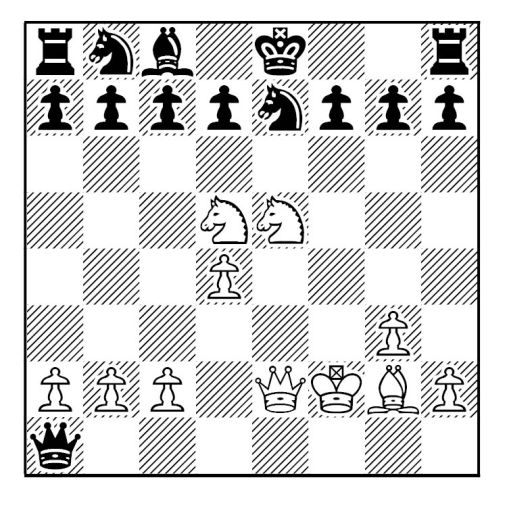
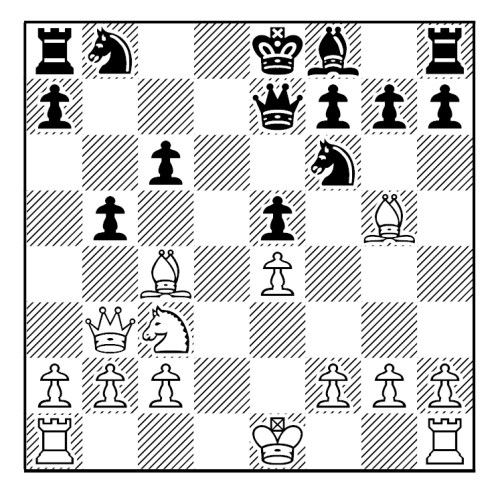
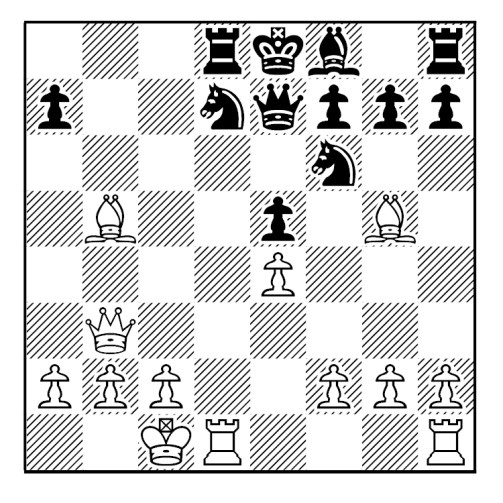
1.e4 c5 2.Nf3 Nc6 3.d4 cxd4 4.Nxd4 Nf6 5.Nc3 d6 6.Bc4 e6 7.Be3 Be7 8.Qe2 O-O 9.O-O-O a6 10.Bb3 Qc7, and now either 11.Rhg1 or 11.g4.


Both main lines require memorization in the opening and preparations for the middle game.


But there exists a third option, one that is relatively unexplored. This move, the neglected one, is 11.Kb1.


Why should this move be studied?


First of all, it forces Black to start thinking on his own, as his hours of research and development of the two main lines probably did not include this sub-variation. Also, in many of the main lines, Black plays Nc6-a5-Nxb3, exchanging his knight for White’s bishop. White usually recaptures with axb3, as cxb3 is almost suicide as it opens a file straight to White king. And after axb3, Black can move his queen from d8 to a5 and give an unwelcomed check on a1. With the king on b1, this threat is nullified.

 
So, let’s see a game.

 
Manfred Scherfke-Uwe Kunsztowicz (2234)
corres.
BRD Ch., 1976
1.e4 c5 2.Nf3 d6 3.d4 cxd4 4.Nxd4 Nf6 5.Nc3 Nc6 6.Bc4 e6 7.Be3 Be7 8.Qe2 O-O 9.O-O-O Qc7 10.Bb3 a6 11.Kb1 b5 12.Nxc6


[Probably even better is 12.g4!? as in IM A. Suarez Uriel (2391)-FM Adrian Galiana Fernandez (2291), Spanish Ch., Linares, Aug. 24 2018. The game continued with 12.g4!? b4 13.Na4 Bb7 14.Nxe6! fxe6 15.Bxe6+ Kh8 16.g5 Nxe4 17.Bb6 Qb8 18.Qxe4 Ne5 19.Bd5 Bxd5 20.Qxd5 Bxg5 21.Rhg1 Bf4 22.Qg2 Ng6 23.Bd4 Be5 24.Bxe5 dxe5 25.Nc5 Qc7 26.Ne6 Qa7 27.Nxf8 Rxf8 28.Qh3 1-0 (Black could try 28…Nf4. But after 29.Qg4, with the idea of Rd7, it’s all over.]


12…Qxc6 13.Bd4


[Not 13.f3?!, as Black is able to get in …Rb8! with impunity. Gregory Pitl (2243)-Stefan Bromberger (2399), Kecskemet, Hungary, 2001 went 13.f3?! Rb8! 14.a4 Nd7 15.axb5 axb5 16.Na2 Qa8 17.Nb4 d5 18.exd5 Bxb4 19.dxe6 fxe6 20.Bxe6+ Rf7 21.Bf4 Rb6 22.Bd5 Qxd5 23.Rxd5 Rxf4 24.Rhd1 Nf8 25.Qe3 Rbf6 26.c3 Ba5 27.Rxb5 Bc7 28.b4 Re6 29.Qa7 Rf7 30.Qa8 Re8 31.Qa2 Be6 32.c4 Rf4 33.Rc1 Rd4 34.Qa7 Rd7 35.Qa2 Bf7 36.Qf2 Bf4 0-1.]


13…Bb7 14.Rhe1 Qc7


[14…Rfe8 is more defensive than aggressive.


(1) Fernand Gobet (2415)-Fabio Bruno (2409), Banco di Roma, Rome, Italy, 1983: 14.Rhe1 Rfe8 15.f4 Rad8 16.a3 h6 17.g4 e5 18.fxe5 dxe5 19.Bxe5 Nxe4 20.Nd5 Bd6 21.Qxe4 Rxe5 22.Qxe5 Bxe5 23.Ne7+ Kf8 24.Nxc6 Rxd1+ 25.Rxd1 Bxc6 26.h4 Ke7 27.Bd5 Bd7 28.Bf3 Be6 29.h5 Bc7 30.c3 f5 31.Re1 Kf6 32.gxf5 Bxf5+ 33.Be4 Bg4 34.Bg6 Bd6 35.b4 Kg5 36.Rg1 Be5 37.Kb2 Kf4 38.Re1 Bf6 39.Kc2 Kg5 40.Rg1 Kf4 41.Kd3 Be6 1-0.]


(2) Joachim Walther-G. Hammerling, corres., East Germany, 1977: 14.Rhe1 Rfe8 15.a3 Qc7 16.f4 Bc6 17.g4 Nd7 18.g5 g6 19.h4 Nc5 20.Ba2 Rad8 21.h5 d5 22.hxg6 fxg6 23.Rh1 Bf8 24.Bf6 Qb7 25.Bxd8 Rxd8 26.exd5 exd5 27.Nxd5 Bxd5 28.Rxd5 Rxd5 29.Rd1 Qe7 30.Qxe7 Bxe7 31.Rxd5 Kf8 32.f5 gxf5 33.Rxf5+ Ke8 34.Rf7 Bxg5 35.Rxh7 Nd7 36.b4 1-0]

 
15.a3 Bc6


[GM Velimirović-GM Csom, IBM I, Amsterdam, 1974 continued instead with 15…Rac8 16.f4! e5 17.fxe5 dxe5 18.Nd5 Bxd5 +- 19.exd5 exd4 20.Qxe7 Qxh2 21.d6 Rce8

2019_05_29_A
22.Bxf7+ Rxf7 23.Qxe8+ Nxe8 24.Rxe8+ Rf8 25.d7 Qd6 26.Rf1 1-0]


16.f4 Qb8 17.f5 e5 18.Bf2 a5 19.Nd5 Bxd5 20.Rxd5 Nxd5 21.Bxd5 b4 22.a4 Bd8 23.Qh5 b3 24.cxb3 Ra6 25.Re3

2019_05_29_B


[Black now has a number of ways to lose.

Here are two sample lines.

25.Re3 g6 26.Qh6 Bf6 (26…Re8 also loses to 27.fxg6 hxg6 28.Qxg6+ +-) 27.Rh3 +-

25.Re3 h6 26.Rg3 Kh7 (26…Bg5 seems good, but after 27.Rxg5! hxg5 28.Qxg5, with the idea of f6, Black is losing big time.) 27.Be3 wins.

So Black takes the honorable way to end the game – he resigns.]


1-0

Self-Destruction or the Big “Z”

ZUGZWANG is the compulsion to move in chess, where any move would result in loss of position, material, or game.


A player who is forced into this type of position does not want to move as any move by that player only makes winning the game easier for his opponent. In other words, he is forced to self-destruct, literally move by move.

Here are a few (simple) examples.
“abdo10000”-Escalante
Blitz Game
chess.com, Feb. 4 2019
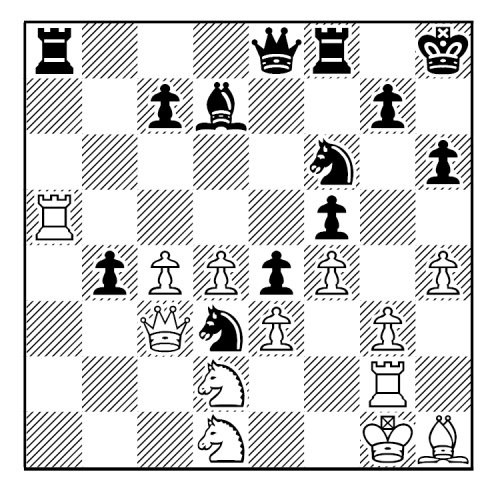
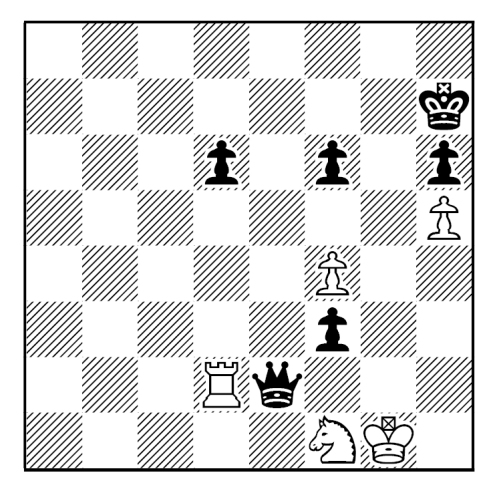
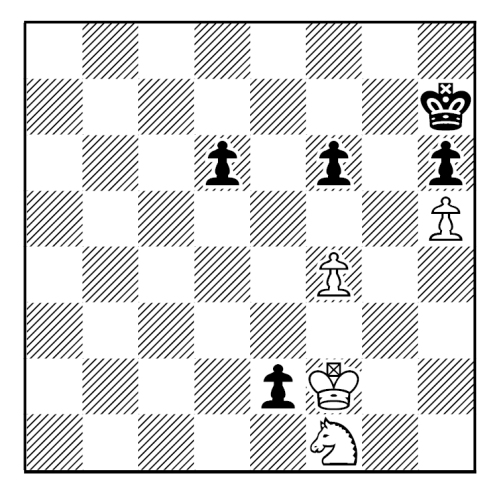
[White made a miscalculation in the middlegame enabling Black to win a bishop. White could resign, but chooses to play on.]

2019_02_14_A46.Kh1 (White puts his king in a stalemate position. Unfortunately for him, he still has pawns he can move.) 46…Kf3 (Black can achieve the same result by …Kg3 or …Kh3. The important thing is to keep the white king trapped in the corner, when he must move his pawns.) 47.a3 bxa3 48.c4 a2 49.c5 a1=Qmate 0-1


Here two more examples, slightly more sophisticated.


Jonny Hector (2465)-Sergei Tiviakov (2490)
Stockholm, 1990
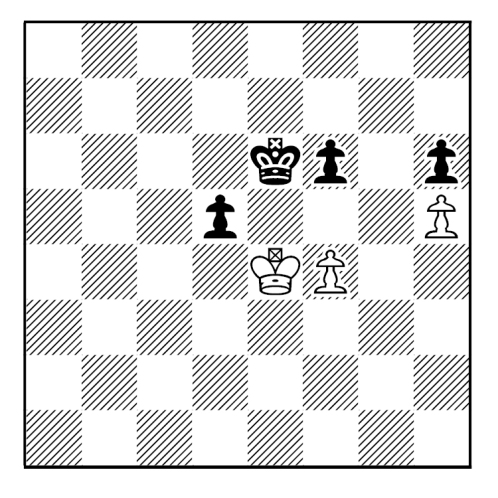
1.e4 c5 2.Nf3 d6 3.d4 cxd4 4.Nxd4 Nf6 5.Nc3 g6 6.Bc4 Bg7 7.h3 (A waiting move. More common is 7.Bb3.) 7…a6 8.O-O b5 9.Bb3 Bb7 10.Re1 O-O 11.Bg5 Nbd7 12.Nd5! (White usually does well if he can get this move in.) 12…Rc8 13.Qd2 Rc5 14.Nf3 Re8 15.c3 Qa8 16.Rad1 Nxd5 17.exd5 Nf6 18.Be3 Rxd5 19.Bxd5 Bxd5 20.Nh4 Bxa2 21.Bh6 Bh8 22.f4 Bb3 23.Ra1 Ne4 24.Qe3 Bd5 25.Qb6 Bb7 26.Re3 Bf6 27.Nf3 Ng3 28.Bg5 Nf5 29.Ree1 Bg7 30.Nh4 f6 31.Nxf5 gxf5 32.Bh4 Kf7 33.Re2 Bh6 34.Bg3 Qc8 35.Kh2 Qc4 36.Rf2 Qe4 37.Rf3 Qc6 38.Rxa6 Qxb6 39.Rxb6 Bxf3 40.gxf3 Ra8 41.Rxb5 Ra2 42.Kg1 Bf8 43.c4 Ra1+ 44.Kf2 Rc1 45.b3 Rc2+ 46.Kf1 h5 47.Rxf5 Rc3 48.Rb5 h4 49.Bf2 Bh6 50.f5 Rc1+ 51.Kg2 Rc2 52.f4 Bxf4 53.Kf3 Bg3 54.Be3 (White is still winning after 54.Bxg3 hxg3 55.Kxg3 Rc3+ 56.Kg4. The text move keeps the tension on the board.) 54…Be1 55.Rb8 Rh2 56.Bh6 e5 57.Rb7+ Ke8 58.Bg7 Rxh3+ 59.Ke4 Kd8 60.Bxf6+ Kc8 61.Rh7 Rxb3 62.Kd5 Rb7 63.Rh8+ Kd7 64.Bxh4! Bxh4 65.Rh7+ Be7 66.f6 Ke8 67.Ke6 d5 68.c5 Rc7 69.Rxe7+ Rxe7+ 70.fxe7
2019_02_14_B
1-0


Of course, such self-destruction is not limited to pawns only endgames.


GM Spassky-GM Fischer
World Ch.
Reykjavik, July 11 1972
Game 1
1.d4 Nf6 2.c4 e6 3.Nf3 d5 4.Nc3 Bb4 5.e3 O-O 6.Bd3 c5 7.O-O Nc6 8.a3 Ba5 9.Ne2 dxc4 10.Bxc4 Bb6 11.dxc5 Qxd1 12.Rxd1 Bxc5 13.b4 Be7 (This position is more or less drawish. Mariotti-Tatai, Match, Rome, 1972 continued with 14.Nfd4 Bd7 15.Bb2 Nxd4 16.Nxd4 Rac8 17.Rac1 Rfd8 18.Bb3 Kf8 19.Rxc8 Rxc8 20.Rc1 Rxc1+ 21.Bxc1 1/2-1/2. Spassky’s move is more dynamic.) 14.Bb2!? Bd7 15.Rac1 Rfd8 16.Ned4 Nxd4 17.Nxd4 Ba4 18.Bb3 Bxb3 19.Nxb3 Rxd1+ 20.Rxd1 Rc8 21.Kf1 Kf8 22.Ke2 Ne4 23.Rc1 Rxc1 24.Bxc1 f6 25.Na5 Nd6 26.Kd3 Bd8 27.Nc4 Bc7 28.Nxd6 Bxd6 29.b5 Bxh2?? (Black, who is the aspiring to be the next world champion, makes a horrible beginner’s move. Black never recovered in this game. And didn’t show up for the next one. Only two games into the match and Bobby was down 0-2. The fact that he won this match, and the world championship, is simply incredible.) 30.g3 h5 31.Ke2 h4 32.Kf3 Ke7 33.Kg2 hxg3 34.fxg3 Bxg3 35.Kxg3 Kd6 36.a4 Kd5 37.Ba3 Ke4 38.Bc5 a6 39.b6 f5 40.Kh4 f4 41.exf4 Kxf4 42.Kh5 Kf5 43.Be3 Ke4 44.Bf2 Kf5 45.Bh4 e5 46.Bg5! e4 47.Be3 Kf6 48.Kg4 Ke5 49.Kg5 Kd5 50.Kf5 a5 51.Bf2 g5 52.Kxg5 Kc4 53.Kf5 Kb4 54.Kxe4 Kxa4 55.Kd5 Kb5 56.Kd6

2019_02_14_C

(White can play Kc7 protecting his pawn while attacking Black’s. Black has no choice but to play 56..Ka6. White will reply with Bd4 and Black can either give up protecting his pawn. or run his pawn down the a-file, and wait for White to play an eventual Bxa1. And then Black has to give up the a6 square.)

Thinking of Jimmy Quon

This morning I was thinking of Jimmy Quon. For those who don’t know was one of the nicest chess players you could ever meet and he achieved his Master title while he was in his late teens.


But I have to admit I didn’t like him when we first met. I thought him to be arrogant and more than slightly condescending.


It was when Jimmy found out that I was analyzing some sharp, tactically rich variations of the Two Knights Defence games that we became friends. He was impressed by some of the lines, and more importantly, how well I could come up with responses to some interesting problems of the variations.


You see, both Jimmy and I were interested in studying and playing tactical games. Which would greatly serve us in a tournament at Cal Tech.


Siamese chess is an extremely tactical variant of chess that be defined as “a variation with two boards, four players, and general mayhem”.

 
Jimmy and I studied for this tournament. And won it with a score of 19-1. The lone loss was due to one of the players telling my opponent a winning move in a complicated position.


He, the kibitzer, was immediately condemned by the organizer, the TD (amazing he even spoke up in front of them), the other players who were watching the game, and his own teammates.


He was not on good terms with most players before this event and was on bad terms after this event.


I remembered running into Jimmy on a Wednesday night, just before the American Open (held every Thanksgiving weekend). I had to smile when I saw him playing a TN in a Siamese game, a variation we had studied for the Cal Tech tournament.


I lost contact with him for a while. I found out he was teaching at San Diego and I was proud he did was doing something he liked. His subject, by the way, was teaching chess.


Jimmy suffered a ruptured brain aneurysm in 2010. It was one of those cases in which you had only hours to live. It happened so fast that a friend who wanted to see him, had to immediately drive from Orange County, CA to San Diego and didn’t know if he could do it in time. He made it.


You won’t find too many games from Jimmy Quon on the Internet as he played most of his in the pre-Internet era. And I know you won’t find this one.


J. Quon-Forte
Blitz Game
Labate’s Chess Center
Anaheim CA, 1986
1.e4 e5 2.Nf3 Nf6 3.d4 exd4 4.Bc4 Nxe4 5.Qxd4 Nf6 6.Bg5 Be7 7.Nc3 Nc6 8.Qh4 d6 9.O-O-O O-O 10.Bd3 h6 11.Rhe1!?

[Estrin analyzed 11.Bxh6 gxh6 12.Qxh6 Ne5 (12…Nb4 13.Ng5 Nxd3+ 14.Rxd3 Bf5 15.Rg3 Bg6 16.Ne6! +/-) 13.Nxe5 dxe5 14.Qg5+ Kh8 15.Bf5 (with the idea of Rd3) +/-. But Jimmy’s idea has it’s own merits.]

11…hxg5 12.Nxg5 Re8 13.Kb1 Bd7?! 14.Nd5! Be6 15.Bh7+ Kf8

2018_12_20

16.Rxe6! +- Nxd5 17.Bg6 Nc3+ 18.bxc3 Kg8 19.Qh7+ Kf8 20.Qh8mate 1-0


In 2011 a Jimmy Quon Memorial was held in Los Angeles. Here are two games.


GM Mackenzie Molner (2458)-GM Mark Paragua (2521)
Jimmy Quon Memorial
California Market Center, Los Angeles, Jan. 19 2011
1.e4 c5 2.Nf3 d6 3.d4 cxd4 4.Nxd4 Nf6 5.Nc3 a6 6.Bg5 Nbd7 7.Bc4 Qb6 8.Bb3 e6 9.Qd2 Be7 10.O-O-O Nc5 11.Rhe1 O-O 12.f4 h6 13.h4 Qa5 14.Bxf6 Bxf6 15.g4 e5 16.fxe5 Bxe5 17.Rg1 Be6 18.Kb1 Rac8 19.g5 h5 20.g6 Nxb3 21.axb3 Bg4 22.Rxg4 hxg4 23.Nf5 Bf6 24.Nd5 Qxd2 25.Nxf6+ gxf6 26.Rxd2 fxg6 27.Ne7+ Kf7 28.Nxc8 Rxc8 29.Rxd6 f5 30.exf5 gxf5 31.Rd7+ Kf6 32.Kc1 g3 0-1


Alessandro Steinfl (2209)-GM Daniel Naroditsky (2419)
Jimmy Quon Memorial
California Market Center, Los Angeles, Jan. 23 2011
1.d4 Nf6 2.c4 g6 3.Nc3 Bg7 4.e4 d6 5.f4 (The Four Pawns variation of the King’s Indian – a rarity.)5…O-O 6.Nf3 Na6 7.Bd3 e5 8.fxe5 dxe5 9.d5 Qe7 10.O-O Nc5 11.Bc2 a5 12.Qe1 Nh5 13.Be3 b6 14.Rd1 Bg4 15.Nb5 f5 16.exf5 e4 17.d6 cxd6 18.Bxc5 dxc5 19.Qxe4 Qxe4 20.Bxe4 Rae8 21.Bd5+ Kh8 22.Nd6 Re7 23.fxg6 hxg6 24.Nf7+ Rexf7 25.Bxf7 Nf4 26.Bd5 Bxb2 27.Rb1 Bd4+ 28.Nxd4 cxd4 29.g3 Ne2+ 30.Kg2 Rd8 31.Rxb6 Bf5 32.Rd1 d3 33.Rd2 Nc3 34.Bf3 a4 35.g4 Be4 36.c5 Rd4 37.c6 Bd5 38.c7 1-0


An Interesting Game.

Wilson-Thompson
Detroit, 1990
Two connected rooks are slightly better than a single queen. The advantage lies with the player who has the initiative.

In this game, the White, with the single queen, is the one with the initiative but cannot break through the Black’s defence. White declines a few forced draws along the game, but is never in real danger.

1.e4 e5 2.Nf3 Nc6 3.Bc4 Nf6 4.Ng5 d5 5.exd5 Na5 6.Bb5+ c6 7.dxc6 bxc6 8.Qf3!? (The Bogolyubov continuation of the Two Knights Defence.) 8…Rb8 9.Bxc6+ Nxc6 10.Qxc6+ Nd7 11.d4 Be7 12.Nf3 (One interesting try is 12.Ne4!? But this lead to a Black victory in Leimkuhler-Heidsiek, corres., 1977/9. The game continued with 12.Ne4 Rb6 13.Qa4 O-O 14.O-O f5 15.Nc5 f4 16.Nxd7 Bxd7 17.Qxa7 Bb5 18.Re1 Bh4 19.c3 Bxf2+ 0-1.) 12…Rb6 13.Qa4 exd4 14.O-O (Tempting is 14.Nxd4. But after 14… Rb4 15.Nc6 Rxa4 16.Nxd8 Bxd8, Black wins a piece. And after 14.Qxd4 O-O 15.O-O Bc5, White’s queen gets kicked around.) 14…O-O 15.a3 Bf6 16.b4 Ba6 17.Re1 Bc4 18.Qxa7 Qc8 19.Bf4 Rb7 20.Qa5 Bb5 21.Bg5 Bxg5 22.Nxg5 Nb8 23.Ne4 Nc6 24.Nd6 Qd7 25.Qxb5 [Surely better is 25.Nxb5 Ra7 (25…d3 26.cxd3 Rxb5 27.Qxb5 Qd4 28.Nd2) 26.Qb6 Rb8 27.Qc5 +-] 25…Rxb5 26.Nxb5 Nxb4 27.Nxd4 Qxd4 28.c3 Qf6 29.axb4 g6 30.Ra2 Rd8 31.Rc2 Qe6 32.Rec1 Qe4 33.Nd2 Qe2 34.Nf1 Qb5 35.Rb2 Qg5 36.Rbb1 f5 37.c4 f4 38.Rc3 Qf5 39.Rbc1 Rb8 40.Rb3 Qg5 41.Rcb1 Qf5 42.c5 g5 43.h3 h5 44.c6 Qb5 45.Rc3 Kf7 46.Rc5 Qd3 47.c7 Rc8 48.Rbc1 g4 49.R1c3 Qb1 50.hxg4 hxg4 51.R5c4 Qf5 52.g3 fxg3 53.Nxg3 Qd5 54.Rc5 Qd1+ 55.Kg2 Qa4 56.b5 Qa8+ 57.Kg1 Ke6 58.Rc6+ Kd7 59.Ne4 Qa1+ 60.Kg2 Qb1 61.Nf6+ Ke7 62.b6 Rh8 63.Rc1 (63.Nd5+ Kf7 64.Rf6+ Kg7) 63…Qf5 64.Ng8+ Rxg8 65.c8=Q Rxc8 66.Rxc8 Qf3+ 67.Kg1 g3 68.R8c7+ Kd6 69.R1c2 gxf2+ 70.Kf1 Qd3+ 71.Kxf2 Qd4+ 72.Kf1 Qxb6

2018_12_12

73.R7c3 (Simply 73.Rc6+ draws.) 73…Qb5+ 74.Ke1 Qe5+ 75.Kd1 Qh5+ 76.Re2 [76.Kc1 Qh1+ (76…Qg5+ 77.Kd1 Qg1+ 78.Kd2 Kd5 79.Rc5+ Kd4 80.R5c4+ Kd5 81.Rc5+) 77.Kb2 Qb7+ 78.Kc1] 76…Qh1+ 77.Kc2 Qa1 78.Rd3+ Kc5 79.Rb3 Qa2+ 80.Rb2 Qa4+ 81.Kc1 Qa1+ 82.Kc2 Qa4+ 83.Kd2 Qd4+ 84.Kc1 Qf4+ 85.Kb1 Qf1+ 86.Ka2 Qf7+ 87.Rb3 Qa7+ 88.Kb2 Qg7+ 89.Rc3+ Kb4 90.Re4+ Kb5 91.Rc4 Qe5 92.Rc8 [Again, a simple draw can be found with a check (92.Rc5+ =)] 92…Qe2+ 93.Rc2 Qe5+ 94.Kb1 Qe1+ 95.Kb2 Qe5+ 96.R2c3 Qe2+ 97.Ka3 Qe7+ 98.Ka2 Qe2+ 99.Rc2 (99.Rc5+ is yet another draw.) 99…Qe6+ 100.Kb1 Qe1+ 101.Kb2 Qe5+ 102.R2c3 Qe2+ 103.Kb1 Qe1+ 104.Ka2 Qe2+ 105.Rc2 Qe6+ 106.Kb1 Qe1+ 107.Rc1 Qe4+ 108.R8c2 (Passive, but still enough to draw. 108.R1c2 is better, as White still has a possible check if necessary.) 108…Kb4 109.Ka1 Qd4+ 110.Ka2 Qd5+ 111.Kb1 Qd3 112.Kb2 Qd4+ 113.Ka2 Qd5+ 114.Ka1 Qd4+ 115.Kb1 Qd3 116.Kb2 Qd4+ 117.Kb1 Qd3 118.Kb2 Qd4+ 119.Ka2 Qd5+ 120.Kb1 Qd3 1/2-1/2

Greatest Game?

One could argue that the Morphy-Count Brunswick+Isouard, Paris, 1858 is the greatest game of chess ever played (see “A Well-Known Game”, Sept. 21 2018).


But this is my favorite, my nomination for the greatest game ever played. As you’ll see this game is full of unknowns and tactical surprises. And it probably sets a record for most queen sacrifices and queen promotions in a single game. Bogoljubov is completely outplayed. This is Alekhine at his best!


Bogoljubov-Alekhine
Hastings, 1922
1.d4 f5

(The Dutch allows many tactical possibilities. Here is another example:

Giampa-Rai. Garcia
AMEBS
La Plata, Argentina, 1998
1.d4 f5 2.Nf3 e6 3.Bg5 Nf6 4.Nbd2 d5 5.e3 Be7 6.Bd3 Nbd7 7.O-O c6 8.Ne5 Nxe5 9.dxe5 Ng4 10.Bf4 g5 11.Bg3 O-O 12.Qe2 Nh6 13.f4 g4 14.Kh1 b6 15.c4 Bb7 16.Rfd1 Qe8 17.Rac1 Rd8 18.Nb1 Qh5 19.cxd5 exd5 20.a3 Nf7 21.b4 Nh8 22.Bb5 Qe8 23.Ba4 Qg6 24.Bb3 Nf7 25.Nc3 b5 26.Qb2 Rc8 27.Ne2 Nd8 28.Rc2 Ne6 29.Rdc1 Rfd8 30.Nd4 Nxd4 31.Qxd4 Ra8 32.a4 a6 33.Be1 Qe6 34.a5 Rd7 35.e4 fxe4 36.Qxe4 Rf8 37.Rf2 Qf5 38.Qd4 Bd8 39.Bc3 Rg7 40.Bc2 Qh5 41.g3 Bc8 42.f5 Bg5 43.Rcf1 Qh6 44.Re2 Qh3 45.Rff2 Rgf7 46.f6 Be6 47.Bf5 Re8 48.Bd2 Bxd2 49.Qxd2 Qh5 50.Qc2 Bxf5 51.Rxf5 Qg6 52.Ref2 Re6 53.Qd2 h6 54.R2f4 Rd7 55.Qd1 h5 56.Qd4 Kf7 57.Rf2 Qh6 58.R2f4 Qg6 59.Kg1 Re8 60.Qb6 Re6 61.Qxa6 Qg8 62.Qb6 Qh7 63.a6 d4 64.a7 d3 65.Qb8 d2 66.a8=Q d1=Q+
2018_11_08_a1
67.Rf1 Qd4+ 68.R5f2 Rxe5 69.Qf8+ Ke6 70.Qxc6+ Qd6 71.Qe8+ 1-0)

2.c4 [A good move. But 2.g3 and 2.Nf3 are more popular, but for opposite reasons. 2.g3 is played for a small, but certain, advantage, while 2.Nf3 can lead to very wild play (see above.)] 2…Nf6 3.g3 e6 4.Bg2 Bb4+ (A seemingly useless move. But it does eliminate Black’s problem bishop, and more importantly for Alekhine, opens up the board for his tactical talents.) 5.Bd2 Bxd2+ 6.Nxd2 Nc6 7.Ngf3 O-O 8.O-O d6 9.Qb3?! (I don’t like this move as Black has the perfect response with 9…Kh8, getting out of the possible pin, rendering White’s move less effective. 9.Qc2 and 9.Nb3 seem to offer more. ) 9…Kh8 10.Qc3 e5 11.e3 (Pirc-Spielmann, Match, Rogatska Slatina, 1931, continued with 11.dxe5 dxe5 12.Rad1 Qe7 13.Rfe1 e4 14.Nd4 Nxd4 15.Qxd4 c5 16.Qc3 Bd7 17.Nf1 Bc6 18.Ne3 Nd7 19.Bh3 Qg5 20.Rd6 Qh5 21.Kg2 Rae8 22.Nd5 Ne5 23.Nf4 Qf7 24.Nd5 f4 25.Nxf4 g5 26.Be6 Qf6 27.Nh5 Qxf2+ 28.Kh1 Rf6 29.Bd7 Rxd6 30.Bxe8 Rd4 0-1) 11…a5 12.b3 Qe8 13.a3 Qh5 14.h4 Ng4 15.Ng5 Bd7 16.f3 Nf6 17.f4 e4 18.Rfd1 h6 19.Nh3 d5 20.Nf1 Ne7 21.a4 Nc6 22.Rd2 Nb4 23.Bh1 Qe8 24.Rg2 dxc4 25.bxc4 Bxa4 26.Nf2 Bd7 27.Nd2 b5 28.Nd1 Nd3 29.Rxa5 b4
2018_11_08_A
30.Rxa8 bxc3! (Why trade queens while losing the exchange? Well, Black’s pawn can’t be stopped from queening. A good move but even better ones coming later in the game!) 31.Rxe8 c2! 32.Rxf8+ Kh7 33.Nf2 c1=Q+ 34.Nf1 Ne1 35.Rh2 Qxc4 36.Rb8 Bb5 37.Rxb5 Qxb5 38.g4 Nf3+ 39.Bxf3 exf3 40.gxf5 Qe2 41.d5 Kg8 42.h5 Kh7 43.e4 Nxe4 44.Nxe4 Qxe4 45.d6 cxd6 46.f6 gxf6 47.Rd2 Qe2!
2018_11_08_B
(Again Black can willing give up his queen as another one will be promoted within a few moves.) 48.Rxe2 fxe2 49.Kf2
2018_11_08_C
49…exf1=Q+ (Black gives up his third queen to achieve an easily won king and pawn ending.) 50.Kxf1 Kg7 51.Kf2 Kf7 52.Ke3 Ke6 53.Ke4 d5+
2018_11_08_D
0-1 (After 54.Kd4 Kd6, Black will promote a queen for the fourth time. And he won’t have to sacrifice this one!)

An early example

The Internet is full of new analyses in chess opening. Some good, some very good, some strange, some wonderful, and some awful. This game is an early example of good, but not complete.


Escalante-“lord_kapatasan”, Game 2
Blitz Game
Yahoo, Mar. 14 2004
1.e4 e5 2.Nf3 Bc5 3.Nxe5 Bxf2+


(Anything else loses. Here are some examples.

Pantaleoni-Milicia
corres., Italy, 1980
1.e4 e5 2.Nf3 Bc5 3.Nxe5 Nf6 4.d4 Bb6 5.Nc3 O-O 6.Be3 d5 7.exd5 Nxd5 8.Nxd5 Qxd5 9.Bc4 Qxg2 10.Kd2 Bxd4 11.Bxd4 Nc6 12.Rg1 Qe4 13.Nxc6 g6 14.Qh5 Qxc6 15.Rxg6+ 1-0

Pohl-Andre
corres., 1986
1.e4 e5 2.Nf3 Bc5 3.Nxe5 Nc6 4.Nxc6 dxc6 5.Bd3 Bxf2+ 6.Kxf2 Qd4+ 7.Ke1 Qc4 8.Bxc4 1-0)


4.Kxf2 Qh4+


[Not 4…Qf6+ 5.Nf3! +- (White is still ahead in material and Black’s attack is at an end.) 5…Nh6!? 6.d4 O-O 7.Nc3 d6 8.Nd5 Qd8 9.Bxh6 gxh6 10.Qd2 Kh8 11.Qxh6 c6 12.Nf6 Qxf6 13.Qxf8+ 1-0, Viatge-Mitchell, Email, IECC, 2000]


5.g3 Qxe4


(Now Black, with White’s king out outside his protective shell and Black’s queen dominating the center, looks like he is winning. But Black’s queen is vulnerable and it’s White’s turn.) 6.d4 (6.Qe2 also wins, but Black has to get greedy. Here is why it works: 1.e4 e5 2.Nf3 Bc5 3.Nxe5 Bxf2+ 4.Kxf2 Qh4+ 5.g3 Qxe4 6.Qe2 Qxh1 7.Bg2! 1-0, as in Krejcik-Baumgartner, Troppau, 1914. So, is 6.Qe2 or 6.d4 the better move? It turns out there is also theory on 6.Qe2.)


6…Qxh1 7.Qe2 Ne7


[You’ll see this is game #2 between my opponent and myself. Here is the first game: Escalante-“lord_kapatasan”, Game 1, Blitz Game, Yahoo, Mar. 14 2004, 1.e4 e5 2.Nf3 Bc5 3.Nxe5 Bxf2+ 4.Kxf2 Qh4+ 5.g3 Qxe4 6.d4 Qxh1 7.Qe2 Qxh2+ (This move is reckless. You’ll notice he did make an improvement in game 2.) 8.Bg2 Ne7 9.Ng4 Qxg2+ 10.Kxg2 d5 11.Bf4 c6 12.Bd6 Be6 13.Bxe7 Kxe7 14.Nc3 Nd7 15.Re1 Rae8 16.Ne5 Nf6 17.Na4 Kd6 18.Qe3 h6 19.Qa3+ Kc7 20.Nc5 a6 21.Qa5+ b6 22.Qxa6 bxc5 23.Qa7+ Kd6 24.Qxc5mate 1-0. He’s the one who told me about theory I didn’t know existed. At least he was smart enough NOT to tell me before the games.]

8.Bg2!? Qxc1 9.Nc3! (Apparently this move, and the move that follows, busts this variation – I can’t see a way out for Black) 9…Qxa1 10.Nd5!

2018_10_31


10…Na6 11.Nxe7 Kxe7 12.Nc6+ Kf8 13.Qe7+ 1-0

A Well-Known Game

Of all the millions of chess games ever played, this game is perhaps the well-known and popular of all. Why? I’m glad you asked!

It’s because it features fast development, pins, forks, castling with gain of a tempo, a sacrifice of the exchange, a sacrifice of the knight, a sacrifice of the queen, and winning a miniature. It’s a lot of fun to play and to even fun to annotate.

But I can’t do a better job in fully annotating this game than Chernev or Sergeant. So I’ll just add a few notes and games to further illustrate the game and let them both have most of the fun.


Morphy-Count Brunswick+Isouard
Paris, 1858
[Chernev, 1000 Best Short Games, #441 ; Sergeant, “Morphy’s Games of Chess”, #LXXIX]
[Long considered a Morphy game, this game has far more value than a mere brilliancy. In all the vast literature of chess there is no game which equals this one in clear, simple instruction in basic principles. In seventeen moves we see such tactical themes as double attack, the pin, sacrifice of a Knight, Castling with gain of a tempo, adding pressure to a pin, sacrifice of the exchange, and (fortissimo) sacrifice of the Queen to force checkmate. Sprinkled throughout are moves that smite – captures or checks which cut down the choice of reply. Strategical concepts, such as rapid development of the pieces, interference with the opponent’s development, centralization, occupation of the open files, and control of the long diagonals are all graphically demonstrated. No wonder Marshall called this “The most famous game of all time!” – Chernev]

1.e4 e5 2.Nf3 d6 3.d4 Bg4 (This move deserves a “?” as it gives White the initiative. – RME.) 4.dxe5 Bxf3 5.Qxf3 dxe5 6.Bc4 Nf6

[Black can go very wrong at this point. Here are two examples.

Atwood-Wilson
Casual Game
London, 1801
1.e4 e5 2.Nf3 d6 3.d4 Bg4 4.dxe5 Bxf3 5.Qxf3 dxe5 6.Bc4 Qd7 7.Qb3 c6 8.a4 Bd6 9.O-O Nf6 10.Nc3 O-O 11.Be3 Kh8 12.Rad1 Nh5 13.Rxd6 Qxd6 14.Qxb7 Nd7 15.Rd1 Qb8 16.Rxd7 Qxb7 17.Rxb7 f5 18.Rxa7 Rab8 19.h3 Rxb2 20.Bc5 Rg8 21.Bd3 g5 22.Bd6 1-0

Rotman-Bornarel
Bern, 1992
1.e4 e5 2.Nf3 d6 3.d4 Bg4 4.dxe5 Bxf3 5.Qxf3 dxe5 6.Bc4 f6? 7.Qb3 Qd4?? 8.Bf7+ Ke7 [Stronger is 8…Kd8 9.Bxg8 (not 9.Qxb7 Qb4+ and Black cuts his losses to a single pawn..) 9…Qxe4+ 10.Be3  Bd5 +-. An interesting and fun line for White is 10…Rxg8? 11.Qxg8 Qxg2 12.Qxf8+ Kd7 13.Qf7+ Kc6 (not 13…Kc8 14.Qe8#) 14.Nc3!! +- and while Black can restore material equality after 14.Qxh1+ 15.Ke2! Qxa1, he is mated by 15.Qd5#.] 9.Qe6+ Kd8 10.Qe8mate 1-0 -RME]

 
7.Qb3 (Now threatening 8.Bxf7+ Kd7 9.Qe6# – Chernev) 7…Qe7 8.Nc3 (Morphy might have played 8.Bxf7+ Qxf7 9.Qxb7 – But, says Lasker, “that would have a butcher’s method, not an artist’s. – Sergeant) 8…c6 9.Bg5 b5?!

(Steinitz suggested Qc7. After the text-move all is over. – Sergeant. Koltanowksi faced 9…Qb4, and won after 10.Bxf7+! Kd8 11.O-O-O+ Kc7 12.f4 Qxb3 13.Bxb3 Bd6 14.Rhe1 Na6
2018_09_20_a
15.Rxd6! Kxd6 16.fxe5+ Kxe5 17.Bf4+ Kd4 18.Rd1+ Kc5 19.Be3+ Kb4 20.Rd4+ Kc5 21.Rd5+ Kb4 22.a3mate 1-0, Koltanowski-L. Smith, 10 sec/move, Fort Worth, 1962. This might have been a blindfold game. Now back to the original game. – RME]


2018_09_20_1
10.Nxb5! cxb5 11.Bxb5+ Nbd7 12.O-O-O (The right way to castle , as the Rook bears down on the pinned Knight without the loss of time. – Chernev) 12…Rd8 (Not 12…O-O-O as 13.Ba6+ Kc7 14.Qb7 is mate. – Chernev)
2018_09_20_2
13.Rxd7! (Again to gain time for the other Rook to strike. – Chernev) 13…Rxd7 14.Rd1 Qe6 (Unpinning his Knight so that it may defend his Rook. – Chernev) 15.Bxd7+ Nxd7 16.Qb8+! Nxb8 17.Rd8mate! (No doubt the opposition was weak; but Morphy’s method of overcoming it was most beautifully logical – a Dasmascus blade cutting a silk cushion.- Sergeant) 1-0

The Worst Opening?

The opening move, 1.f3, is  one most Black players would welcomed, if for no other reason that he (or she) might secretly wish for 1.f3 e5! 2.g4?? and 2…Qh4mate.

In fact, this opening almost always leads to a lost game for White.

Almost!


Gedult-Seligann
Blitz Game
Paris, 1966
1.f3 f5 2.e4 fxe4 3.Nc3 exf3 4.Nxf3 Nf6 5.Bc4 e6 6.O-O d5 7.Bb3 c6 8.d4 Bd6 9.Bg5 O-O 10.Ne5 Nbd7 11.Qe1 Nb6?! 12.Ng4! Qe7 13.Nxf6+ gxf6 14.Bh6 Rf7 15.Qh4 e5? 16.Ne4! dxe4 17.Rxf6! Nd5 18.Qg5+ Kh8 19.Rxf7 Qxf7 20.Bxd5 cxd5 21.Qd8+ Bf8 22.Rf1 1-0


Gedult-Selmar
Paris, 1966
1.f3 c5 2.e4 (An unusual way of reaching a Sicilian.) 2…g6 3.d4 cxd4 4.c3 dxc3 5.Nxc3 Bg7 6.Bf4 Qa5 7.Qb3 Nc6 8.O-O-O Nf6 9.Nb5 d6 10.Rxd6?! exd6 (a6) 11.Nxd6+ Kd7 12.Qxf7+ Ne7 13.Bb5+ Kd8 14.Qe8+ Rxe8 15.Nf7mate 1-0


Gedult-Melchior
Trouville, 1968
1.f3 f5 2.e4 fxe4 3.Nc3 exf3 4.Nxf3 Nf6 5.Bc4 d5 6.Bb3 Bg4 7.O-O d4 8.Ne5! Bh5 9.Qxh5+ Nxh5 10.Bf7mate 1-0


CHESS 4.6-Nigel Short
Match, 1978
[For the last game of this match Short had the opportunity to decide what would be the computer’s first move. It didn’t help.]
1.f3 e5 2.Nc3 d5 3.d4 exd4 4.Qxd4 Be6 5.Qa4+ Nd7 6.Be3 c5 7.Bf4 a6 8.Bg3 b5 9.Qf4 Ngf6 10.e3 b4 11.Nce2 Be7 12.Qc7 O-O 13.Qxd8 Rfxd8 14.a3 a5 15.axb4 axb4 16.Rxa8 Rxa8 17.Nc1 Ra1 18.Kd2 c4 19.Nge2 Nc5 20.Nd4 c3+ 21.bxc3 bxc3+ 22.Kd1 Na4 23.Bb5 Ba3 24.Ndb3 Nb2+ 25.Ke2 Nc4 26.Nxa1 1-0


Crawford-Black
corres., 1995
1.f3 d5 2.g3 e6 3.Nh3 c5 4.Nf2 Bd6 5.Bg2 Nf6 6.O-O O-O 7.c3 e5 8.Na3 a6 9.Nc2 Nc6 10.e4 d4 11.d3 b5 12.cxd4 Kh8 13.dxe5 Bxe5 14.f4 Bd4 15.e5 Bxf2+ 16.Rfxf2 Nd5 17.Ne3 Nce7 18.Rc2 Bb7 19.Rxc5 Nxe3 20.Bxe3 Bxg2 21.Kxg2 Nf5 22.Bf2 g6 23.d4 h5 24.d5 h4 25.g4 h3+ 26.Kxh3 Nh6 27.d6 Kg7 28.Bh4 Qd7 29.Rc7 Qe6 30.d7 Rh8 31.Bf6+ Kh7 32.f5 gxf5 33.Bxh8 fxg4+ 34.Kg2 Rd8 35.Bf6 Nf5 36.Qd3 Kh6 37.Bxd8 1-0

The Albin Counter Gambit

After a brief time of not playing or studying this gambit, I’ve returned to this interesting line of play. Here are some games which you might enjoy (esp. if you also experiment with the Albin).


~~~~~~~~~~~~~~~~~

Curt Jones-Doug Ralston
Nashville Invitational
Tennessee, 1974
1.d4 d5 2.c4 e5 3.dxe5 d4 4.Nf3 Nc6 5.e3 Bb4+ 6.Bd2 dxe3 7.Bxb4 exf2+ 8.Ke2 Qxd1+ 9.Kxd1 Nxb4 10.a3 Nc6 11.Nc3 Bg4 12.Be2 O-O-O+ 13.Kc2 Bxf3 14.Bxf3 Nd4+ 0-1

George Murphy-Robert Beacon
SCCA Premiers, 2000
[Robert Beacon]
1.d4 d5 2.c4 e5 3.dxe5 d4 4.Nf3 Nc6 5.Nbd2 (Normal here is 5.g3, but the game soon transposes.) 5…f6 6.exf6 Nxf6 7.g3 Bg4 8.a3 Qe7 (Normal would be 8…Qd7 as mentioned. The text is an idea of Nikolay Minev in Inside Chess. I’m following the game Lignell-Niemela 1941.) 9.Bg2 d3! 10.e3 Nd4 11.O-O (11.h3 was obligatory according to Minev.) 11…Ne2+ 12.Kh1 O-O-O 13.Qa4 [13.b4 was played in the above mentioned game (if 13.h3 h5! ). I’m now on my own!] 13…Kb8 14.b4 h5 15.Bb2 h4 16.Nxh4 Bd7 17.Qa5 Ng4 18.Ndf3 Qe8 19.Ne5 (19.Qg5!? with the idea of 20 Qg6!?) 19…Rh5 20.Nxd7+ Rxd7 21.Qa4 g5 (For me it is “all or nothing” in this position. It is difficult to say what the alternatives are.) 22.Bf3 Qe6 23.Kg2? (The game now swings in Black’s favor. Possibly 23.Qb5 to bring the Queen into the game would be better.) 23…gxh4 24.h3 Nxe3+ (Forced ) 25.fxe3 Rg5 26.Bg4 Qe4+ 27.Rf3 Rf7 (The pressure now builds on White.) 28.Raf1 Nxg3 (With hindsight 28…Rxg4 followed by 29… h3+ looks stronger.) 29. R1f2 Nf5 (Black throws away some of his advantage – 29…Ne2 is the move!) 30.Kg1 Bd6 31.Rxf5 (This is probably the decisive mistake At this point the game was finely balanced. 31.c5!? looks better.) 31…Rfxf5 32.Rxf5 (32.Bd4 prolongs the game.) 32…Qxe3+ (32…Rxg4+ 33.hxg4 Qxg4+ 34.Kh1 Qh3+ 35.Kg1 Qh2+ 36.Kf1 Qh1+ 37.Kf2 Bg3# would be more precise.) 33.Kf1 Rxf5+ 34.Bxf5 Bg3! (In a lot of lines in the Albin White’s Queen goes to a4 to pressure Black’s queenside. In this instance it was his undoing as it remained out of the game The back rank threat was an illusion!) 35.Bd4 (The Bishop threat comes too late.) 35…Qe1+ 36.Kg2 Qe2+ 37.Kg1 Qh2+ 0-1

Solis (1934)-WFM Horn (2012)
Women’s Ol.
Khanty-Mansiysk, Russia, Oct. 3 2010
1.d4 d5 2.c4 e5 3.dxe5 d4 4.g3 Nc6 5.Nf3 Nge7 6.Bg2 Ng6 7.Nbd2 Ngxe5 8.Nxe5 Nxe5 9.Nf3 Bb4+ 10.Bd2 Bxd2+ 11.Nxd2 O-O 12.O-O Be6 13.b3 c6 14.Nf3 Nxf3+ 15.Bxf3 Qb6 16.Qc2 c5 17.Rfe1 Rad8 18.Rad1 g6 19.Rd2 Rfe8 20.Red1 Bf5 21.Qb2 g5 22.Bd5 Rd7 23.Bf3 g4 24.Bg2 Rde7 25.Bd5 a5 26.a4 h5 27.Bg2 h4 28.gxh4 Qh6 29.Re1 Qxh4 30.Qc1 Qg5 31.Qb2 Re6 32.Bxb7 Rh6 33.Kg2 Ree6 34.Rh1 Rh3 35.Qc1 Rxb3 36.Ra2 Qxc1 37.Rxc1 Rxb7 0-1

“sergiydazhura”-Escalante
Blitz Game
chess.com, July 16 2018
[chess.com computer and Escalante]
1.d4 d5 2.c4 e5 3.dxe5 d4 4.Nf3 Nc6 5.Bg5 Bb4+ 6.Nbd2 Nge7 7.a4 (7.g3 is more common and the game could follow many different paths.) 7…h6 (This move allows an escape square just in case an attack gets too hot – I still don’t know what White’s plans are. In addition, the move …h6 also prepares a kingside attack by Black if White was to castle on that side or plays weakly.) 8.Bxe7 Qxe7 9.e3 (The chess.com computer calls this an inaccuracy and claims a better move with 9. Qc2 Nxe5 10.Nxd4 O-O 11.e3 Bg4 12.Be2 Rad8 13.Bxg4 Nxg4. I consider this move a little passive, after all, Black intentions are clear – he wants to attack.) 9…dxe3 10.fxe3 Nxe5 11.Nxe5 Qxe5 12.Qb3 Bxd2+ [Mistake. The best move was 12…Bg4!! (The !! are mine – the move wins outright – RME.) See, computer analysis does have its good points!] 13.Rd1 Qg5 14.h4 Qe5 15.Kf2 Bxd1 16.Qxb4 O-O-O 17.Nf3.) 13.Kxd2 Bf5 (Inaccuracy. A better move was 13…O-O. How true! In general, the more pieces involved in an attack, the better!) 14.Bd3 [The best move was 14.Qb5+ (and blunting Black’s attack.) Qxb5 15.axb5 O-O-O+ 16.Ke1 Rhe8 17.Ra3 Kb8 18.Be2 Be4.] 14…O-O-O 15.Rhd1 Rxd3+ 16.Qxd3 Bxd3 (Inaccuracy. A better move was 16… Qxb2+ 17.Ke1 Bxd3 18.Rxd3 Qxa1+ 19.Kd2 Qb2+ 20.Kd1 Qxg2 21.h3.) 17.Kxd3 Rd8+ (The best move was 17… Qxb2 18.e4 Re8 19.a5 Qb3+ 20.Kd4 Rd8+ 21.Ke5 Rxd1 22.Rxd1.) 18.Ke2 Qxb2+ 0-1