Back to School!

Labor Day has traditionally been the last day of summer vacation. It’s a time to go back to school and re-engage the brain.


Perhaps you already started school. But whether you did or not, it’s time to exercise more than a suntan. We have to get you ready for your daily quizzes, your tests, and your exams.


What better way start than a short, but not-so-easy chess quiz?


So……


Here it is! You can’t use the Internet, nor books, and no help from your friends. It is a quiz, after all!


(well…. ok – you can use friendly help.)


Answers and explanations available on PDF file, should you need them (and you will).


~~~~~~~~~~~~~~~~~~~~~~~


Pub-Quizzes


ROB’S BASIC CHESS QUIZ


1) Where did the word, CHECKMATE, come from?


a) The Australians had morbid, slightly amusing, phrase that was most popular during WWII.  It was, “CHECK ON THE MATE PLEASE. HE’S DEAD”.

b) A term in which a sailing ship would briefly hit (or “checked”) another boat in order to board it, esp. in acts of piracy.

c) A Sanskrit phrase meaning “THE KING IS DEAD”.

d) An ancient Pharaoh’s curse.


2) Which chess piece is also the name of a GM?

(a) KING

(b) QUEEN

(c) ROOK

(d) KNIGHT

(e) SPRINGER


3) Who was not a World Chess Champion from the United States before Bobby Fischer?

(a) STEINITZ

(b) BERLINER

(c) LOMBARDY

(d) Trick Question! – Fischer was the first World Champion from the United States

(e) BELLE


4) Which word does not belong?

(a) CHECKMATE

(b) STALEMATE

(c) CASTLING

(d) RESIGNATION

(e) DRAW


5) Which word does not belong?

(a) KING

(b) QUEEN

(c) KNIGHT

(d) CASTLE

(e) PAWN

(f) ROOK

(g) RESIGN

(h) SACRIFICE

(i) ELO


6) Which word does not belong?

(a) PARIS

(b) MOSCOW

(c) VIENNA

(d) BERLIN

(e) BUDAPEST


7) A “RINGED PIECE” refers to:

 
(a) A pendant that hangs from the neck that is, or features, a chess piece.

(b) A piece of art created by Ringo Starr, who was inspired by Lennon’s chess set that featured two sets of white pieces to indicate harmony.

(c) A piece on the chessboard with a ring around it, indicating that this piece was to be the one to deliver the checkmate.


8) What is the definition of SCACCHIC?

(a) [n. the Computer World Champion for 1981.]

(b) [n. a famous correspondence player of the 1950’s who came up with a new move in the Two Knights Defence.]

(c) [adj. of or relating to chess.]

(d) [adj. referring to the queenside in chess.]

(e) [adj. referring to a dive into the ocean by leaping far off the side of a cliff.]


Answers below : 

Robs_Words_Quiz_Answers


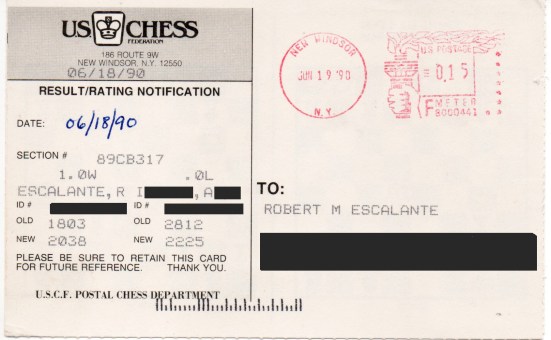
I Beat A 2812!

Yes, this is true.


And this is the story.


In order to gain an established rating, you must play events obviously. During the time you start playing tournament games and your rating more or stabilizes, you are issued a provisional rating. This rating can wildly swing as you win and lose games.


In 1988 my correspondence rating was settling into a stable one. My opponent’s rating was still in wild flux before he and I started our game.


And this is the game.


A.I.-Escalante
corres. 1990
1.e4 e5 2.Nf3 Nc6 3.Bc4 Nf6 4.Ng5 Bc5 (This is the Wilkes-Barre Variation, an extremely tactical and popular opening in the 1980s.  It was my favorite opening at this time as well. And it also seems to have been a favorite of my opponent as he made book move almost to the end of the game. Kenneth Williams’s pamphlet, The Real American Wilkes-Barre, published in 1979, was probably the reason for its popularity.) 5.Nxf7 (An alternate move is 5.Bxf7+. But if tactical is your M.O., then you can’t beat 5.Nxf7 for the pins, forks, checks, and sacrifices.) 5…Bxf2+ 6.Kxf2 Nxe4+ 7.Ke3!? [7.Kg1 is another move. But boldly (or maybe even recklessly) moving one’s king to the center in this variation is stronger than it appears (IMHO) as Black doesn’t have too many pieces developed and White is ahead materially.]

7…Qh4

[Black has the choice of the text move and 7…Qe7. I chose 7…Qh4 as I felt the queen was more active on this square.

Remember I mentioned this was popular opening back in the 1980s? Here two very strong players trying out 7…Qe7!? Notes are from NIC Yearbook #4.

Van de Loo-Hesslin
Netherlands, 1985
1.e4 e5 2.Nf3 Nc6 3.Bc4 Nf6 4.Ng5 Bc5 5.Nxf7 Bxf2+ 6.Kxf2 Nxe4+ 7.Ke3 Qe7 8.c3 Nd4 9.Kxe4 Qh4+ 10.Ke3 Qf4+ 11.Kd3 d5 12.Bxd5 Bf5+ 13.Kc4 b5+ 14.Kc5 Qh4 15.Nxe5 O-O-O 16.c4 Rxd5+ 17.cxd5 Rd8 18.Nc3 Nc6 19.Qa4!! Qe7+ (19…bxa4 20.Nc6 -/+) 20.Kxb5 Qxe5 21.Qc4?! (21.Qa6+!? Kb8 22.Qc6 Bd7) 21…Nd4+ 22.Ka4 Bd7+ 23.Ka5?! (Ka3!?) 23…Nc6+ 24.Ka6? (Ka4) 24…Nb8+ 25.Kxa7 (unclear) c6? (Qd6! -+) 26.Nb5! (with the idea of Kb6, Na7#) 26…Bf5 27.d4 Rd7+ 28.Ka8 (Kb6!) 27…Qe7 29.dxc6 Be4 30.d5 Bxd5 31.Qxd5 Rxd5 32.Na7+ Kd8 33.Kxb8?! (33.Bf4 with the idea of c7) 33…Qc7+? [33…Qe5 34.Kb7 (34.Ka8? Kc6!) Rb5 35.Nxb5 Qxb5=] 34.Ka8 Ra5 (Ke8!?) 35.Bg5+!! Rxg5 (35…Ke8 36.Rae1 Kf7 37.Re7+ -+) 36.Rad1+ Ke8 37.Rhe1+ Kf8 38.Rd7 Qxh2 39.Ree7 Qxg2 40.Rb7 Rc5 41.c7 Qg4 42.Rf7+! Ke8 43.b4 Rc2 44.a4 h5 45.a5 h4 46.b5 h3 47.Nc6! h2 48.Rxg7!! 1-0 Back to the game!]

8.g3 Nxg3 9.hxg3 Qd4+ 10.Kf3 d5!

[Black has the option of 10…O-O, letting his rook into play. However, again IMHO, the text move is stronger as it allows Black’s c8-bishop to come into play AND lay claim to the center.

Oleksenko-Malksirits, corres., 1984, continued with 11.Rh4!? e2+ 12.Kg2 d5 13.Rf4 dxc4 14.Qf1 Rxf7 15.Rxf7 Bg4 16.Nc3 Ne5 17.Qf2! Bf3+ 18.Rxf3 exf3+ 19.Kg1 Qd7 20.d4 cxd3 21.Bf4 Ng6 22.Qxf3 dxc2 23.Rc1 Nxf4 24.Qxf4 Rf8 25.Qc4+ Kh8 26.Rxc2 c6 27.Qc5 Rf5 28.Rf2+ 1-0]

11.Be2

[All this studying for correspondence can pay off. Here is another game by the author.

Escalante-Tym Belanger, US Amateur Team Ch., Feb., 20 2006, 11.Rh4 e4+ 12.Kg2 Rf8 13.Bxd5 Qxd5 14.Qh5 Qxh5 15.Rxh5 Rxf7 16.Rxh7 Nd4 17.Na3 Bg4 -/+ 18.Rh8+ Rf8 19.Rxf8+ Kxf8 20.c3 Bf3+ 21.Kf2 Nf5 22.d3 Rd8 23.dxe4 Bxe4 24.Bg5? (>24.Bf4 c6 25.Nc4) 24…Rd3 25.Bf4 Rf3+ 26.Ke2 Nxg3+ 27.Bxg3 Rxg3 28.Rf1+ Ke7 29.Kd2 Rd3+?! (>29…Rg2+ 30.Ke3 Bc6 31.Nc4? Bb5) 30.Ke2 Rg3 31.Kd2 g5 32.Re1 Kf6 33.Rxe4 Kf5 34.Re2 Kf4 35.Nb5 Kf3 36.Nd4+ Kg4 37.Rf2 Kh3 38.Ke2 Rg4 39.a4 Re4+ 40.Kd3 Re1 41.Rf3+ Kg2 42.Rf7! +- (White wins with a windmill.) 42…g4 43.Rxc7 Kf2 44.Rf7+ Kg1 45.Rxb7 Rf1 46.Rg7 g3 47.Rxg3+ Kh1 48.Rg7 Rb1 49.b4 Rd1+ 50.Kc2 Rf1 51.Rxa7 Rf2+ 52.Kd3 Rf8 53.Rg7 Rf3+ 54.Kc4 (Of course not Nxf3, stalemate!) 54…Rf8 55.b5 Rc8+ 56.Kb4 Rf8 57.a5 Rf3 (Another attempt at stalemate.) 58.a6 Rf2 59.c4 Rf1 60.a7 Ra1 61.b6 Rb1+ 62.Kc5 Ra1 63.b7 Rxa7 64.b8=Q Rc7+ (Yet another try at stalemate; the third of the game. 65.Qxc7 is a draw, so…) 65.Rxc7 1-0]

11…O-O (11…Bxe2 Bg4 12.Kg2 Qe4 13.Bf3! +-) 12.Rf1? (Kg2! – K. Williams)

2019_07_25

12…Bh3!! 0-1 (This is stronger than 12…Qe4+ 13.Kf2 Rxf7+ and either 14.Ke1 or 14.Kg1 and the White king lives. But after 12…Bh3!!, White has a choice between …Rxf7# or losing a massive amount of material with 13.Bd3 Rxf7+ 14.Ke2 Bg4+ 15.Ke1 Rxf1+ 16.Kxf1 Bxd1.)


correspondence_AI_1

I played in a Women’s Team Championship.

Just in case you couldn’t figure it out, I’m a male.


So how did I play in Women’s Team Championship? This is the story.


Back in 1989, the Southern California Chess Federation had a very active women’s group with their own league and some very good players. It was this year they had a  Women’s Team Championship.


But let me step back for a moment. It was in 1988 that I started to play correspondence chess. I only mention this because my opponent I was due to play was also a correspondence player. And being a fairly strong one at that (she was a Master in correspondence).


Back to the story.


I had several female friends that were playing in this match, so I decided to drive down and watch (and hopefully get a chance to cheer).


It soon became apparent to all the players that one of the participants had car trouble and couldn’t make to the event. How she made the phone call, I don’t know – this was in the days before cell phones. But news like  this travels fast and soon they were looking for another player.


After half-heartily looking for another female player (as most of them were already playing in the event), they decided to ask me. I think it was due because of my rating, and the fact that most of the other players personally knew me.  The two games I and my opponent were to play were to be rated but not counting towards the overall score in the match.


I agreed and my opponent, Dr. Christine Rosenfield drew White for the first game.


Now I knew she was a good correspondence player – but I didn’t know how good and I didn’t know a thing about her 1.d4 openings. Remember this is before cell phones, the Internet, and chess web sites.  I played loosely with my response, a little loosely as it turned out. She had a strong d-pawn in the middlegame and I couldn’t do anything about it. I lost the game. Badly.


So we take a lunch break. And we both chatted about game, as well as other games that were played in the first round.


After the meal and the chatting, we started the second game. I didn’t know anything about Christine’s openings, and I felt sure she didn’t know too much about mine either. I began with my favorite opening and played 1.e4.


 Now I was in my territory.  I have always been good with tactics and this game featured  open lines, control of queenside and two pawns that couldn’t be stopped


So we tied with one victory each. A good way to start off any friendship. But, if I remember correctly, she had to move to another state the very next year.


 I enjoyed my experience and my games. I enjoyed my company and I got another view into chess. Dr. Christine Rosenfield has my respect. I’ve studied her correspondence games and learned how sometimes it is necessary grind away to victory. And how to use a very strong d-pawn.


Oh, that was an experience! 


~~~~~~~~~~~~~~~~~~~~~~~~~~~~~


Here are some correspondence games from the Christine Rosenfield.


Christine Rosenfield (2205)-Norbert Molzahn (2350)
corres.
ICCF, WT/M/GT/264, 1989
1.d4 Nf6 2.c4 c5 3.d5 d6 (I should mention here that Christine likes strong, advanced queen pawns, so this setup is perfect for her. I should also mention that correspondence players are noted, and notorious, for slowly eroding away any advantage that their opponent might have.) 4.Nc3 g6 5.e4 Bg7 6.Bd3 O-O 7.Nf3 Bg4 8.h3 Bxf3 9.Qxf3 Nbd7 (The game is about even here.) 10.O-O Ne5 11.Qe2 e6 12.Bc2

(Alternate moves include 12.Qd1 and 12.f4. Bibisara Assaubayeva (2287)-Rahneda Fiadosenka (2059), World Youth Girls U18 Ch., Khanty-Mansiysk, Russia, Oct. 3 2016, continued with 12.f4 Nxd3 13.Qxd3 exd5 14.exd5 Re8 15.f5 Nd7 16.Bf4 Bd4+ 17.Kh1 Ne5 18.Bxe5 Rxe5 19.Ne4 Qh4 20.Rae1 Rae8 21.fxg6 f5 22.Nxd6 Rxe1 23.Nxe8 Qf2 24.Nf6+ Bxf6 25.gxh7+ Kxh7 26.Qxf5+ Qxf5 27.Rxe1 0-1 The text move seems the best.)

12…exd5 13.cxd5 Qe7 14.Bg5 h6 15.Bh4 g5 16.Bg3 a6 17.f4 gxf4 18.Rxf4 b5 19.Rc1 Rae8 20.Rf5 Ng6 21.Re1 Nd7 22.a4 b4 23.Nd1 a5 24.Kh2 Nde5 25.b3 Qc7 26.Ne3 Rc8 27.Rf2 Ne7 28. Ref1 Kh7 29.Kg1 N7g6 30.h4 f6 31.Ng4 Nxg4 32.Qxg4 Ne5 33.Qf5+ Kh8 34.Bd1 c4 35.Rc2 c3 36.Bh5 Nd3 37.Bf2 Nc5 38.Bg4 Qf7 39.Bxc5 dxc5 40.Rcf2 c4 41. e5 cxb3 42.e6 Qg8 43.e7 Rfe8 44.d6 c2 45.Qxc8 Rxc8 46.Bxc8 Qxc8 47.Re2 c1=Q 48.e8=Q+

2019_07_11

(A game with three queens – a rarity in correspondence. This setup does not last long, as Black’s extra queen disappears almost as fast as she first appears.) 48…Kh7 49.Rxc1 Qxc1+ 50.Kh2 Qf4+ 51.g3 Qxd6 52.Qe4+ f5 53. Qxf5+ Qg6 54.Qd7 h5 55.Rb2 Qe4 56.Rd2 Kg6 57.Qb5 Bf6 58.Rd6 Qc2+ 59.Kg1 1/2-1/2


Christine’s forte was playing against the Dutch.


Christine Rosenfield-J. Orlowski
corres.
USCCC – 15 prem., 2000
1.d4 e6 2.c4 f5 3.Bf4 Nf6 4.e3 b6 5.Nc3 Bb7 6.Nf3 Bb4 7.Bd3 Bxc3+ 8.bxc3 d6 9.O-O O-O 10.Re1 Ne4 11.Nd2 Nd7 12.f3 Nxd2 13.Qxd2 e5 14.Bg3 Qf6 15.Bc2 Rad8 16.Rab1 Ba6 17.Bb3 c5 18.Rbd1 f4 19.dxe5 dxe5 20.exf4 exf4 21.Qd5+ Kh8 22.Re6 Qf7 23.Bh4 Bb7 24.Qd6 Bc8 25.Bxd8 Rxd8 26.Re7 Qg6 27.Qxf4 Rg8 28.Rexd7 1-0


Christine Rosenfield-James L. Chessing
corres.
14th US CC Ch., P07, 1998
1.d4 e6 2.c4 f5 3.Nc3 Nf6 4.Bg5 Be7 5.e3 b6 6.Bd3 Bb7 7.f3 Nc6 8.Nge2 O-O 9.O-O Nh5 10.Bxe7 Qxe7 11.a3 d6 12.d5 Ne5 13.Nd4 Nxd3 14.Qxd3 e5 15.Nxf5 Qg5 16.g4 g6 17.Ne4 Qd8 18.Nfxd6 cxd6 19.gxh5 g5 20.f4 exf4 21.exf4 g4 22.Ng5 1-0




A Fun Story and Ending.

A few decades ago, before the invention of laptops and chess engines, I used to study chess on a large tournament-sized set.

 
During the warm summer nights California is known for, I would set up a playing board, along with notes and books, in the backyard.

 
This particular night I had just set up the board when I noticed a bright light zigzagging in the night. My eyes followed it and for some strange reason it noticed me. And it sped towards my backyard.


UFO_1


I wasn’t frightened, more curious than anything else. It’s not every day a strange, bright, flying, object settles in my backyard.


It was small thing and when the door opened a tiny being emerged. It (it could have been a male, female, or animal, or robot) began to talk with me. Now since I’m not a polyglot, nor do I know any extra-terrestrial languages, I didn’t understand everything this otherly-world being was trying to say.


But with some hand movements I got a general idea what this entity wanted to know. It (again, I’m sure what gender this being was or if it had a gender) wanted to know what I was doing with the tablecloth (the chessboard), and the little figurines (the pieces).

 
As I am happy to share the game with others, with adults, children, pets, and now aliens, I started to teach the game to it.

 
But this visitor, like so many other beginners, was impatient, and soon fell behind in material, key squares, position, and was on the wrong end of possible checkmates.

 
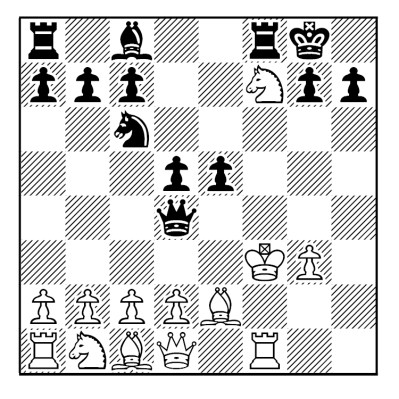
So here is the diagram which we eventually reached.

2019_05_15

1.Qa1+ Kxa1 (Obviously not 1…Ka3 due to 2.Qc3+ Ka4 3.Bb5+! Kxb5 4.Qc5+ Ka4 5.a8=Q+. My space-traveling friend, being a quick learner, figured this out and avoided it. Besides, there was another point to his move.)


2.Kc2 (with the idea of Bd4#) 2…h1=K!

(Whoa! I started to tell him that was an illegal move. To which he replied, “Didn’t you tell me that a pawn reaching the last rank, could become any piece? And I want another king”.

I had to admit he was right. What to do now? If I leave both kings on the board, it would seem likely I would stalemate one of them, and possibly both. I looked at his smug expression. It knew the problems I faced. But then I had moment of inspiration.)

 
3.a8=K! (Now he had at least one move that didn’t result in stalemate.) 3…Kb8 (forced.)

 
4.h7 Ka8 (again forced.)

5.h8=Q mate, mate, mate!

Books I Love

I had a recent discussion with a chess friend of mine. The topic? Chess!, of course.


One interesting topic we covered was answering the question, “What is your favorite chess books you ever read?”


Well, my friend a Dragon junkie, said any book with the Dragon can’t be bad.


I take a slightly different approach about chess books. I love to read and read chess books not so much for instruction, but for enjoyment. So my list is slightly different from most other chess zealots.


First on the list is 1000 Best Short Games of Chess by Chernev, who, with his annotations, make all the miniatures of his book so joyous. One characteristic of Chernev I hope current and future chess writers would seek to emulate is to keep the text and notes to a minimum and let the reader have some space to actually ENJOY the game.


Another book with the same approach is Morphy’s Games of Chess by Sergeant. Notes about the game, and people who played them, are simple and short and they don’t get in the way of the game.


1001 Brilliant Ways to Checkmate by Reinfeld. Isn’t that the preferred goal of playing every game? Also it’s a good primer for Siamese Chess. 

 
Soltis’ Chess to Enjoy, is exactly that. It is at times, hilarious, thought-provoking, and at all times, entertaining.


17140.5f75786a.5000x5000o.0ff78dae4615
The best periodical, IMHO (for all those who don’t speak Internetse, is short for In My Humble Opinion), are the New In Chess Yearbooks. If you ever want to study an opening, or even a minor variation of an opening, in great detail, then these books are for you! The games covered in each opening are plentiful and there is enough space between the games and the individual moves of the game to keep you from getting yourself a major eye strain.


Do you have some favorites in your chess library? Why do you like them? Leave us a message! =)

PETS PLAYING CHESS

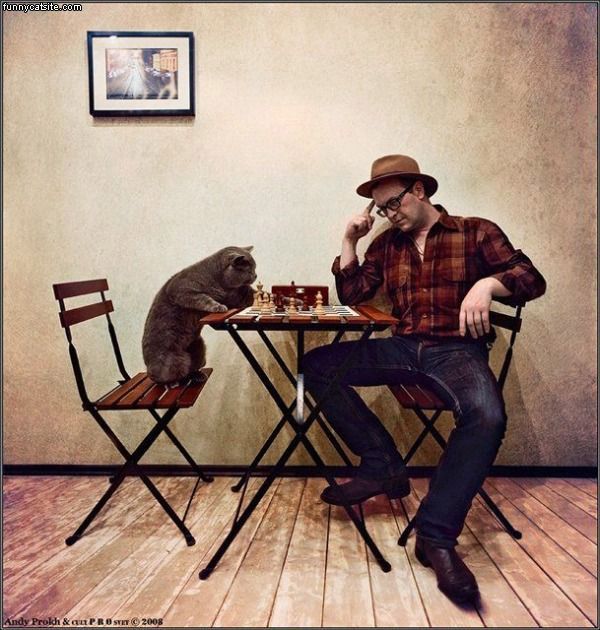
Pets are loveably, cute, cuddly, and can play a tough game of chess.


You might not believe it, but they actually do play chess. Here are some photos showing what I mean.

Chess_Cat682


cat


565400_l


1e0679j7e49240hachpobhc9l1529ea8fdc8fc8


It’s been noted that pets tend to win more than 80% of the games played to completion. Of the 20% that they did not win occurred when the pet got bored with the game when the losing human player didn’t finish the game, and they walked away from the board on all four paws.


Remember that next time you hear a stupid pet joke.