Happy Thanksgiving!

Happy Thanksgiving!


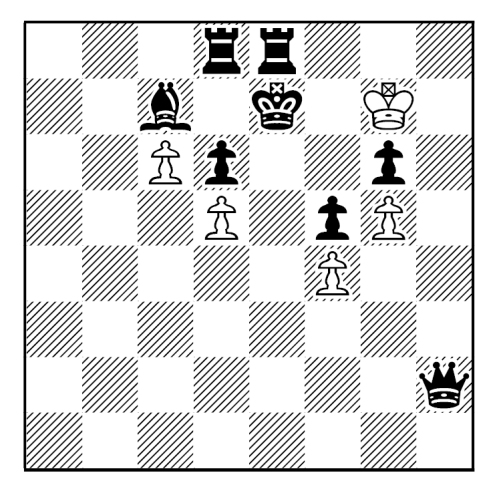
Let’s first start off with the answers from last week’s simple (or maybe not-so simple) problems.


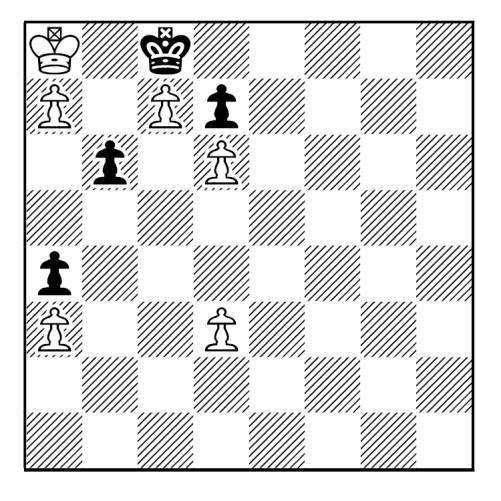
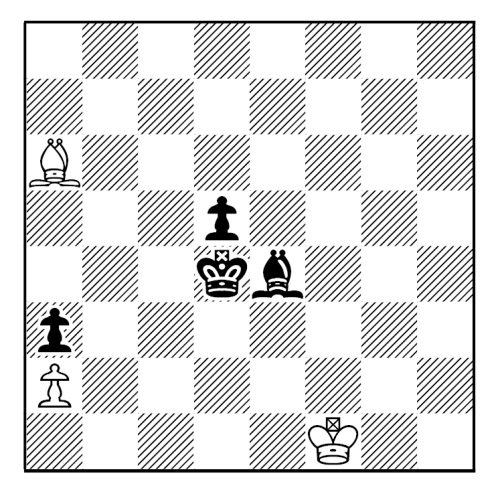
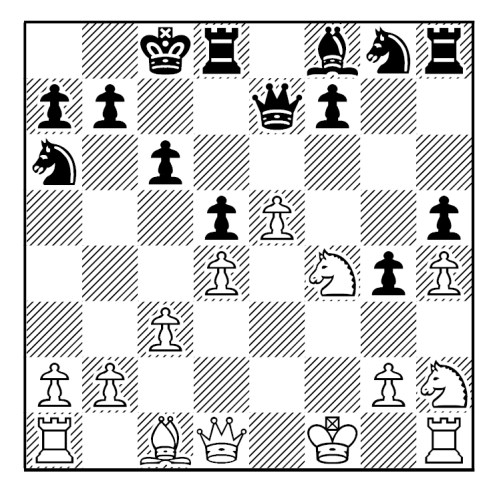
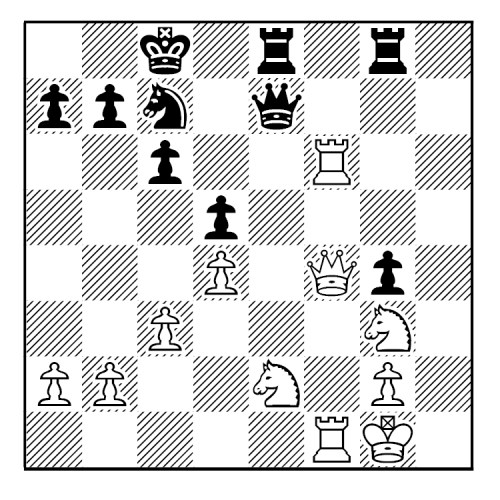
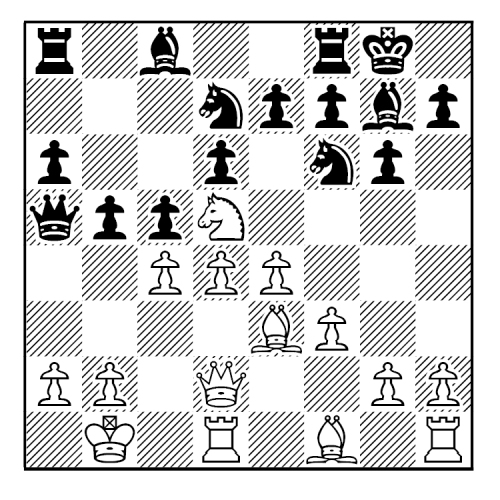
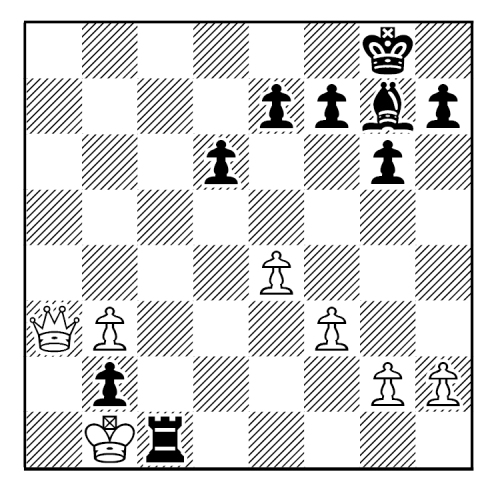
(1)  This one is very easy. White can only make legal moves. So, he must play 1.d4. And Black can only respond with 1… b5. The problem continues with 2.d5 b4 3.axb4 a3 4.c5, and mate cannot be avoided.


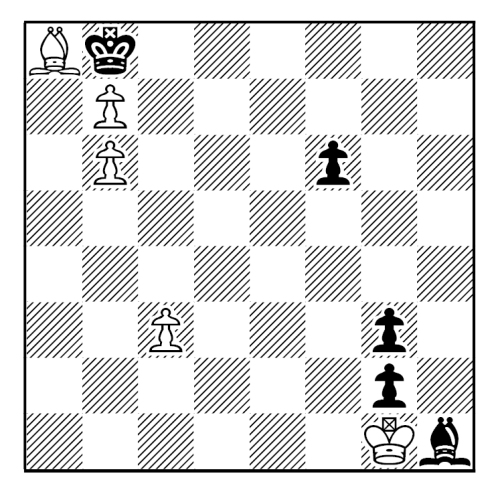
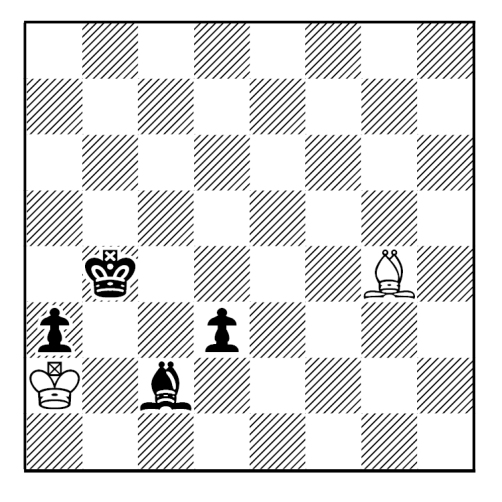
(2) Cook’s problem also can be solved with just making the only legal moves available. 1.c4 leads directly to mate. Incidentally, if it is Black to move in this position, he also mates with legal moves, starting with 1…f5.


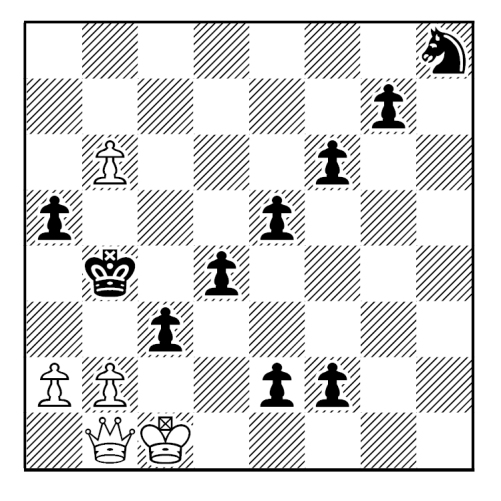
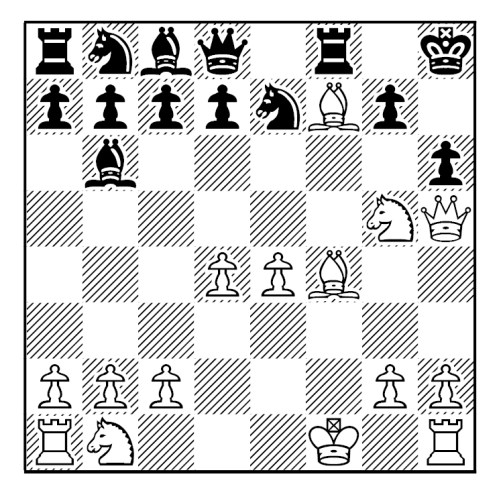
(3) Black threatens promoting and winning with his two pawns on the seventh rank. White must therefore check to have any chances at winning.


White must play 1.bxc3+. If Black king was to step on a white square, White would immediately have winning endgame after Qb3+. Black then has to stay on the dark squares and plays 1….Kc5. And White continues with 2.cxd4+. If you can see the pattern forming you figure out the rest.


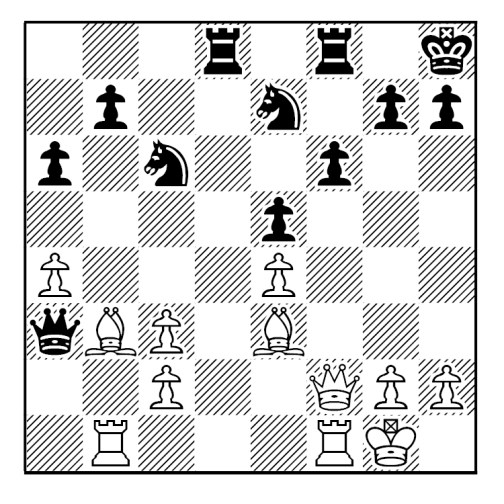
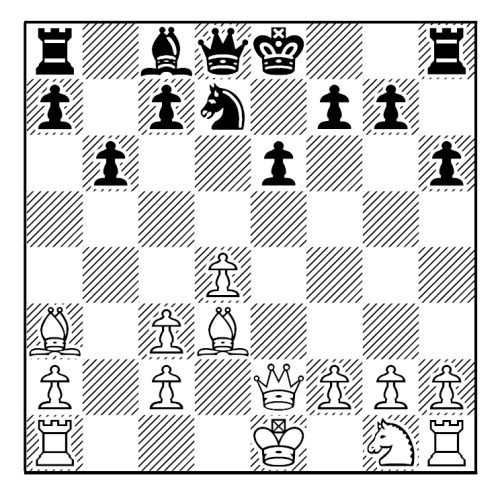
(4) Since it is White to play and win Black must have made the last legal move. But which one would let White win?


To save a little time, I’ll just mention that Black’s last move was 1…f7-f5. Now you can figure it out.


~~~~~~~~~~~~~~~~~~~~~~~~~~~~~~~~~~~~~~~~~~~~~~~~~~~~~~


There are a number of chess tournaments being held this weekend. Perhaps the best well-known is the American Open, being held in Costa Mesa, California. See website for details:


http://www.americanopen.org/


~~~~~~~~~~~~~~~~~~~~~~~~~~~~~~~~~~~~~~~~~~~~~~~~~~~~~~


One thing I enjoy about chess is the endless possibilities for exploration. Here is a recent blitz game, and maybe I’m wrong, but it rapidly goes into new territory.


Escalante-“GGRap”
Blitz Game
Chess.com, Nov. 23 2019
1.e4 c5 2.Nf3 Nc6 3.d4 cxd4 4.Nxd4 e6 5.Nc3 Bb4 6.Be2?!


[Theory recommends Nxc6 on this move or the next. Here is a game showing at least one possibility of the Nxc6.


Sadek (2183)-El Ghazali (2362)
Golden Cleopatra
Cairo, Apr. 7 2002
1.c4 c5 2.e4 Nc6 3.Ne2 Nf6 4.Nbc3 e6 5.d4 cxd4 6.Nxd4 Bb4 7.Nxc6 bxc6 8.Bd3 Bxc3+ 9.bxc3 Qa5 10.O-O O-O 11.Be3 Ba6 12.c5 Bxd3 13.Qxd3 Ng4 14.Rfd1 Rab8 15.h3 Nxe3 16.Qxe3 Rb5 17.Rxd7 Rxc5 18.Rb1 a6 19.Rbb7 Rxc3 20.Qf4 e5 21.Rxf7 Rc1+ 22.Kh2 1-0.


But I didn’t want to play it. Blitz games can help you learn more about your pet opening in two ways. One, it is a good way to try out new ideas, and two, it is a way to find out why a suggested move is usually better than one’s own idea. Here’s a game to try out a different, but not necessarily better, move.]


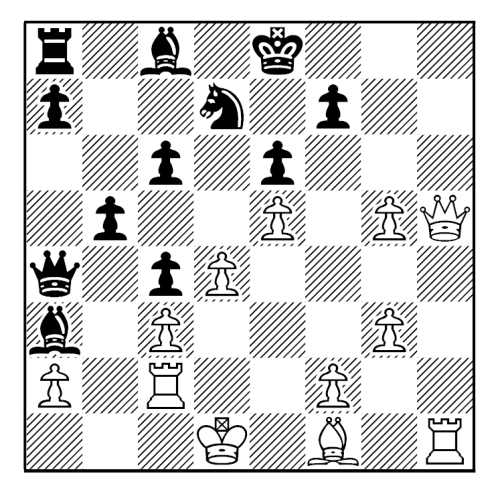
6…Nge7 7.O-O O-O 8.Be3 Bxc3 (8…d5 is better for Black as it opens lines for a possible attack.) 9.bxc3 a6 10.a4?! (OK, this move doesn’t do much other than gain space for White on the queenside. Perhaps better is still Nxc6!?) 10…Qc7 11.Qd2 d6 12.f4 f6?! (Black should keep developing with 12…Bd7. He soon falls behind in development and piece play.) 13.Rab1 e5 14.fxe5 dxe5 15.Bc4+! Kh8 16.Ne6 Bxe6 17.Bxe6 Rad8 18.Qf2 Qd6 19.Ba2 Qa3? (Black gets greedy and being behind in development category is not good for his game.) 20.Bb3!


2019_11_28
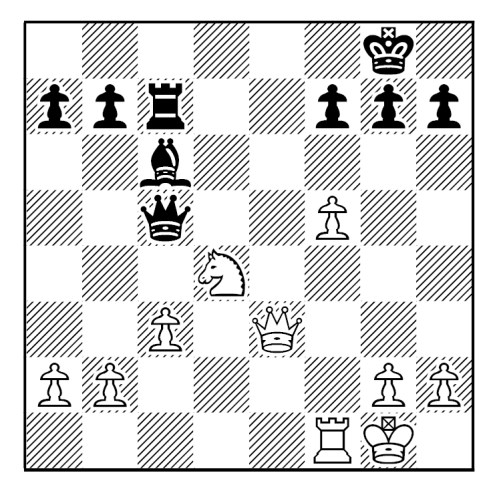
20…Rd7?? (Black should admit his mistake and move his queen back to d6, with White having an advantage, but not necessarily a winning one.)  21.Bc5!! (Now White has winning advantage as Black’s queen is trapped.) 21…Rfd8 22.Bxa3 Rd2 23.Qe3 Ng6 24.Bd5 Nf4 25.Qxd2 Nxd5 26.exd5 Na5 27.Qd3 1-0


Easy Problems?

Chess problems are not supposed to be easy. After all, that is why they are known as “problems”.

 
Nevertheless, there are some problems that are easy to solve. One just has to know how the pieces move, add in a little logic thought, and the solution readily presents itself.

 
We’ll start with the easiest and move onto the ones that are a little more difficult (but still easy) to solve.


All are White to move and eventually mate.


2019_11_21_A

Ropke, no date


2019_11_21_B

E.B. Cook, 1926


2019_11_21_C

Korolkov, 1958
[Hint: The black pawns are ready to promote and check the White king.]


2019_11_21_D

Escalante, 1994
[Hint: Black is threatening mate in one, three different ways.]


Solutions, in case you need them, will be presented next Thursday.

An Introduction to Chess Poetry

Book_Chess_Poems


Many poems and the like have been written about chess. They range from the simple to the epic, from the silly to the serious, and can include the profound and philosophical.


We’ll start with the simple, and sometimes, silly limerick.


~~~~~~~~~~~~~~~~~~~~~~~~~~~~~~~~~~~~~~~~~~~


The first two are from NM Bill Wall.


(1)

There once was a player from Maine,
Who played chess on a fast train.
He took a move back
And was thrown off the track,
And he never played chess again.


(2)

Postal chess is still played today
And no reason why I shouldn’t play.
It is nice and slow,
And I can use my ECO,
It’s the postage I can’t afford to pay.


With the Internet now, you don’t have to pay postage.


~~~~~~~~~~~~~~~~~~~~~~~~~~~~~~~~~~~~~~~~~~~

 
Here’s an old classic, first appearing in Chess Potpourri by Alfred C. Klahre (Middletown, 1931). It’s titled, “The Solver’s Plight


There was a man from Vancouver
Who tried to solve a two-mover;
But the boob, he said, ‘“Gee”,
I can’t find the “Kee”,
No matter HOW I manouvre.’

 
Like most people, I also prefer original material, always searching for something new.

 
A short poem that perfectly illustrates the frustrations of that search.
Some Editors – pretend to edit –
Use scissors and paste and give no credit.

(Columbia Chess Chronicle, 20 August 1887, page 66.)


Another short one. This one is slightly whimsical and yet, very accurate.


Chess is such a noble game,
How it does the soul inflame!
Ever brilliant, ever new,
Surely chess has not its due;
Sad to say, ’tis known to few!


Poem written by W. Harris and printed in the book, “A Complete Guide to the Game of Chess”(1882).


By The Way (or BTW in Internet lingo), the poem is also an acrostic. We’ll let you figure it out! =)


~~~~~~~~~~~~~~~~~~~~~~~~~~~~~~~~~~~~~~~~~~~

 
For another poem that is simply a delight, here is one by Alan Hall and printed in CHESS POST, Volume 33, No. 3 (or the June 1995 issue).


The Game of Chess


A poem about chess? Well, there’s an idea.
Hopefully this one will be one to hear.
What of the pieces? I’ll take them in turn.
And try to tell how each it’s living does earn.
The pawns can move straight or diagonally
Depending on whether it’s taking, you see.
Next comes the bishop – it moves across,
Of diagonals it is the boss.
Then there is the knight – some call it a horse
From its siblings it pursues a quite different
course.
One square diagonally, then one straight.
It’s so crafty, you start to hate
It when you’ve lost to its smothered mate.
Stronger still than all these is rook.
If you’ve got two of them, you’re in luck.
The you may even beat the might queen.
A rook and bishop combined, she reigns
supreme.

 
Last, but not least, is the humble king.
When you’ve mated him, you can sing.
Well, that’s all the pieces that make this game
of chess.


The playing of which can bring happiness.


~~~~~~~~~~~~~~~~~~~~~~~~~~~~~~~~~~~~~~~~~~~


We’ll end here with an appropriate form of poetry; the epitaph.


Surprisingly, chess epitaphs are more common than you might believe. Here is the best on I could find. It was written by Lord Dunsany (who was a chess player among many other inspired pursuits) and it was for Capablanca, first published in the June 1942 issue of CHESS (pg. 131).


Now rests a mind as keen,
A vision bright and clear
As any that has been
And who is it lies here?
One that, erstwhile, no less
Than Hindenburg could plan,
But played his game of chess
And did no harm to man.


If we could only aspire to be so talented and noble.


~~~~~~~~~~~~~~~~~~~~~~~~~~~~~~~~~~~~~~~~~~~

 
Here’s two games related to the poems, or rather the poets that created them.


Jim Murray (1876)-Alan Hall (1746)
Isle of Man Open – Major
Chess.com, Sept. 26 2017
[A52]
1.d4 Nf6 2.c4 e5!? (The Budapest is a surprising response for Mr. Hall, who regularly employs more solid and safe openings such as the London System. Nevertheless, he makes a fair attempt at winning the game.) 3.dxe5 Ng4 4.Nf3 Nc6 5.e3 Ngxe5 6.Be2 Bb4+ 7.Bd2 Bxd2+ 8.Qxd2 d6?! (Black usually plays either 8…O-O or 8…Nxf3+. The text move allows White to simplify with 9.Nxe5!? dxe5 10.Qxd8+.) 9.O-O Be6 10.b3 O-O 11.Nc3 h6 12.Rad1 Qd7 13.Nxe5 Nxe5 14.f4 Ng6 15.e4 f5 16.e5 Rfd8 17.Qe3 Qe7 18.Bh5 Nh8 19.Nd5 Bxd5 20.cxd5 g6 21.Be2 a6 22.g4 Rf8 23.Kh1 Rae8 24.e6 c6 25.gxf5 Rxf5 26.dxc6 bxc6 27.Bg4 Rf6 28.Qd3 Ref8 29.Qxd6 Qxd6 30.Rxd6 g5 31.Rd7 Ng6 32.f5 Ne5 33.Rd4 Nxg4 34.Rxg4 Rxf5 35.Rxf5 Rxf5 36.Rc4 c5 37.Ra4 Kf8 38.Rxa6 Ke7 39.Kg2 h5 40.a4 Re5 41.Kf2 g4 42.Rc6 h4 43.a5 Rf5+ 44.Kg2 Rd5 45.a6 Rd2+ 46.Kg1 Rd1+ 47.Kf2 Rd2+ 48.Kg1 1/2-1/2


Capablanca-Lord Dunsany
Simul
Selfridges, London, Apr. 12 1929
[C70]
1.e4 e5 2.Nf3 Nc6 3.Bb5 a6 4.Ba4 b5 5.Bb3 Nf6 6.Ng5 d5 7.exd5

[After 7…Nxd5 8.Nxf7 Kxf7 9.Qf3+ Ke6 10.Nc3 Nce7 11.d4, we reach a position very similar to the Fried Liver Attack. Capablanca decided not to play into it. Apparently he remembered this game:

Capablanca-Pagliano & Elias
Consultation Game
Buenos Aires, June 1911
7.exd5 Nxd5 8.Nxf7 Kxf7 9.Qf3+ Ke6 10.Nc3 Nce7 11.d4 Bb7 12.Bg5 c6 13.O-O-O h6 14.Ne4 Qc7 15.Nc5+ Kd6 16.dxe5+ Kxc5 17.Be3+ Kb4 18.Bd2+ Kc5 19.Bxd5 Nxd5 20.Be3+ Kb4 21.Bd2+ Kc5 22.Be3+ Kb4 23.a3+ Ka4 24.b3+ Kxa3 25.Bd2 Bb4 26.c3 Qxe5 27.Kc2 Bxc3 28.Bxc3 Nxc3 29.Rhe1 Qc5 30.Qxc3 Qxf2+ 31.Rd2 Qf5+ 32.Kc1 Qf6 33.Qa5+ Kxb3 34.Re3+ Kc4 35.Rc2+ Kd5 36.Qd2+ Qd4 37.Rd3 c5 38.Rxd4+ cxd4 39.Qd3 Rab8 40.Qf5+ Kd6 41.Qc5+ Ke6 42.Re2+ Kf7 43.Re7+ Kg8 44.Rxb7 Rxb7 45.Qd5+ Kh7 46.Qe4+ Kg8 47.Qxb7 Kh7 48.Qe4+ Kg8 49.Qxd4 Kh7 50.Qe4+ Kg8 51.Qa8+ 1-0.]

7…Ne7 8.d6 Ned5 9.dxc7 Qxc7 10.Nc3 Bb7 11.a4 b4 12.Nxd5 Bxd5 13.Bxd5 Nxd5 14.O-O Be7 15.d4 O-O 16.dxe5 Qxe5 17.Re1 Qd6 18.Ne4 Qc6 19.Bg5 Bxg5 20.Nxg5 Rac8 21.Qf3 Nf6 22.Re2 h6 23.Qxc6 Rxc6 24.Nf3 a5 25.Nd4 Rc5 26.Nb3 Rd5 27.Rae1 Nd7 28.Re4 Nb6 29.Re5 Rfd8 30.Rxd5 Rxd5 31.Kf1 Nxa4 1/2-1/2


Blindfold Games


blindfold+ Chess_Board_Start


In a blindfold game, at least one of the players is not allowed to see the board. Most of the time, however, this means one player is playing a simul of which he cannot see either the boards or the players. And while the term “blindfold” may imply that the said player is wearing a blindfold, he does not. Instead, he would usually have his back turned to the players and boards, calling out his moves to the game.


A “caller” would then announce the moves of the other players while a “referee” would make the moves on the boards on behalf of the blindfold player.


If a blindfold is used, it is usually to amuse the participants. After all, such blindfold feats are performed for amusement, amazement, and enjoyment for the participants and promotion of the game.

Here are some of my favorites.


Morphy-Carr
Blindfold Simul
Birmingham, Aug. 27 1858
[J. Lowenthal]
1.e4 h6 2.d4 a5 3.Bd3 b6 4.Ne2 e6 5.O-O Ba6 (This series of unusual moves was no doubt adopted with the view of embarrassing the blindfold player, in place of which it served to allow him to bring out his pieces and secure victory in a shorter space of time.) 6.c4 Nf6 7.e5 Nh7 8.f4 Be7 9.Ng3 d5 10.Qg4 O-O 11.Nh5 g5 12.fxg5 hxg5 (Black has indeed placed himself in a deplorable condition in vainly attempting to puzzle his antagonist.) 13.Bxh7+ (Nf6+ would also have led to a speedy termination.) 13…Kh8 14.Nf6 dxc4 15.Bc2 Qxd4+ 16.Qxd4 Bc5 17.Qxc5 bxc5 18.Bxg5 Nc6 19.Rf3 (Threatening mate in two moves.) 19…Kg7 20.Bh6+ Kxh6 21.Rh3+ Kg5 22.Rh5+ Kf4 23.Kf2 (Terminating the game in masterly style, and giving it an interest, from the nature of the opening, which we had not looked.) 1-0


Tarrasch-Landau
Blindfold Game, 1880
1.e4 e5 2.Nf3 Nc6 3.Bc4 Nf6 4.d4 exd4 5.O-O d5 6.exd5 (This move opens the game too much for Black. Safer is 5…d6.) 5…Nxd5 7.Nxd4 Nxd4 8.Qxd4 Be6 9.Re1 c6 10.Nc3 Nxc3 11.Qxc3 Qd7 12.Bg5 Be7 13.Rad1 Qc8 14.Qxg7 +-

2019_11_07_A
14…Bxg5 15.Qxh8+ Ke7 16.Qg7 Qg8 17.Rxe6mate 1-0


N.N.-Blackburne
Casual game
London, 1884
[Blackburne]
1.e4 e5 2.Nf3 Nc6 3.Bc4 Bc5 4.Bxf7+ Kxf7 5.Nxe5+ Nxe5 6.Qh5+ (Note – I used to call this the Kentucky opening. For a while after its introduction it was greatly favored by certain players, but they soon grew tired of it.) 6…g6 7.Qxe5 d6 (Not to be outdone in generosity.) 8.Qxh8 Qh4 9.O-O Nf6 10.c3 Ng4 11.h3 Bxf2+ 12.Kh1 Bf5! 13.Qxa8

2019_11_07_B
13…Qxh3+ 14.gxh3 Bxe4mate 0-1


Zukertort-Gerold
Blindfold Exhibition, 1885
1.e4 e5 2.Nf3 Nc6 3.Bc4 Nf6 4.Ng5 d5 5.exd5 Nxd5 6.Nxf7 Kxf7 7.Qf3+ Ke6 8.Nc3 Ne7 9.d4 h6 10.O-O c6 11.dxe5 Nf5 12.Rd1 Ne7 13.Be3 b6 14.Rd2 Bb7 15.Rad1 Qd7 16.Qh3+ Nf5 17.Nxd5 cxd5 18.Bxd5+ Bxd5 19.Rxd5 Qc7 20.Qg4 g5 21.Qe4 Be7 22.Rd6+ Kf7 23.Qxf5+ Ke8 24.Rd7 Rd8 25.e6 Rxd7 26.Rxd7 Qxd7 27.exd7+ 1-0


H. Mela Jr.-Franco de Freitas
Blindfold Simul – 2 boards, 1996
1.e4 e5 2.Nf3 Nc6 3.Bc4 Nf6 4.Ng5 d5 5.exd5 Nxd5 6.Nxf7 Kxf7 7.Qf3+ Ke6 8.Nc3 Nb4 9.Qe4 a6 10.d4 c6 11.a3 Qa5 12.axb4 Qxa1 13.Nxd5 Qxc1+ 14.Ke2 Qxh1 15.Qxe5+ Kd7 16.Qc7+ Ke8 17.Nf6+ gxf6 18.Bf7mate 1-0


Gonssiorovsky-Alekhine
Blindfold Game
Odessa, 1918
1.e4 e5 2.Bc4 Nf6 3.d3 c6 4.Qe2 Be7 5.f4 d5 6.exd5 exf4 7.Bxf4 O-O 8.Nd2 cxd5 9.Bb3 a5 10.c3 a4 11.Bc2 a3 12.b3? (White creates a fundamental weakness in his castled position. But what else can he do? If he doesn’t play this move, then Black can put tremendous pressure on his queenside with moves like …Qa5, …Be6, and White is forced to play defence for the rest of the game.) 12…Re8 13.O-O-O Bb4 14.Qf2 Bxc3 15.Bg5 Nc6 16.Ngf3 d4! (Black entombs the king. The rest of the game is a completion of the task – which Alekhine does in a most spectacular way.) 17.Rhe1 Bb2+ 18.Kb1

2019_11_07_C
18…Nd5! (The Queen is offered for the first time.) 19.Rxe8+ (Naturally 19.Bxd8 fails to 19…Nc3#) 19…Qxe8 20.Ne4 Qxe4! (The second offer!) 21.Bd2 Qe3 (The third offer!) 22.Re1 (Now White gets into the act!) 22…Bf5 23.Rxe3 dxe3 24.Qf1 exd2 25.Bd1 Ncb4! (And White finally realizes that he cannot stop Nc3#) 0-1


Alekhine-Feldt
Blindfold Simul
Odessa, 1916
1.e4 e6 2.d4 d5 3.Nc3 Nf6 4.exd5 Nxd5 (The more modern move is 5…exd5.) 5.Ne4 f5? 6.Ng5 Be7 7.N5f3 c6 8.Ne5 O-O 9.Ngf3 b6 10.Bd3 Bb7 11.O-O Re8 12.c4 Nf6 13.Bf4 Nbd7 14.Qe2 c5

2019_11_07_D
15.Nf7!! Kxf7 (15…Qc8 16.Qxe6 and White threatens 17.Nh6+, with mate to follow.) 16.Qxe6+!! (He goes there anyway!) 16…Kg6 (16…Kxe6 17.Ng5#) 17.g4 Be4 18.Nh4mate 1-0


George Koltanowski-Enrique Garcia
Blindfold Simul
Havana, 1939
1.e4 c5 2.b4!? (Koltanowski used the Wing Gambit against unsuspecting opponents in simuls. He knew the theory; they usually didn’t. This game is an example.) 2…e6 3.bxc5 Bxc5 4.d4 Bb4+ 5.c3 Be7 6.Bd3 Nf6 7.Ne2 Nc6 8.O-O O-O 9.f4 d6 10.h3 Re8 11.Nd2 Bf8 12.Nf3 d5 13.e5 Ne4 14.Qc2 f5 15.exf6 gxf6 16.Bxe4 dxe4 17.Qxe4 f5 18.Qb1 Re7 19.Ba3 Rg7 20.Bxf8 Kxf8 21.Qb3 Na5 22.Qb4+ Kg8 23.Nc1 Qd5 24.Nd3 b6 25.Rf2 Bb7 26.Re1 h6 27.Nde5 Kh7 28.Qb1 Kh8 29.Kh2 Nc4 30.Nxc4 Qxc4 31.Qb3 Bd5 32.Qxc4 Bxc4 33.Ne5 Bd5 34.g4 Rag8 35.c4 Be4 36.Re3 Rd8 37.Rd2 Rdg8 38.d5 exd5 39.cxd5 Rc7 40.d6 1-0


George Koltanowski-Humphrey Bogart (yes, that Bogart!)
Blindfold Exhibition
San Francisco, 1952
1.e4 e6 2.d4 d5 3.exd5 exd5 4.Bd3 Nf6 5.Ne2

[This is a tricky position. White varied with the seemingly better 5.Bg5, but lost after 5…Bd6 6.Ne2 O-O 7.Nbc3 c6 8.Qd2 b5 9.O-O Bg4 10.Rae1 Nbd7 11.Nd1 Qc7 12.Ng3 Rfe8 13.c3 Ne4 14.Nxe4 Bxh2+ 15.Kh1 dxe4 16.Bxe4 Qd6 17.Qd3 Bf4 18.Bxf4 Qxf4 19.Bxh7+ Kf8 20.Be4 Re6 (White has a problem – how does he stop 21.Rh6+?) 21.Bf3 Rh6+ (He doesn’t.) 0-1 (Garcia Galan Ruiz-Ortega Gonzalez (1905), Malaga Open, Spain, Feb. 23 2010).]

5…Bg4 6.O-O Bd6 7.f3 Be6 8.Bf4 O-O 9.Nd2 Nc6 10.c3 Ne7 11.Bxd6 Qxd6 12.f4 c5 13.Nf3 Nf5 14.Qd2 Ne4 15.Qc1 Rac8 16.dxc5 Qxc5+ 17.Ned4 Nxd4 18.Nxd4 Rc7 19.f5 Bd7 20.Bxe4 dxe4 21.Qf4 Re8 22.Rae1 Re5 23.Rxe4 Rxe4 24.Qxe4 Bc6 25.Qe3 (White has the advantage due to the open lines.)

2019_11_07_E
25…Re7 26.Qg3 Re8 27.f6 g6 28.Qh4 h5 29.Re1 Rxe1+ 30.Qxe1 Qd6 31.Nxc6 Qxc6 32.Qe7 Qc8 33.h3 Qc6 34.b4 Qxc3 35.Qe8+ Kh7 36.Qxf7+ Kh6 37.Qe7 Qc1+ 38.Kf2 (The game is drawn after 38.Kh2?? Qf4+.) 38…Qf4+ 39.Ke2 Qc4+ 40.Kf3 Kg5 41.f7+ 1-0

Gambit of the Day

Halloween_Gambit


Today, being Halloween, we present an appropriately named gambit for the day.


The Halloween Gambit, played since the 19th century, has never been popular. Among the reasons is that most players do not want to sacrifice a piece early in the opening, more so if the continuation of the game does not directly involve attacking the enemy king, or at least allowing him to say, “check!”


The opening move are 1.e4 e5 2.Nf3 Nc6 3.Nc3 Nf6 4.Nxe5. With this move White willing gives up his knight with the idea to gain tempi on the opposing knight that  just captured his knight.


Let’s take a look at some lines.


First of all, Black does NOT to take White’s knight. By ignoring the knight on e5, he is effectively playing a gambit of his own. But his counterplay is less that White’s.


~~~~ 4.Nxe5 Bc5 ~~~~


Schlechter-Marshall
Monte Carlo, 1903
1.e4 e5 2.Nf3 Nc6 3.Nc3 Bc5 4.Nxe5 Nf6 5.Be2 (Black would welcome 5.Nxc6? dxc6 6.Bc4 as he has winning game after 6…Bxf2+! 7.Kxf2 Qd4+.) 5…Nxe5 6.d4 Bd6 7.O-O Nc6 8.e5 Nxe5 9.dxe5 Bxe5 10.Bd3 d6 11.Bg5 h6 12.Bh4 g5 13.Bg3 Bg4 14.Qd2 Qe7 15.Rae1 O-O-O

2019_10_31_A

16.Qe3! (Inducing a weakness in Black’s castled position.) 16…b6 (16…Kb8? leads to a worse position after 17.Nb5 c5.) 17.a4 Kb8 18.a5 Bc8 19.axb6 axb6 20.Nb5 Bb7 21.Be2 Rhe8 22.Qa3 c6 23.Qa7+ Kc8 24.Na3 Kc7 25.Ba6 Rb8 26.Nc4 Nd7 27.Rxe5 dxe5 28.Bxe5+ Nxe5 29.Qxb6+ Kd7 30.Bxb7 Ke6 31.Nxe5 Qxb7 32.Qe3 f6 33.Nc4+ Kd5 34.Qd3+ Kc5 35.Nd6 Qxb2 36.c3 Kb6 37.Nc4+ (Winning the queen and the game.) 1-0


Wolf-Marshall
Monte Carlo, 1903
1.e4 e5 2.Nf3 Nc6 3.Nc3 Bc5 4.Nxe5 Nf6 5.Be2 Nxe5 6.d4 Bd6 7.dxe5 Bxe5 8.Nb1 O-O 9.f4 Nxe4 10.Qd5 Qh4+ 11.g3 Nxg3 12.hxg3 Qxg3+ 13.Kd1 Bf6 14.Qd3 Qxd3+ 15.Bxd3 h6 16.Nc3 Bxc3 17.bxc3 d5 18.f5 Re8 19.Rg1 Kh7 20.Bf4 c5 21.f6+ g6 22.Bd6 Re6 23.Be7 c4 24.Be2 Re3 25.Kd2 Rh3 26.Rh1 Rxh1 27.Rxh1 Be6 28.Ke3 g5 29.Bh5 Rc8 30.Kd4 Rg8 31.Re1 Rc8 32.Rxe6 fxe6 33.Ke5 b5 34.Kxe6 d4 35.cxd4 a5 36.f7 Kg7 37.f8=Q+ Rxf8 38.Bxf8+ Kxf8 39.d5 b4 40.d6 b3 41.d7 1-0


Jacopo Motola (2217)-Giuseppe Bisignano (1864)
Open Carnevale
Milan, Feb. 18 2015
1.e4 e5 2.Nf3 Nf6 3.Nc3 Bc5 4.Nxe5 Nc6 5.Nxc6 dxc6 6.Be2 Be6 7.d3 Qd7 8.h3 b5 9.a3 O-O 10.Bg5 Bd4 11.Qd2 Rab8 12.Be3 c5 13.Nd1 Qc6 14.Bf3 Qb6 15.c3 Bxe3 16.fxe3 Rfd8 17.Nf2 Nd7 18.Bg4 Ne5 19.Bxe6 Qxe6 20.Qe2 Rb6 21.O-O Qg6 22.d4 cxd4 23.exd4 Nc4 24.Nd3 Re8 25.Rae1 Qg5 26.e5 f6 27.b3 Nd2 28.Rf2 Nxb3 29.Qa2 1-0

 
Black, however, usually takes the knight. And White puts the question to Black’s knight after 5.d4. Neither 5…Nc4?! nor 5…Bb4 offer much.


~~~~ 4.Nxe5 Nxe5 5.d4 ~~~~


Weenink-Apsheniek
Prague Ol., 1931
1.e4 e5 2.Nc3 Nc6 3.Nf3 Nf6 4.d4 Bb4 5.Nxe5 Nxe5 6.dxe5 Nxe4 7.Qg4 Nxc3 8.Qxb4 Nd5 9.Qe4 Ne7 10.Bg5 d5 11.exd6 Qxd6 12.Bc4 Bf5 13.Qe2 Be6 14.Bxe6 Qxe6 15.Qxe6 fxe6 16.O-O-O h6 17.Bxe7 Kxe7 18.Rd3 Rhf8 19.f3 Rad8 20.Rhd1 Rxd3 21.Rxd3 Rf4 22.Kd2 Ra4 23.a3 Rh4 24.h3 Rh5 25.Ke3 Rg5 26.Kf2 Rb5 27.b3 Ra5 28.a4 Rc5 29.c4 a5 30.Ke3 b6 1/2-1/2


Chapman (2156)-Lindgren
Hallsberg Jr. Open
Sweden, Dec. 28 1972
1.e4 e5 2.Nf3 Nc6 3.Nc3 Nf6 4.d4 Bb4 5.Nxe5 Nxe5 6.dxe5 Nxe4 7.Qd4 Bxc3+ 8.bxc3 Ng5 9.Ba3 Ne6 10.Qd5 Qg5 11.Bc4 f6 12.exf6 Qxf6 13.O-O Rb8 14.Rae1 Kf7 15.Re3 Kg8 16.Rf3 Qd8 17.Qf5 Qf6 18.Qc5 d6 19.Rxf6 1-0


Frank-Remsted
Pinneberg Open, 1996
1.e4 e5 2.Nf3 Nc6 3.Nc3 Nf6 4.Nxe5 Nxe5 5.d4 Bb4 6.dxe5 Nxe4 7.Qd4 Bxc3+ 8.bxc3 f5 9.Bd3 Qe7 10.O-O d6 11.exd6 Nxd6 12.Ba3 O-O 13.Bc4+ Kh8 14.Rfe1 Qf6 15.Qxf6 gxf6 16.Rad1 Rd8 17.Re7 Rd7 18.Rxd6 Rxd6 19.Re8+ Kg7 20.Rg8+ Kh6 21.Bc1+ Kh5 22.Be2+ Kh4 23.g3+ 1-0


Nicolaisen (2035)-Brondum
Politiken Cup
Copenhagen, July 28 2000
1.e4 e5 2.Nf3 Nc6 3.Nc3 Nf6 4.d4 Bb4 5.Nxe5 Nxe5 6.dxe5 Nxe4 7.Qg4 Bxc3+ 8.bxc3 d5 9.Qxg7 Rf8 10.Bh6 Qe7 11.Qxf8+ Qxf8 12.Bxf8 Kxf8 13.Bd3 1-0


Legvold-Peller
Dos Hermanas
Internet Section 07B, Mar. 7 2004
1.e4 e5 2.Nf3 Nc6 3.Nc3 Nf6 4.Nxe5 Nxe5 5.d4 Nc4 6.Bxc4 Qe7 7.O-O Qb4 8.Bb3 d6 9.e5 Nd7 10.e6 fxe6 11.Bxe6 Be7 12.Nd5 Qa5 13.Bd2 Qa4 14.Nxc7+ Kd8 15.Nxa8 Qxd4 16.Ba5+ b6 17.Qxd4 bxa5 18.Qxa7 Rf8 1-0


Ankerst (2362)-Tokarchuk
Dos Hermanas
Internet Section 08B, Mar. 8 2004
1.e4 e5 2.Nf3 Nc6 3.Nc3 Nf6 4.d4 Bb4 5.Nxe5 Nxe5 6.dxe5 Bxc3+ 7.bxc3 Nxe4 8.Qg4 Nxc3 9.Qxg7 Rf8 10.Bg5 f6 11.Bxf6 Rxf6 12.exf6 Nd5 13.Qg8mate 1-0


Schoupal (1957)-Spalek (1572)
Brno II, Apr. 20 2004
1.e4 e5 2.Nf3 Nc6 3.Nc3 Nf6 4.Nxe5 Nxe5 5.d4 Bb4 6.dxe5 Bxc3+ 7.bxc3 Nxe4 8.Qg4 Nxc3 9.Qxg7 Rf8 10.Bg5 f6 11.Bxf6 Rf7 12.Qxf7+ Kxf7 13.Bxd8 d6 14.Bxc7 dxe5 15.Bxe5 1-0


Kurilov (2312)-Kovar (2238)
White Nights Open
St. Petersburg, June 25 2008
1.e4 e5 2.Nf3 Nc6 3.Nc3 Nf6 4.d4 Bb4 5.Nxe5 Nxe5 6.dxe5 Nxe4 7.Qg4 d5 8.Qxg7 Rf8 9.a3 Bxc3+ 10.bxc3 Qh4 11.g3 Qg4 12.Qxg4 Bxg4 13.Bg2 Nxc3 14.Bd2 Na4 15.Bh6 Rg8 16.Bxd5 Rg6 17.Be3 O-O-O 18.Bxf7 Rg7 19.e6 Bf3 20.O-O Rf8 21.Bd4 Rgxf7 22.exf7 Rxf7 23.Rfe1 c5 24.Be5 Nb6 25.a4 Nc4 26.Bf4 Kd7 27.Rab1 b6 28.Rb3 Bc6 29.Rc3 Na5 30.Rd3+ Kc8 31.Rde3 Bxa4 32.Re7 Rxe7 33.Rxe7 Bxc2 34.Rxa7 Nb7 35.Ra6 b5 36.Rc6+ Kd8 37.Rb6 Be4 38.Rxb5 Kd7 39.Rb6 c4 40.Be5 Nc5 41.Rd6+ Ke8 42.Bd4! (Either the knight or bishop is lost.) 1-0

 
Black has two reasonable options here.


One is static, and more or less stable, which slows down the play. The other is more dynamic, with chances for both sides.


We’ll take a look at the stable and static play first.


~~~~ 4.Nxe5 Nxe5 5.d4 Nc6 ~~~~

 
White can play 6.e5 or 6.d5. The first move obviously attacks the knight, but 6.d5 is more popular as White’s initiative is more positional and cramps Black. And White still has a later e5.
The 6.e5 continuation:

Riemann-Von Kraewel
Breslau, Mar. 26 1875
1.e4 e5 2.Nf3 Nc6 3.Nc3 Nf6 4.Nxe5 Nxe5 5.d4 Nc6 6.e5 Qe7 7.Be2 Ng8 8.Nd5 Qd8 9.O-O Bb4 10.c3 Ba5 11.Bc4 Nge7 12.Bg5 O-O 13.Nf6+ Kh8 (13…gxf6 14.Bxf6 d5 15.Qh5 Qe8 16.Qg5+ Ng6 17.Qh6) 14.Qh5 h6 15.Bxh6 Ng6 16.Bxg7+ Kxg7 17.Qh7mate 1-0


“fcpanginen” (1999)-“odirtyredo” (1725)
Halloween Gambit Thematic Tournament
http://www.chess.com, 2009
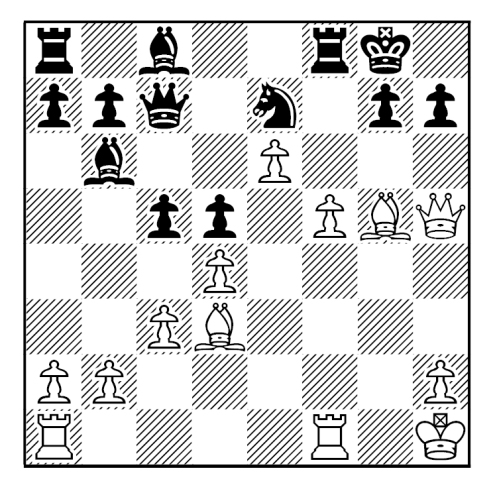
1.e4 e5 2.Nf3 Nc6 3.Nc3 Nf6 4.Nxe5 Nxe5 5.d4 Nc6 6.e5 Ng8 7.Be3 Bb4 8.Bc4 Nge7 9.O-O Ng6 10.Nd5 Ba5 11.c3 O-O 12.f4 Nce7 13.Nxe7+ Nxe7 14.f5 d5 15.Bd3 f6 16.e6 Bb6 17.g4 c6 18.g5 fxg5 19.Bxg5 Qc7 20.Qh5 c5
2019_10_31_B
21.f6! Ng6 22.f7+ Rxf7 23.exf7+ Kf8 24.Bxg6 cxd4 25.Qxh7 dxc3+ 26.Kh1 Bf5 27.Qh8mate 1-0

 
The 6.d5 continuation:


Grigor Minchev-Zoran Golubovic, 1990
1.e4 e5 2.Nf3 Nc6 3.Nc3 Nf6 4.Nxe5 Nxe5 5.d4 Nc6 6.d5 Ne5 7.f4 Ng6 8.e5 Qe7 9.Qe2 Ng8 10.d6 Qe6 11.Nb5 Bxd6 12.exd6 Qxe2+ 13.Bxe2 Kf8 14.f5 Ne5 15.dxc7 f6 16.Bf4 Ne7 17.O-O-O d5 18.Nd6 N5c6 19.Bf3 Bxf5 20.Nxf5 Nxf5 21.Bxd5 g5 22.Bxg5 fxg5 23.Rhf1 Ke7 24.Rxf5 Kd6 25.Rf7 h6 26.Bc4+ Kc5 27.Be6 a5 28.c8=Q Rhxc8 29.Bxc8 Rxc8 30.Rxb7 Re8 31.a4 Nd4 32.c3 Kc6 33.Rf7 Nb3+ 34.Kc2 Nc5 35.Rf6+ Re6 36.Rxe6+ Nxe6 37.b4 axb4 38.cxb4 Nf4 39.g3 Nd5 40.Rxd5 Kxd5 41.Kd3 Ke5 42.a5 Kd5 43.g4 Kc6 44.a6 Kb6 45.b5 1-0


R. Schlenker-D. Klostermann
Casual Game
Villingen-Schwenningen, Oct. 6 1993
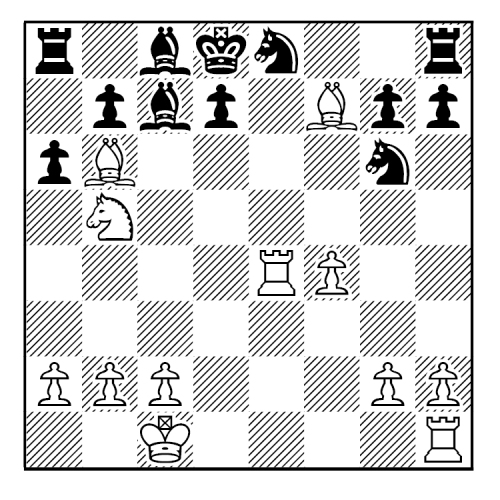
1.e4 e5 2.Nf3 Nc6 3.Nc3 Nf6 4.Nxe5 Nxe5 5.d4 Nc6 6.d5 Ne5 7.f4 Ng6 8.e5 Ng8 9.d6 cxd6 10.exd6 Qf6 11.Nb5 Kd8 12.Be3 Qe6 13.Qd4 Nf6 14.Bc4 Qe4 15.O-O-O Qxd4 16.Rxd4 Ne8 [16…a6 17.Re4 Nxe4 (17…axb5 18.Bb6# ; 17…Bxd6 18.Bb6+ Bc7 19.Bxc7#) 18.Bb6+ Ke8 19.Nc7+ Kd8 20.Bxf7!] 17.Bxf7 a6 18.Re4 Bxd6 19.Bb6+ Bc7
2019_10_31_C
20.Rhe1! d5 21.Rxe8+ Rxe8 22.Bxc7+ Kd7 23.Bxe8mate 1-0


Grigor Minchev-V. Velev
Bulgaria Students Tournament
Svishtov, Sept. 1994
1.e4 e5 2.Nf3 Nf6 3.Nc3 Nc6 4.Nxe5 Nxe5 5.d4 Nc6 6.d5 Ne5 7.f4 Ng6 8.e5 Ng8 9.d6 cxd6 10.exd6 Qa5 11.h4 Qb4 12.Qe2+ Kd8 13.f5 Nxh4 14.a3 Nxg2+ 15.Qxg2 Qxd6 16.Bd2 Qe5+ 17.Be2 Qxf5 18.O-O-O Qg6 19.Qxg6 fxg6 20.Nb5 Nf6 21.Bf4 Ne8 22.Be3 a6 23.Bb6+ Ke7 24.Rhe1 axb5 25.Bc4+ Kf6 26.Bd8+ Kf5 27.Rd5+ Kf4 28.Rd4+ Kg3 29.Bh4+ Kh2 30.Bd5 Bc5 31.Rh1mate 1-0


“Brause” (2575)-“GeorgeJohn” (2330)
Rated Blitz Match
ICS, 1997
1.e4 e5 2.Nf3 Nc6 3.Nc3 Nf6 4.Nxe5 Nxe5 5.d4 Nc6 6.d5 Bb4 7.dxc6 Nxe4 8.Qd4 Bxc3+?! 9.bxc3 Qe7 10.Qxg7 Nxc3+? (>10…Nf6+ 11.Be3 Rg8 12.Qh6 dxc6) 11.Be3 1-0


Zedtler Uwe-Winkler Andreas, 2002
1.e4 e5 2.Nf3 Nc6 3.Nc3 Nf6 4.Nxe5 Nxe5 5.d4 Nc6 6.d5 Ne5 7.f4 Ng6 8.e5 Bb4 9.Qd4 Bxc3+ 10.bxc3 Nh5 11.f5 Qh4+ 12.g3 (12…Qxd4 13.cxd4 Ne7 14.g4) 0-1


Pascutto-Simoni
E-Mail game
IECG, 2002
1.e4 e5 2.Nf3 Nc6 3.Nc3 Nf6 4.Nxe5 Nxe5 5.d4 Nc6 6.d5 Ne7 7.e5 Nfxd5 8.Nxd5 c6 9.Ne3 Qa5+ 10.Bd2 Qxe5 11.Bc3 Qe6 12.Be2 d5 13.O-O Qh6 14.Re1 Be6 15.Qd4 Nc8 16.Bd3 Bd6 17.Ng4 Bxh2+ 18.Kf1 Be5 19.Qxe5 Qh1+ 20.Ke2 Qxg2 21.Ne3 Qh3 22.Qxg7 Qh5+ 23.Kd2 Rf8 24.Ng4
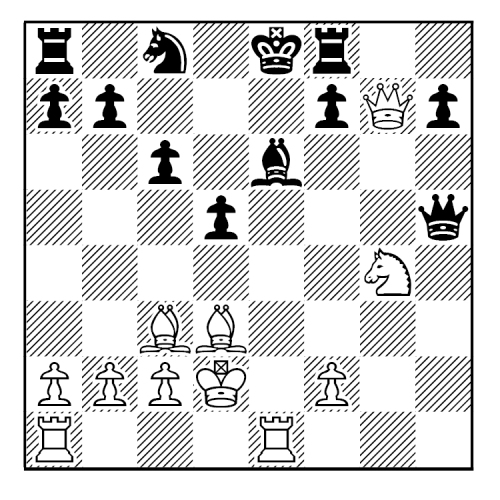
2019_10_31_D

(Black certainly has his problems. White threatens 25.Nf6+ winning the queen. If Black tries to escape via d7, then the knight checks wins again. And if …Kd8, then White again wins the queen with 25.Bf6+. Black’s best 24…Qh4 25.Nf6+ Ke7 26.Nxh7, which has the sole benefit of not losing immediately.) 24…Qxg4 25.Qxg4 Ne7 26.Rxe6 1-0


Bruno Gaillard (2035)-Alexandre Platel (2088)
French Team Ch., North, Feb. 1 2004
1.e4 e5 2.Nf3 Nc6 3.Nc3 Nf6 4.Nxe5 Nxe5 5.d4 Nc6 6.d5 Bb4 7.dxc6 Nxe4 8.Qd4 Qe7 9.Be3 O-O 10.Bd3 Nxc3 11.bxc3 Ba5 12.O-O Bb6 13.Qf4 Bxe3 14.fxe3 dxc6 15.Rab1 Rb8 16.Rb4 Be6 17.Qg3 g6 18.Rbf4 Rbe8 19.h4 Qc5 20.h5 Qxh5 21.Rh4 Qc5 22.Rh6 Kg7 23.Qh4 Qxe3+ 24.Rf2 Qxh6 25.Qf6+ Kg8 26.Rf4 Bf5 27.Rf3 Bxd3 28.cxd3 Qg7 29.Qf4 Qxc3 30.Rh3 Qe1+ 0-1


Roosink-Bergkamp
Haarlem Nova Open, July 2 2004
1.e4 e5 2.Nf3 Nc6 3.Nc3 Nf6 4.Nxe5 Nxe5 5.d4 Nc6 6.d5 Ne5 7.f4 Ng6 8.e5 Ne4 9.Nxe4 Bb4+ 10.c3 Ba5 11.d6 cxd6 12.Nxd6+ Kf8 13.Qd5 Qe7 14.Qxa5 b6 15.Qd5 Rb8 16.Nxf7 Rg8 17.Ng5 Bb7 18.Nxh7+ Ke8 19.Qxg8+ Nf8 20.Be2 Bxg2 21.Bh5+ Kd8 22.Nxf8 Kc7 23.Qc4+ Kd8 24.Ng6 Qe8 25.Rg1 Rc8 26.Qd4 Bh3 27.Rg5 a5 28.Qxb6+ Rc7 29.Be3 Be6 30.Qb8+ Rc8 31.Bb6mate 1-0


“Catalyst_Kh” (2655)-“odyson” (2405)
Halloween Gambit Thematic Tournament
http://www.chess.com, 2010
1.e4 e5 2.Nf3 Nc6 3.Nc3 Nf6 4.Nxe5 Nxe5 5.d4 Nc6 6.d5 Ne5 7.f4 Ng6 8.e5 Ng8 9.d6 cxd6 10.exd6 Qf6 11.Nb5 Nxf4 12.Nc7+ Kd8 13.Qf3 Bxd6 14.Nxa8 Qe5+ 15.Qe3 b6 16.Qxe5 Bxe5 17.g3 Bb7 18.gxf4 Bd4 19.c3 Bxa8 20.cxd4 Bxh1 21.Bc4 Nh6 22.Bd2 Re8+ 23.Kf2 Be4 24.Rg1 g6 25.a4 Bf5 26.Re1 Ng4+ 27.Kf3 Nxh2+ 28.Kg3 Rxe1 29.Bxe1 Ng4 30.Bxf7 Nf6 31.Bc4 Ne4+ 32.Kf3 Nd6 33.Be2 Be4+ 34.Ke3 Bc6 35.a5 Nf5+ 36.Kf2 Nxd4 37.Bd3 Bd5 38.Bc3 Nc6 39.axb6 axb6 40.f5 Bf7 41.f6 Kc7 42.Bb5 Kd6 43.Bxc6 dxc6 44.Kf3 Kd5 45.Kg4 c5 0-1


T. Klepaczka (2240)-Mi. Olszewski (2533)
Rapid Game
European Ch.
Warsaw, Dec. 15 2012
1.e4 e5 2.Nf3 Nc6 3.Nc3 Nf6 4.Nxe5 Nxe5 5.d4 Nc6 6.d5 Bb4 7.dxc6 bxc6 8.Bd3 d5 9.exd5 cxd5 10.O-O O-O 11.Bg5 c6 12.Qf3 Be7 13.Rfe1 Rb8 14.Rab1 Be6 15.Ne2 h6 16.Bxf6 Bxf6 17.Nf4 Bd7 18.b3 Bg5 19.Nh3 Be7 20.c4 Bd6 21.cxd5 cxd5 22.Nf4 Bc6 23.Rbc1 Ba8 24.Ne2 Qg5 25.Qf5 g6 26.Qxg5 hxg5 27.Nd4 Rbc8 28.h3 Bf4 29.Rxc8 Rxc8 30.Ba6 Rd8 31.Re7 Bd6 32.Re1 Kg7 33.Kf1 Bc5 34.Rd1 Bb6 35.Ke2 Re8+ 36.Kd3 Re4 37.Kc3 g4 38.hxg4 Rxg4 39.g3 Re4 40.a4 Kf6 41.b4 Ke5 42.f4+ Kf6 43.a5 Bc7 44.Bd3 Re3 45.Ne2 g5 46.Kd4 Re8 47.Rc1 Bd6 48.b5 gxf4 49.gxf4 Bb4 50.Ra1 Bd2 51.b6 axb6 52.axb6 Be3+ 53.Kc3 Bxb6 54.Ra6 Rb8 55.Nd4 Ke7 56.Nf5+ Kd7 57.Bb5+ Kc7 58.Kd3 Rh8 59.Ra1 Rh3+ 60.Kc2 Bb7 61.Re1 Bc5 62.Be8 f6 63.Bb5 Rf3 64.Re6 Rxf4 65.Rxf6 Rf2+ 66.Kc3 d4+ 67.Kd3 Rf4 68.Rf7+ Kb6 69.Bd7 Ba6+ 70.Kd2 Bb4+ 71.Kc1 d3 72.Rf6+ Ka5 73.Re6 d2+ 0-1


With 5…Ng6, Black attempts to create a little chaos in the position. He can advance both his knights and pawns on the kingside and is even be willing to give up his extra knight if it will accomplish a win. White doesn’t have the ability to give up another knight and must deal with the upcoming threat.


Black’s plan, however, has a wrinkle in it. In order advance his knight and pawn, he must castle queenside. And that takes time.


As this is the most popular variation of the Halloween Gambit, let’s look at the moves which lead to the current position:


1.e4 e5 2.Nf3 Nc6 3.Nc3 Nf6 4.Nxe5 Nxe5 5.d4 Ng6. White normally continues with 6.e5, as he needs to gain as many tempi as possible.


Black’s most popular response is 6..Ng8 as he intends to redeploy his knight to e7 or h6 (the latter after the rook pawns advance). But let’s first take a look at other responses.


Grigor Minchev-Nejad, 1996
1.e4 e5 2.Nf3 Nc6 3.Nc3 Nf6 4.Nxe5 Nxe5 5.d4 Ng6 6.e5 Qe7 7.Bg5 Qe6 8.Qf3 c6 9.O-O-O Ng8 10.h4 Bb4 11.d5 Qxe5 12.Bc4 Bxc3 13.bxc3 f6 14.Rde1 Kf8 15.Rxe5 Nxe5 16.Qe4 Nxc4 17.Qxc4 fxg5 18.hxg5 Ne7 19.Qf4+ Ke8 20.d6 Ng6 21.Qe4+ Kf7 22.Rh3 Rf8 23.Rxh7 Nf4 24.g3 1-0


Goldsmith (2247)-Tao Trevor (2390)
Adelaide Open
Australia, 2002
1.e4 e5 2.Nf3 Nc6 3.Nc3 Nf6 4.Nxe5 Nxe5 5.d4 Ng6 6.e5 Bb4 7.exf6 Qxf6 8.Qe2+ Qe7 9.Be3 d5 10.h4 Nxh4 11.g4 Bxc3+ 12.bxc3 g5 13.Rb1 h6 14.c4 Qe4 15.Rxh4 gxh4 16.f3 Qe7 17.cxd5 h5 18.g5 b6 19.Kd2 Bb7 20.c4 O-O-O 21.Rb3 Qd7 22.Qh2 Qa4 23.Kc1 Kb8 24.Bf4 Rd7 25.Be5 Rg8 26.c5 Rxd5 27.cxb6 axb6 28.Bxc7+ Ka8 29.Qc2 Rdxg5 30.Qb2 Rg1 31.Qf2 Qc6+ 32.Kb2 Qxc7 33.Ra3+ Kb8 0-1


Sigfusson (2351)-Schubert (2005)
Reykjavik Open, Mar. 13 2002
1.e4 e5 2.Nf3 Nc6 3.Nc3 Nf6 4.Nxe5 Nxe5 5.d4 Ng6 6.e5 Bb4 7.exf6 Qxf6 8. Be3 d5 9.Qd3 c6 10.O-O-O O-O 11.Kb1 Bg4 12.f3 Bf5 13.Qd2 Rfe8 14.Bg5 Qd6 15.g4 Bd7 16.h4 Bxc3 17.Qxc3 a5 18.h5 Nf8 19.h6 Ne6 20.Be3 g5 21.Qd2 f6 22.Bd3 Re7 23.Bf5 Nf8 24.f4 Rae8 25.Rh3 Bxf5 26.gxf5 Qd7 27.fxg5 Qxf5 28. Rg3 Kh8 29.gxf6 Qxf6 30.Bg5 Qd6 31.Qg2 [On 31…Re6 (or 31…Rf7) White wins with 32.Bf6+ Rxf6 33.Qg8#] 1-0


Sigfusson (2344)-Nohr (2146)
Politiken Cup
Copenhagen, July 23 2005
[White didn’t win in the opening but his second attack is just beginning when Black resigns.]
1.e4 e5 2.Nf3 Nc6 3.Nc3 Nf6 4.Nxe5 Nxe5 5.d4 Ng6 6.e5 Bb4 7.exf6 Qxf6 8. Qd3 O-O 9.Be3 d5 10.O-O-O c6 11.Kb1 a5 12.Qd2 Re8 13.h4 a4 14.Nxd5 cxd5 15.Qxb4 a3 16.h5 Nf8 17.b3 1-0

 
Now for the more common 6…Ng8.


Heemskerk-Loman
The Hague, 1890
1.e4 e5 2.Nf3 Nc6 3.Nc3 Nf6 4.Nxe5 Nxe5 5.d4 Ng6 6.e5 Ng8 7.f4 d5 8.Qf3 Bb4 9.g3 Bf5 10.Kd1 Bxc3 11.bxc3 Be4 12.Qg4 h5 13.Qh3 Bxh1 14.f5 Bf3+ 15.Be2 Bxe2+ 16.Kxe2 Qd7 17.Bg5 f6 18.e6 Qb5+ 19.Kd2 N6e7 20.Bf4 O-O-O 21.g4 Nh6 22.Bxh6 Rxh6 23.gxh5 Rdh8 24.Qg4 Rxh5 25.Qxg7 Rxh2+ 26.Kc1 Rh1+ 27.Kd2 R8h2+ 28.Ke3 Qe2+ 29.Kf4 Qe4+ 30.Kg3 Rg2mate 0-1


Mes-Spoel
corres.
Netherlands, 1992
1.e4 e5 2.Nf3 Nc6 3.Nc3 Nf6 4.Nxe5 Nxe5 5.d4 Ng6 6.e5 Ng8 7.Bc4 d5 8.Bxd5 c6 9.Bb3 Be6 10.O-O Bxb3 11.axb3 Qd7 12.Ne4 a6 13.f4 Nh6 14.c3 O-O-O 15.Kh1 Be7 16.Be3 Nf5 17.Qe2 Qd5 18.Nd2 h5 19.c4 Qd7 20.d5 Nxe3 21.Qxe3 cxd5 22.Qa7 Qc7 0-1


Frank-Meyberg
Pinneberg Open, 1992
1.e4 e5 2.Nf3 Nc6 3.Nc3 Nf6 4.Nxe5 Nxe5 5.d4 Ng6 6.e5 Ng8 7.Bc4 d5 8.Bxd5 c6 9.Bb3 Bb4 10.Qf3 Be6 11.Bd2 Bxc3 12.bxc3 N8e7 13.O-O O-O 14.Qd3 c5 15.f4 Rc8 16.Bc4 Bxc4 17.Qxc4 cxd4 18.Qxd4 Qxd4+ 19.cxd4 Rxc2 20.Bc1 Rfc8 21.Ba3 Nf5 22.d5 Ne3 23.Rf3 Nxd5 24.g3 R2c3 25.Rxc3 Rxc3 26.Bb2 Rc2 27.Ba3 h5 28.Bd6 Ne3 29.Bb8 a6 30.Ba7 Ng4 31.h3 Nh2 32.a3 Nf3+ 33.Kf1 h4 34.Bf2 hxg3 35.Bxg3 Ne7 36.Rb1 Nf5 37.Bf2 Nd2+ 0-1


Grigor Minchev-Plamen Lambev
Bulgaria Team Ch.
Svishtov, Oct. 27 1994
1.e4 e5 2.Nf3 Nc6 3.Nc3 Nf6 4.Nxe5 Nxe5 5.d4 Ng6 6.e5 Ng8 7.Bc4 d6 8.Qf3 Qd7 9.O-O dxe5 10.dxe5 Nxe5 11.Re1 Bd6 12.Bf4 f6 13.Bb5 c6 14.Rad1 Qe6 15.Qg3 Kf8 16.Bxe5 Bxe5 17.f4 cxb5 18.fxe5 Qb6+ 19.Re3 Bf5 20.Rd6 Qc5 21.Rd5 Qc8 22.Qf4 Be6 23.Qb4+ Ne7 24.exf6 gxf6 25.Rxb5 Rg8 26.Qe4 Qc6 27.Rxb7 Qxe4 28.Nxe4 Nf5 29.Rf3 Bd5 30.Rb4 Bxe4 31.Rxe4 Ne7 32.Rxf6+ Kg7 33.Rd6 Ng6 34.Rd7+ Kh8 35.c4 Rgd8 36.Rdd4 Kg7 37.c5 Rxd4 38.Rxd4 Ne5 39.b4 Rf8 40.b5 Rc8 41.c6 a5 42.Rd6 h6 43.Kf2 a4 44.Kg3 Nc4 45.Rd4 Nb6 46.Kf3 Rf8+ 47.Ke4 Rf2 48.Rd6 Rxa2 49.c7 Re2+ 50.Kd3 Re7 51.Rxb6 Rxc7 52.Ra6 Rc5 53.b6 Rb5 54.Kc4 Rb2 55.Kc5 Rc2+ 56.Kb5 Rb2+ 57.Kc6 Rxg2 58.b7 Rc2+ 59.Kb6 Rb2+ 60.Ka7 1-0


“Brause” (2560)-“humanoid” (2340)
Rated Blitz Match
ICS, 1997
1.e4 e5 2.Nf3 Nc6 3.Nc3 Nf6 4.Nxe5 Nxe5 5.d4 Ng6 6.e5 Ng8 7.Bc4 f5 8.Qh5 d6 9.e6 Nf6 10.Qxf5 Be7 11.O-O O-O 12.Qh3 c6 13.Bd3 d5 14.Re1 Qd6 15.Bxg6 hxg6 16.Bd2 Nh5 17.Na4 b6 18.b4 Nf4 19.Qc3 Nxe6 20.Rad1 Bg5 21.Rxe6 Bxe6 22.Bxg5 Bf5 23.Re1 Rae8 24.Re5 Rxe5 25.dxe5 Qe6 26.a3 Re8 27.f4 Be4 28.h3 Rc8 29.Qd2 c5 30.b5 d4 31.Nb2 Qa2 32.c3 Qb1+ 33.Kh2 Qc2 34.Qxc2 Bxc2 35.cxd4 cxd4 36.Bh4 Be4 37.Nd1 Kf7 38.Bg3 Rc2 39.Nf2 Bf5 40.Bh4 d3 41.Kg3 d2 42.Kf3 Be6 43.Ke3 Bb3 44.Nd1 Ra2 45.Nc3 Rc2 46.Nd1 Rc1 47.Kxd2 Rxd1+ 48.Kc3 Bd5 49.g3 Rh1 50.Kd4 Ke6 51.g4 Rd1+ 52.Ke3 Ra1 53.Kd4 Rd1+ 54.Ke3 Bg2 55.Ke2 Ra1 56.Be1 Rxa3 57.Bb4 Ra2+ 58.Ke3 Bxh3 59.g5 Bg4 60.Bf8 Kd5 61.Kd3 Ra3+ 62.Bxa3 Be6 63.Kc3 Ke4 64.Bd6 Kxf4 65.Bb8 Kxg5 66.Bxa7 Kf5 67.Bxb6 Bd7 68.Kd4 Bxb5 69.Bd8 Bd7 70.Bh4 Be6 71.Be7 Ba2 72.Bf8 g5 73.Bxg7
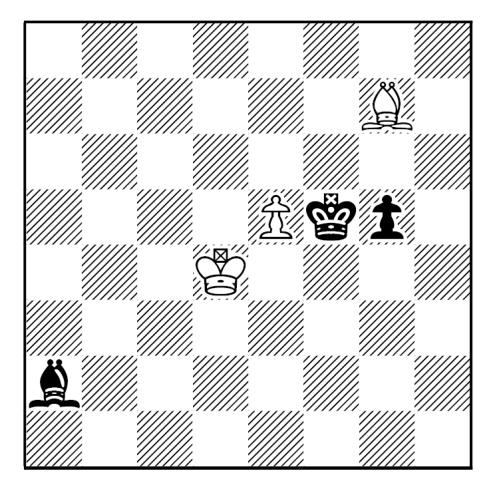
2019_10_31_E

(Ok, is there anyone who believes this is NOT a drawn position? Yet the players continue to move the pieces for another 82 moves. At this point you can be forgiven for skipping to the next games.) 73…g4 74.Ke3 Be6 75.Bf6 Bd5 76.Kd4 Be6 77.Bh4 Ba2 78.Bg3 Bf7 79.Kc5 Ba2 80.e6 Bxe6 81.Kd4 Ba2 82.Ke3 Bd5 83.Kd3 Ba2 84.Ke2 Be6 85.Kf2 Ba2 86.Ke1 Bf7 87.Kd1 Ke4 88.Ke2 Bd5 89.Kf2 Bc4 90.Kg2 Be2 91.Be1 Kf5 92.Kg3 Bd1 93.Bd2 Ke4 94.Bg5 Kd3 95.Bf4 Be2 96.Be5 Kc2 97.Bd6 Kd1 98.Kf4 Ke1 99.Be5 Kf2 100.Bd4+ Kg2 101.Ke3 Bd1 102.Be5 Bc2 103.Kf4 Kh3 104.Bd6 g3 105.Bc5 g2 106.Bg1 Bb3 107.Ke5 Bg8 108.Kd6 Kg3 109.Kc5 Kf3 110.Kd4 Ke2 111.Be3 Kf1 112.Ke5 Ba2 113.Bd4 Bb3 114.Ke4 Ke2 115.Ke5 Bc2 116.Kd5 Bb1 117.Ke5 Bc2 118.Ke6 Bb1 119.Kd5 Bc2 120.Kc4 Bg6 121.Kd5 Bh7 122.Ke5 Bg8 123.Kf6 Ba2 124.Ke5 Bg8 125.Ke4 Ba2 126.Kf4 Bg8 127.Bc5 Ba2 128.Ke5 Bb1 129.Kd5 Bh7 130.Bd4 Bc2 131.Ke5 Bh7 132.Kd6 Bc2 133.Kc6 Bd3 134.Kd5 Bg6 135.Ke5 Bh5 136.Kf4 Bf3 137.Bg1 Bd5 138.Ke5 Bc6 139.Kd6 Bb7 140.Kc7 Ba8 141.Kb8 Bf3 142.Bd4 Be4 143.Kc7 Bb7 144.Kb6 Kf3 145.Bg1 Ke4 146.Kc5 Kf3 147.Bd4 Kg4 148.Kb4 Bd5 149.Bg1 Kf3 150.Kc3 Bc4 151.Kd4 Ke2 152.Kc5 Bd3 153.Kb4 Kf3 154.Kb3 Bb5 155.Ka3 Kg4 156.Bd4 1/2-1/2


“Brause” (2470)-“humanoid” (2400)
Rated Blitz Match
ICS, 1997
1.e4 e5 2.Nf3 Nc6 3.Nc3 Nf6 4.Nxe5 Nxe5 5.d4 Ng6 6.e5 Ng8 7.Bc4 f5 8.Qh5 d6 9.g4 fxg4 10.Bd3 N8e7 11.Bg5 Rg8 12.Qxh7 1-0


“Brause” (2485)-“humanoid” (2385)
Rated Blitz Match
ICS, 1997
1.e4 e5 2.Nf3 Nc6 3.Nc3 Nf6 4.Nxe5 Nxe5 5.d4 Ng6 6.e5 Ng8 7.Bc4 f5 8.Qh5 d6 9.g4 Qh4 10.Nd5! 1-0


“Brause” (2490)-“humanoid” (2380)
Rated Blitz Match
ICS, 1997
1.e4 e5 2.Nf3 Nc6 3.Nc3 Nf6 4.Nxe5 Nxe5 5.d4 Ng6 6.e5 Ng8 7.Bc4 f5 8.Qh5 d6 9.Bf4 Qh4 10.Qxh4 Nxh4 11.Bg5 Ng6 12.Nb5 Kd7 13.e6+ Kc6 14.d5+ 1-0


“Brause”-N.N. (1800)
Internet Game
Germany, Sept. 8 1997
1.e4 e5 2.Nf3 Nc6 3.Nc3 Nf6 4.Nxe5 Nxe5 5.d4 Ng6 6.e5 Ng8 7.Bc4 c6 8.Qf3 f6 9.O-O d5 10.exd6 Bxd6 11.Ne4 N8e7 12.Qxf6!?
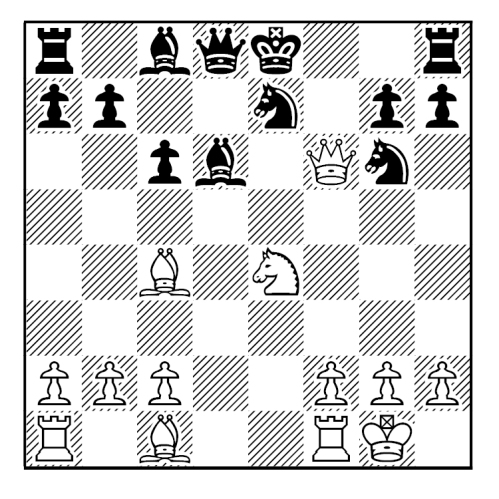
2019_10_31_F

12…gxf6? (Black might just survive 12…Rf8 13.Nxd6+ Kd7 14.Qe6+ Kc7. But then we would be denied an entertaining miniature.) 13.Nxf6+ Kf8 14.Bh6mate! 1-0


Vermaat- Tondivar
Leeuwarden Ch., July 1 2004
1.e4 e5 2.Nf3 Nc6 3.Nc3 Nf6 4.Nxe5 Nxe5 5.d4 Ng6 6.e5 Ng8 7.Bc4 d5 8.Bxd5 c6 9.Bb3 Be6 10.O-O Qd7 11.Ne4 O-O-O 12.Be3 Kb8 13.c4 f5 14.exf6 Nxf6 15.Ng5 Bf5 16.d5 h6 17.Nf3 c5 18.Ba4 Qc7 19.b4 Ne4 20.Rc1 Bd6 21.bxc5 Nxc5 22.Nd4 Rhf8 23.Rc3 Ne5 24.Bc2 Bxc2 25.Rxc2 a6 26.f4 Ned3 27.g3 Rde8 28.Ne6 Nxe6 29.Qxd3 Nc5 30.Qd2 Ne4 31.Qc1 Nxg3 32.hxg3 Rxe3 33.c5 Rxg3+ 34.Kh2 Rg4 35.cxd6 Qxd6 36.Qe3 Qxd5 37.Rf3 Qh5+ 38.Rh3 Qf5 39.Rb2 Qxf4+ 40.Qxf4+ Rgxf4 41.Kg2 Ra4 42.Re3 Rf7 43.Rc2 Rg4+ 44.Kh3 h5 45.Rc5 g6 46.Re6 Rf3+ 47.Kh2 Rf2+ 48.Kh3 Rf3+ 49.Kh2 Ra3 50.Re2 Rga4 51.Re6 Rxa2+ 52.Kh1 Rb4 53.Rxg6 Rh4+
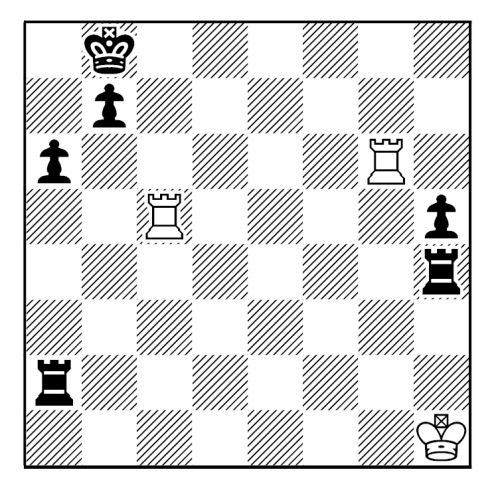
2019_10_31_G

(54.Kg1 Rg4+ 55.Rxg4 hxg4 56.Rg5 Rc2 and Black wins easily.) 0-1


Bagatsch (2125)-J. Hess
Oberliga Ost B
Germany, Nov. 27 2005
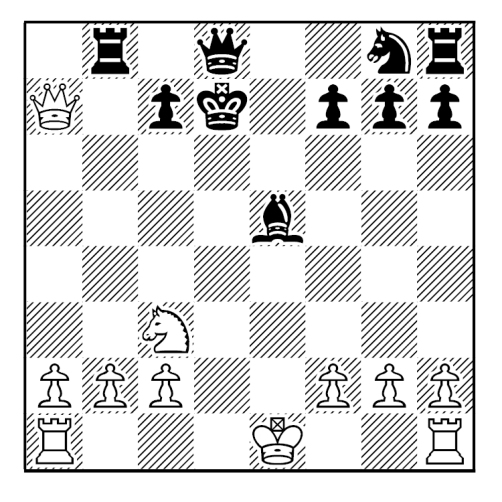
1.e4 e5 2.Nf3 Nc6 3.Nc3 Nf6 4.Nxe5 Nxe5 5.d4 Ng6 6.e5 Ng8 7.Bc4 d6 8.Qf3 Be6 9.Qxb7 Rb8 10.Bb5+ Bd7 11.Bxd7+ Kxd7 12.Qxa7 dxe5 13.dxe5 Nxe5 14.Bf4 Bd6 15.Bxe5 Bxe5
2019_10_31_H

16.O-O-O+! Bd6 17.Rxd6+! Kxd6 18.Rd1+ Kc6 19.Qa6+ Kc5 20.Ne4+ 1-0


Alexander Smirnov (2234)-Petr Kosolapov
Russia Central Region Ch.
Tula, Mar. 19 2007
1.e4 e5 2.Nf3 Nc6 3.Nc3 Nf6 4.Nxe5 Nxe5 5.d4 Ng6 6.e5 Ng8 7.Bc4 Bb4 8.Qf3 f6 9.O-O Bxc3 10.bxc3 d6 11.Re1 Kf8 12.Qd5 Qe8 13.Ba3 N6e7 14.exd6 Nxd5 15.d7+ Nde7 16.dxe8=Q+ Kxe8 17.Bxg8 Rxg8 18.Rxe7+ Kd8 19.Rae1 Bf5 20.Rf7 Bg6 21.Rf8+ Rxf8 22.Bxf8 Bxc2 23.Bxg7 f5 24.Bf6+ Kd7 25.Re7+ Kd6 26.Rxh7 Rc8 27.h4 Kc6 28.Be5 Bb1 29.a3 b5 30.h5 a5 31.h6 f4 32.Rf7 1-0


“odyson” (2399)-“Catalyst_Kh” (2677)
Halloween Gambit Thematic Tournament
http://www.chess.com, 2010
1.e4 e5 2.Nf3 Nc6 3.Nc3 Nf6 4.Nxe5 Nxe5 5.d4 Ng6 6.e5 Ng8 7.Bc4 d5 8.Bxd5 N8e7 9.Bg5 Qd7 10.Be4 Nf5 11.Qd3 Bb4 12.O-O-O Bxc3 13.bxc3 h6 14.Bd2 O-O 15.h4 Qe6 16.Kb1 Rd8 17.f4 h5 18.Ka1 Nge7 19.Be1 c6 20.g3 b5 21.Rb1 Qc4 22.Rxb5 Qxb5 23.Qxb5 cxb5 24.Bxa8 Be6 25.Bf3 Bd5 26.Bxd5 Nxd5 27.Kb2 Rc8 28.Rg1 Nfe3 0-1


HAPPY HALLOWEEN!!!


pumpkin-988231_1920

Lesser GM?

Like most chess players I am a fan of some of the greats; namely Fischer, Alekhine, and Tal.


But I also enjoy the lesser known greats, those IMs and GMs who occasionally can take an original route in the opening, explore what is there to find, and promote original theory.


One of those is the Finnish GM, Jouni Yrjola. He won his country’s championship in 1985 and 1988. And his flair for unexplored openings didn’t prevent him from earning the IM title (1984) or the GM title (1990).


More importantly, at least to this blogger, is that today is his birthday.


Happy Birthday Jouni!

~~~~~~~~~~~~~~~~~~~~~~~~~


Here is Yrjola, playing against a former World Champion.


IM Jouni Yrjola-GM Mikhail Tal
TV exhibition game, 1986
[D44]
1.d4 e6 2.c4 Nf6 3.Nf3 d5 4.Nc3 c6 5.Bg5 dxc4 6.e4 b5 7.e5 h6 8.Bh4 g5 9.Nxg5 hxg5 10.Bxg5 Nbd7 11.g3!? (Unusual. More common is 11.exf6. Perhaps Yrjola didn’t want to get into a tactical tussle with a Tal.) 11…Rg8 12.h4 Rxg5 13.hxg5 Nd5 14.Qh5 Nxc3 15.bxc3 Qa5 16.Rc1 Ba3 17.Rc2 Qa4 18.Kd1! (Effectively closing off the White’s queenside. Now Black must worry about his kingside.)
2019_10_24_A
18…Nf8 19.Qf3 Bb7 20.Rh8 Be7 (Black wants to castle queenside but first he needs to shore up his defenses on the kingside.) 21.Bh3 Bxg5? 22.Bxe6! 1-0


IM Julian Hodgson (2480)-IM Jouni Yrjola (2425)
Tallinn, Estonia, Apr. 8 1987
[B21]
1.e4 c5 2.f4!? (The Grand Prix Attack, a very popular way of meeting the Sicilian around this time.) 3…d5 (A strong defence, and one that almost put the Grand Prix out of business.) 3.exd5 Nf6 4.Bb5+ Nbd7 5.c4 a6 6.Ba4 b5 7.cxb5 Nxd5 8.Nf3 g6!? (The fianchetto on Black’s kingside usually leads to unbalanced games, perfect for both Hodgson and Yrjola.) 9.Nc3 N5b6


[This game, heading rapidly into more craziness, now forms theory.


Vladislav Zernyshkin (2319)-Yuri Yakovich (2539), Lev Polugaevsky Memorial, Samara, Russia, July 9 2011, continued with 10.d4 Bg7 11.Bc2 cxd4 12.Nxd4 O-O 13.O-O axb5 14.Ndxb5 Ba6 15.Bd3 Nc5 16.Be2 Nba4 17.Qc2 Nxc3 18.Nxc3 Qd4+ 19.Kh1 Nd3 20.h3 Rfd8 21.a4 Bc4 22.Ra3 Nb4 23.Qb1 Bd3 24.Bxd3 Nxd3 25.Qc2 e6 26.Nb5 Qe4 27.Nc3 Qc4 28.Qe2 Qb4 29.Na2 Nxc1 30.Nxc1 Bxb2 31.Rb3 Qd2 32.Rxb2 Qxe2 33.Nxe2 Rxa4 34.Rc1 Rd7 35.Kg1 e5 36.fxe5 Re4 37.Rc5 Re7 38.Kf2 R4xe5 39.Rxe5 Rxe5 40.Ng1 h5 41.Nf3 Re7 42.Ng1 Kg7 43.Kf3 Ra7 44.Rb3 Ra5 45.h4 Ra4 46.g3 Ra7 47.Nh3 Re7 48.Ng5 Kg8 49.Re3 Ra7 50.Ke4 Kg7 51.Kd5 Kf6 52.Kc6 Kf5 53.Kd6 f6 54.Ne4 g5 1/2-1/2]


10.d4 Nxa4 11.Qxa4 Bg7 12.Be3 Nb6 13.Qa5 O-O 14.O-O-O axb5 15.Qxb5 Ba6 16.Qxc5 Nc4! (Black has penetrated White’s position and his knight will prove to be impossible to dislodge.) 17.Rhe1 Qb8! (Forcing the next move.) 18.b3 Rc8! (White’s queen is trapped. Hodgson grabs the best deal he can make for his queen …) 19.Qxc8+ Bxc8 (…and then promptly resigns.) 0-1


GM Jonny Hector (2535)-GM Jouni Yrjola (2460)
Nordic Ch.
Ostersund, Sweden, Aug. 1992
[B76]
1.e4 c5 2.Nf3 d6 3.d4 cxd4 4.Nxd4 Nf6 5.Nc3 g6 6.Be3 Bg7 7.f3 Nc6 8.Bc4 O-O 9.Qe2 Bd7 10.O-O-O Na5 11.Bd3 (11.Bb3!?) 11…Rc8 12.h4 Rxc3 13.bxc3 Qc7 14.Qe1 d5 15.e5 Qxe5 16.Nb3 Nc6 17.g4 h5 18.g5 Ne8 19.Bd4 Nxd4 20.cxd4 Qd6 (Black could, of course, play 20…Qxd1 21.Rhd1, but that kills his play and he has to respond with 22…e6, which further limits his play. On 20…Qd6, his queen can at least travel to a3 and say “Boo!” Forgive this jest- it’s close to Halloween.) 21.Qc3 b6 22.Rhe1 Nc7 23.Rxe7 Ne6 24.Rxe6 Bxe6 25.Qd2 Rc8 26.c3 a5 27.Kb1 a4 28.Nc1 b5 29.Ne2 Rb8 30.Qf4 Bf8 31.Qxd6 Bxd6 32.Kc2 b4 33.cxb4 Rxb4 34.Rb1 Rxb1 35.Kxb1 Kg7 36.Kc2 f6 37.gxf6+ Kxf6 38.Kd2 g5 39.hxg5+ Kxg5 40.Ke3 h4 41.Nc3 h3 42.Bf1 Kh4 43.Kf2 a3 44.Nb5 Be7 45.Bd3 Bf6 46.Be2 Bd7 47.f4 Bg7 48.Bd3 Kg4 49.f5 Kf4 50.Kg1 Kg3 51.Kh1 Be8 52.Be2 Bd7 53.Bd3 Bf6 54.Nc3 Bc6 55.Ne2+ Kf3 56.Kh2 Ke3 57.Ba6 Bd7 58.Kxh3 Bxf5+ 59.Kg2 Be4+ 60.Kf1 Bxd4 61.Nxd4 Kxd4
2019_10_24_B
(Here, Black’s king is more centralized than White’s and he has an extra pawn. But it’s a draw as White can block the queening of the center pawn and Black’s other pawn is on a rook’s file, Right? Wrong!) 62.Ke1 Bb1 63.Kd2 Bxa2 64.Kc2 Kc5 65.Bb7 d4 66.Be4 Kb4 67.Bf5 Bb3+ 68.Kb1 Kc3 69.Ka1 Bc2 70.Bg4 d3 71.Ka2 Kb4
2019_10_24_C
0-1 [Incredibly Black wins after 72.Bh5 Bb3+ 73.Ka1 d2 74.Kb1 Kc3 75.Ka1 Kd3 76.Bf3 Ke3 77.Bg4 Kf2 78.Kb1 Ke1 79.Bh5 Bc4 80.Kc2 (with the idea of Be2) -+ , or 72.Ka1 d2 73.Ka2 Bb3+ 74.Kb1 Kc3 75.Be2 Kd4 76.Bf3 Ke3 77.Bh5 Kf2 78.Bg4 Ke1 79.Bh5 Bc4 80.Kc2 -+, or 72.Bf3 Bb3+ 73.Kb1 d2 74.Bh5 Kc3 75.Ka1 Kd3 76.Bf3 Ke3 77.Bg4 Kf2 78.Kb1 Ke1 79.Bh5 Bc4 80.Kc2 -+. Now, I had to run the position through a chess engine just to make sure my main ideas had some validity. It’s astonishing what a GM can figure out over the chessboard!]

A Chess Player’s Favorite Word

No matter if it is a miniature, a King-Hunt, a long endgame, or even a casual game, there is a word that every chess player would love to speak, and conversely, hate hearing it.


That word, so much loved and feared, is MATE.


But if it is a word much beloved in the chess world, why don’t we speak it more in normal conversations?


Well, it turns out that four letters, arranged in a M-A-T-E sequence, do not occur often in English, and even less in other languages.


Let’s look at words with the letters M-A-T-E in them.


ACCLIMATE
ACOELOMATE
AGEMATE [n. one who is about the same age as another.]
AMALGAMATE
AMATE [n. a Central American timber tree with lustrous foliage and edible fruits.]
AMATEUR
ANIMATE
ANTEPENULTIMATE
APPROXIMATE
AUTOMATE
BANDMATE
BEDMATE
BICHROMATE
BREGMATE [n. a junction point of the skull.]
BROMATE
BUNKMATE
CABINMATE
CARBAMATE
CASEMATE
CHECKMATE
CHROMATE
CLASSMATE
CLIMATE
COELOMATE [adj. having a coelom (the main body cavity in most animals).]
COINMATE
COLLIMATE
COMATE
CONSUMMATE
COPEMATE
CREMATE
CREWMATE
CYCLAMATE [n. a salt of cyclamic acid formerly used as an artificial sweetener.]
CYCLOSTOMATE
DECIMATE
DEPHLEGMATE
DESPUMATE [v. to clarify or purify a liquid by skimming a scum from its surface.]
DESQUAMATE
DICHROMATE
DIPLOMATE
DISANIMATE
DITHIOCARBAMATE [n. any salt or ester of dithiocarbamic acid, commonly used as fungicides.]
ECOCLIMATE
ESTIMATE
EXANIMATE
EXHUMATE
FERMATE
FISSIPALMATE [adj. having lobed or partially webbed separated toes, as in the feet of certain birds.]
FLATMATE
FORMATE
GEMMATE [adj. (1) having buds, (2) adorned with gems or jewels.]
GLUTAMATE
GUESSTIMATE
GUESTIMATE
HAMATE [n. a bone on the inner side of the second row of the carpus in mammals.]
HELPMATE
HIEROGRAMMATE [n. a writer of hierograms (sacred symbols or records, esp. hieroglyphics).]
HOUSEMATE
HUMATE
ILLEGITIMATE
IMAMATE [n. the office of an imam]
IMPOSTHUMATE
IMPOSTUMATE
INANIMATE [adj. not alive.]
INCREMATE [v. to cremate]
INHUMATE
INMATE
INTIMATE
LEGITIMATE
LITTERMATE
MACROCLIMATE
MAMMATE
MATE [n. a companion ; v. (1) to checkmate an opponent in chess, (2) to produce offspring.]
MATELOTE [n. a fish stew that is cooked in a wine sauce.]
MATER [n. an informal use of the Latin word for mother; adj. not reflecting light; not glossy.]
MATERIAL [n. the elements, constituents, or substances of which something is composed or can be made.]
MATERNAL [adj. relating to or characteristic of a mother or motherhood.]
MEPROBAMATE [n. a bitter-tasting drug used as a mild tranquilizer.]
MESSMATE
MICROCLIMATE
MIDSHIPMATE
MISESTIMATE
MISESTIMATE
MISMATE
MONOCHROMATE
NIZAMATE
OPTIMATE
OSMATE
OSTOMATE
OVERESTIMATE
PALAEOCLIMATE
PALAMATE
PALMATE
PENULTIMATE
PLAYMATE
PLUMATE
PRIMATE [n. any mammal of the order Primates (defined as having an up-right appearance, large brains relative to body size, body hair, and giving live birth). This group, with over 300 mammals, includes lemurs, lorises, gibbons, tarsiers, gorillas, monkeys, apes, and humans.]
PROXIMATE
PSEUDOCOELOMATE
RACEMATE
RAMATE [adj. having branches; branched.]
REANIMATE
REESTIMATE
REFORMATE
REMATE
ROOMMATE
SCHOOLMATE
SEATMATE
SEMIPALMATE
SHIPMATE
SIGMATE
SOULMATE
SQUAMATE
STABLEMATE
STALEMATE
STEARSMATE [n. same as STEERSMATE.]
STEERSMATE [n. one who steers; steersman.]
STOMATE [n. a minute opening in the epidermis of a plant organ.]
SUBLIMATE
SUBPRIMATE
SUMMATE
TABLEMATE
TEAMMATE
TOTIPALMATE [adj. having webbing that connects each of the four anterior toes, as in water birds.]
ULTIMATE
UNDERESTIMATE
WORKMATE
YOKEMATE


It doesn’t seem fair that we can mostly say MATE in the chess world. So, what to do if we want to say MATE more often? It’s easy! Play more chess!
Meanwhile, let’s indulge in a few more MATES.


Rudolf-N.N., 1912
1.e4 e5 2.f4 exf4 3.Bc4 Bc5 4.d4 Qh4+ 5.Kf1 Bb6 6.Nf3 Qd8 7.Bxf4 Ne7 8.Ng5 O-O 9.Qh5 h6 10.Bxf7+ Kh8
2019_10_17_A
11.Qxh6+! gxh6 12.Be5mate 1-0


Alekhine-Vasic
Graz, 1931
1.e4 e6 2.d4 d5 3.Nc3 Bb4 4.Bd3!? Bxc3+ 5.bxc3 h6 6.Ba3 Nd7 7.Qe2 dxe4 8.Bxe4 Ngf6 9.Bd3 b6
2019_10_17_B
10.Qxe6+!! fxe6 11.Bg6mate 1-0


Savanto-Molder
Helsinki, 1950
1.e4 e5 2.f4 exf4 3.Nf3 Be7 4.Bc4 Bh4+ 5.g3 fxg3 6.O-O gxh2+ (Believe it or not, this is all theory. It is mostly known by the name, “Three Pawns Gambit”.) 7.Kh1 Be7 8.Bxf7+ Kxf7 9.Ne5+ Ke6 10.Qg4+ Kxe5 11.Qf5+ Kd6 12.Qd5mate 1-0


Joe Ei-Ken Scott
corres.
Golden Knights, USCF, 1982
1.e4 d5 2.exd5 Qxd5 3.Nc3 Qa5 4.d4 Nf6 5.Nf3 Bg4 6.h3 Bxf3 7.Qxf3 c6 8.Bd2 Qd8 9.Bc4 e6 10.O-O-O Qb6?! 11.Ne4 Qxd4? 12.Ba5 Qxc4
2019_10_17_C
13.Qxf6! gxf6 14.Nxf6+ Ke7 15.Bd8mate 1-0


L. Bohne (2025)-J. Adamski (2400)
Hassloch, 1999
1.d4 Nf6 2.c4 e6 3.Nc3 Bb4 4.Qc2 c5 (Other adequate responses include 4…d5, 4…O-O, and 4…Nc6.) 5.dxc5 Qc7 6.a3 Bxc5 7.Nf3 a6 8.e3 Be7 9.Be2 d6 10.O-O Nbd7 11.b3 b6 12.Bb2 Bb7 13.Rac1 Rc8 14.Nd4 O-O 15.Bf3 Bxf3 16.Nxf3 Qb7 17.Qe2 Rc7 18.Nd2 Rfc8 19.e4 Ne8 20.Rc2 Ne5 21.f4 Nc6 22.Nf3 Na5 23.Nd4 Nc6 24.Nxc6 Rxc6 25.Rcc1 Qb8 26.f5 Nf6 27.g4 Nd7 28.fxe6 fxe6 29.Nd5 Bg5 30.Nf4 Re8 31.Rcd1 Bf6 32.Bxf6 Nxf6 33.h3 b5 34.cxb5 axb5 35.Rc1 Rxc1 36.Rxc1 Qa7+ 37.Kg2 Qxa3 38.Rc7 Qb4 39.Rb7 h6 40.Rxb5 Qd4 41.Rb7 Nxe4 42.Ng6 Kh7 43.Qf3 Kxg6 44.Qf7+ Kh7 45.Qxe8 Qf2+ 46.Kh1 Ng3mate 0-1

Fischer, the Invincible

Recently, I was going over some games from the 1963/64 US Championship. That tournament stands out for at least three reasons.

 
(1) The winner was the first, and so far, the only one, to achieve a perfect score in the Championship.


(2) Fischer won his sixth Championship in a row. He would eventually win eight of them, which was another perfect score as he played in a total of eight Championships.


(3) Fischer played a King’s Gambit, a rarity in a national championship. It was also one of his best games.
Here is the game, annotated by Fischer, with a few additional notes (mostly to highlight some background information) by me (RME).


GM Fischer-GM Evans
US Ch.
New York, Nov. 16 1963
[Fischer, “Exclusive Commentary on Round Two”, Chess Life and Review, Jan. 1964]

1.e4 e5 2.f4 [I knew that my opponent had some prepared line (since he usually plays the Sicilian) but felt that he would be unfamiliar with the King’s Gambit. Besides, I’d made up my mind to play it in this tournament anyway.] 2…exf4 3.Bc4 [Better than 3.Nf3 which is practically refuted by 3…d6 (see my analysis in the American Chess Quarterly.)] 3…Qh4+ [Turning it into an old-fashioned slugfest. The moderns frown on this move and prefer to fight in the center with 3…Nf6 4.Nc3 c6, etc. (But 4…Qh4+ is, by far, still the most common response in the Bishop’s Gambit as it displaces White’s king and prevent him from transposing into other variants of the King’s Gambit. RME.)] 4.Kf1 d6?

[Evans said this game would set chess back a hundred years. He didn’t know how right he was! The defense he chooses was also played by LaBourdonnais against MacDonnell (20th Match Game, 1834) which continued 5.d4 Bg4 6.Qd3 Nc6 7.Bxf7+? Kxf7 8.Qb3+ Kg6 9.Qxb7 Nxd4 10.Qxa8 f3 with a winning attack. More usual is 4…g5 (or d5) 5.Nc3 Bg7 6.d4 Ne7 7.Nf3 Qh5 8.h4 h6 and it’s a hard game.

(Here is the game in its entirety.

Macdonnell-de la Bourdonnais
Match, London, 1834
1.e4 e5 2.f4 exf4 3.Bc4 Qh4+ 4.Kf1 d6 5.d4 Bg4 6.Qd3 Nc6 7.Bxf7+ Kxf7 8.Qb3+ Kg6 9.Qxb7 Nxd4 10.Qxa8 Nf6 11.Na3 f3 12.g3 Bh3+ 13.Ke1 Qg4 14.Be3 d5 15.Qxa7 Nc6 16.Qxc7 d4 17.Bd2 Qxe4+ 18.Kd1 f2 19.Nxh3 Qf3+ 20.Kc1 Qxh1+ 0-1. RME)]

5.Nc3? [Returning the compliment. It’s natural that White should want to save the juicy tempo (5.Nf3!) and I make the same mistake as MacDonnell by delaying this move.] 5…Be6! [I overlooked this move. Now Black has a choice of where to put his Queen once she’s attacked. (This move also eliminates any quick victories by White as his bishop is thwarted. RME)] 6.Qe2

[Moving the bishop back is really not an option.

Harrwitz-Mayet
Match
Berlin, 1847
1.e4 e5 2.f4 exf4 3.Bc4 Qh4+ 4.Kf1 d6 5.Nc3 Be6 6.Be2?! Qf6 7.d4 g5 8.d5 Bc8 9.Nf3 h6 10.h4 Be7 11.Nb5 Na6 12.Bd2 Qg7 13.Bc3 f6 14.Kg1 g4 15.Nfd4 f3 16.Bf1 Bd8 17.gxf3 gxf3+ 18.Kf2 Nc5 19.Qxf3 a6 20.Na3 Bg4 21.Qf4 h5 22.Re1 Nh6 23.Rg1 Be7 24.b4 Na4 25.Ne6 Qh7 26.Nxc7+ Kd7 27.Nxa8 Nxc3 28.Nb6+ Kc7 29.Nbc4 f5 30.Kg2 fxe4 31.Kh1 Nxd5 32.Qxe4 Qxe4+ 33.Rxe4 Bf3+ 34.Bg2 Bxe4 35.Bxe4 Nxb4 36.Rg7 Kd8 37.Bxb7 Nf5 38.Rf7 Nxh4 39.Na5 d5 40.c3 Ke8 41.Rxe7+ Kxe7 42.cxb4 Kd6 43.Bxa6 Nf5 44.Bd3 Ne7 45.Nc2 Rg8 46.Nb7+ Ke6 47.Nc5+ Kd6 48.a4 Nc6 49.Nb7+ Ke7 50.Nc5 Kd6 1/2-1/2. Fischer didn’t mention this game, but in all fairness, he didn’t have access to the Internet. RME]

6…c6 7.Nf3 (Inaccurate. Having made the mistake of delaying this move once, White should hold off a while longer and play 7.d4, which does not permit Black’s Queen to retreat to e7 without relinquishing his “f” pawn.) 7…Qe7 (If 7…Qh5 8.Nd5! Now, however, Black has time to consolidate his king’s position.) 8.d4 Bxc4 9.Qxc4 g5 (Despite White’s strong center and great lead in development, Black’s position is not easy to crack. If 10.h4 g4 11.Ne1 Bh6, etc.) 10.e5 d5 [During the game I thought Black’s best defense was 10…dxe5 11.Nxe5 (11.dxe5 Nd7 12.Ne4 Nxe5 13.Nxe5 Qxe5 14.Bd2 is unclear) 11…Nd7 12.h4 Nxe5 13.dxe5 Qxe5 14.hxg5 O-O-O 15.Bxf4 Qf5 with equality.] 11.Qd3 [11.Nxd5 cxd5 12.Qc8+ Qd8 13.Qxb7 Nd7 is unsound. (14.Nxg5? Rb8). Now the threat is simply 11.Qf5.] 11…Na6 12.Ne2 (Not 12.Qf5 Nh6 13.Qxg5 Qxg5 14.Nxg5 Nb4 15.Bxf4 Nxc2 16.Rd1 Nf5 and Black wins.) 12…Nb4 (12…f6 loses 13.Qf5 Bg7 14.exf6 Bxf6 15.Bxf4! gxf4 16.Nxf4 with a winning attack. It is important to repel White’s queen from its present diagonal.) 13.Qd1 O-O-O (Very complicated, and possibly better, is 13.c3 which leads to a more active defense.) 14.c3 Na6 15.h4 g4 16.Nh2! h5 (Better was 16…f3 17.gxf3 gxf3 18.Nxf3 f6 although White’s king is quite safe and Black lags in development. Also to be considered was 16…Qxh4 17.Nxf4! g3 18.Qg4+ Qxg4 19.Nxg4 with a powerful ending.) 17.Nxf4

2019_10_10_A
17…Qxh4? [The losing move. Relatively best is 17…Kb8 (preventing Nxh5!) (Fischer is referring to White’s threat of 18.Nxh5! Rxh5 19.Qxg4+, winning the rook and the game. RME) but his game is already bad. (The advanced pawn on e5 which is crippling Black’s play on the kingside. RME).] 18.Kg1 (Black apparently underestimated the strength of this move. He has no adequate defense now to the twin threats of 19.Nxg4 and Nf1.) 18…Nh6 (The only way to avoid outright material loss. Black originally intended 18…Bh6 but 19.Nf1 followed by Rxh5 stands him up.) 19.Nf1 Qe7 20.Nxh5 Rg8 (Black already knew he was lost and was shaking his head in amazement at how quickly White’s dead pieces had sprung to life.) 21.Nfg3 Rg6 22.Nf4 Rg5 (If 22…Rg8 23.Nxd5, etc.) 23.Be3 Nc7 (The last hope. 23…f6 is answered by 24.Qd2 fxe5 25.Nxd5, winning a full rook.) 24.Qd2 Rg8 25.Nfe2 (This piquant retreat wins a piece, putting a clear end to black’s agony.) 25…f6 (Black is still hoping for a miracle.) 26.exf6 Qxf6 27.Bxh6 Bd6 28.Rf1 Qe6 29.Bf4 Rde8 30.Rh6 Bxf4 31.Qxf4 Qe7 32.Rf6
2019_10_10_B
[Tripling on the Bishop file. (And being material up, the victory is not too far off. RME)] 32…Ne6 33.Qe5 Ng5 34.Qxe7 Rxe7 35.Rf8+ (Trading down to skin and bones.) 35…Rxf8 36.Rxf8+ 1-0


SHORT GAMES

71VI3wqWYKL._AC_UL720_


Sometimes I get asked, “What is the shortest game of chess ever played?”


It seems like a simple question. But the problem is trying to define exactly what a game of chess is.


For example; Do only complete games count? How many moves IS a complete game? Does one of the players need to come up with a new move? Otherwise, one can claim both opponents are just repeating or copying a game, from memory, and not really “playing”?


What type of players count? For example, what if one of the players just knows how to move his pawns? He can never win, but is it a game of chess?


Do Over The Board (OTB – that is, tournament games and matches, and usually with clocks) count more than skittles? Can a computer actually “play” a game of chess? Or is it just programming?


Perhaps these questions are for another time.
Meanwhile, let me give you my answer to the question, “What is the shortest game of chess ever played?”


I am defining a game with at least two players (person, computer, team, alien, ghost, or anyone or anything) that can make an independent choice on his, her, their, or its, move.


I am also defining a game with at least one move, or one ply being made. So prearranged draws, in which both players are absent from the board, do not count.

So, the shortest game possible, at least among GMs, is the following:


GM Bobby Fischer-GM Oscar Panno
Palma de Mallorca Interzonal
Spain, 1970
[A10]
1.c4 1-0


As a protest against the Tournament Directors, GM Panno actually resigned at this point.


Most players believed that Panno was going to lose the game against strongest player in the tournament, and of the world, but he should have played the game anyway.

If one is so inclined to insist that a game which one of the players does not show up, and loses the game on time, is actually a game, then we have the following:


GM Bobby Fischer-GM Boris Spassky
World Championship, Game #2
Reykjavik, July 11 1972
[A00]

0-1


Fischer didn’t show up and lost by forfeit. Perhaps the best-known example of a forfeit loss.


A sub-category of the question, “What is the shortest game of chess every played…” that continues with “…that ended in a checkmate?”
Many players would say it’s Scholar’s Mate:
1.e4 e5 2.Bc4 Nc6 3.Qf3 Nd4?? (To attack the queen and threaten Nxc2+, winning the rook. But it immediately loses to to…) 4.Qxf7#.
Indeed, I’ve seen this played in many beginner and scholastic games.
But nothing can beat Fool’s Mate (1.f3 e5 2.g4 Qh4#). And now the question is “Has it ever been played in a rated game?” If so, when was it first played?
I have an old copy of Chess Life and Review in front of me. In it, a claim is made. Here is what it says;
“Round 1.


Here, one game was over before the TD could get all the clocks started! The moves were 1.P-KB3 P-K4 2.P-KN4; would anyone care to guess Black’s 2nd? The players of this game now hold the dubious world record of the shortest game resulting in mate ever played in a rated event.” – Dr. Lindsay F. Phillips, Tournament Director, “U.S. Junior Open Co-Champions Brown and Anderson”, Chess Life and Review, Nov. 1977.

This is an interesting claim. Surely, Fool’s Mate has occurred in a rated game before 1977. Does anyone have proof of this??

TAL’S SACRIFICES

Mikhail Tal (1936-1992), was a tsunamic and torrential tactical player. Known for his surprising speculative sacrifices and brilliant follow-ups, he made a name for himself even as a young player.


His style of sacrificial play introduced a new and novel way of creating play for one’s own pieces.


But exactly what is this new style? What type of pieces are used in this new style?


The second question is easy to answer; “All of them”.


As to the first question, let his games demonstrate this style.


~~~~~~~~~~~~~~~~~~~~~~~~~~~~~


Kliavinsh-GM Tal
Latvian Ch., 1958
1.e4 c5 2.Nf3 d6 3.d4 cxd4 4.Nxd4 Nf6 5.Nc3 a6 6.Bc4 e6 7.Bb3 Be7 8.O-O O-O 9.f4 b5 10.a3 Nbd7 11.Be3 (If you are thinking about 11.Bxe6, please remember there are three type of sacrifices; there are good sacrifices, bad sacrifices and Tal-like sacrifices. This move is neither a Tal-like, or even a good sacrifice, as after 11.Bxe6?! fxe6 12.Nxe6 Qb6+ 13.Kh1 Rf7 Black is a little better. Black can also play 12.Nxe6 Qe8. In either case White is down material with very little compensation.) 11…Bb7 12.Bxe6?! fxe6 13.Nxe6 Qe8! (This, however, is a Tal-like sacrifice. The Black rook will stay en prise for the next few moves until White takes it. For that, Tal will get exactly what he wants – very active pieces.) 14.Qd4 Rc8 15.Rae1 Rc4 16.Qa7 Qc8 17.Nxf8 Bxf8 18.Bd4 d5 19.Kh1 dxe4 20.Rd1 Qc6 21.b3 Rxc3 22.Bxc3 e3 23.Rf3 e2!
2019_09_25_A
[This is just a good move and nothing special. However, a good sacrifice is just around the corner. We would like to see it on the scoresheet. But White resigned so we’ll have to see it in the analysis. After 24.Re1, Black has 24…Qxf3! (It’s both a good sacrifice and a Tal-like sacrifice for sure!) 25.gxf3 Bxf3+ 26.Kg1 Bc5+ 27.Qxc5 Nxc5 28.Kf2 Bh5, and Black wins!] 0-1


Isaak Birbrager-Tal
Kharkov, 1953
[Notes based on NM SamCopeland’s excellent article, “Mikhail Tal’s Most Spectacular Queen Sacrifice – Birbrager vs. Tal, 1953”, chess.com, Sept. 9 2019]
1.d4 Nf6 2.c4 c5 3.d5 e6 4.Nc3 exd5 5.cxd5 d6 6.e4 g6 7.Nf3 Bg7 8.Bd3 (White has several alternatives here; 8.Nf3, 8.Bg5, 8.Nd2, and even 8.h3.) 8…O-O 9.O-O Na6?! 10.Nd2 Nb4 11.Be2 {11.Bb1! +/-. This would have contained the knight more effectively and kept an eye on possible kingside actions.) 11…Re8 12.a3 Na6 13.Re1 Nc7 14.Qc2 Rb8 15.a4 b6 16.Nb5? a6 17.Nxc7 (17.Na7!?. The text move practically forces Black’s response.) 17…Qxc7 18.Ra2 Qe7 19.f3? Nh5! (Getting ready to steamroll the kingside pawns with the knight providing cover.) 20.Nf1 f5! 21.Bd3 f4! (The plan of …Be5, and …g5-g4 with a mating attack is deadly.) 22.g4! Bd4+ 23.Kh1 (23.Kg2? Qh4 24.Re2 Bxg4! 25.fxg4 Qxg4+ 26.Kh1 Qg1#.) 23…Qh4 24.Re2 Qh3? 25.Rg2 Qxf3 26.Nd2 (26.gxh5 Rxe4! -+ is a beautiful and punishing blow.) 26…Qe3 27.Nf1 Qf3 28.Nd2 (draw?)
2019_09_25_B
28…Bxg4!! (No draw! Tal chooses to sacrifice his queen instead! This is a perfect example of a “Tal” sacrifice; there is not a clear idea to regain the material, but Tal’s pieces are alive and crackling with energy while White’s pieces struggle to find meaning in the position. Objectively, MAYBE White can defend, but there’s no clear refutation, and White collapses almost immediately.) 29.Nxf3 Bxf3 30.h4 Rf8 31.Be2?? Ng3+ 32.Kh2 Bxg2 33.Kxg2 Nxe2 34.Qxe2 f3+ 35.Qxf3 Rxf3 36.Kxf3 Rf8+ 37.Kg3 Be5+ 38.Kg2 Bf4 […Rf4 (before or after trading on c1) wins another pawn and the game.] 0-1


GM Tal-GM Velimirovic
USSR vs. Yugoslavia
Teslic, 1979
[A30]
[A complete analysis by Tal can be found in Informant 27, game #64]
1.c4 c5 2.b3 Nc6 3.Bb2 e5 4.g3 d6 5.Bg2 Be6 6.Nc3 Qd7 7.Nf3 Bh3 8.Bxh3 Qxh3 9.Nd5! Qd7 10.e3 Nce7 11.Nc3! Nf6 12.0-0 e4 (12…Ng6 13.d4 +/-) 13.Ng5!? d5!? 14.cxd5 Qf5

2019_09_25_C
15.Nxf7! Kxf7 16.f3! Nexd5 17.fxe4 Nxc3 18.Bxc3 Qxe4 19.Qh5+ Ke6 20.Qh3+ Kd6 (20…Kf7! 21.Rf5! is unclear but the advantage probably lies with White.) 21.b4!! Kc7 22.Rac1 +/- Rc8 23.Rf5!! Qg4 24.Be5+ Kd7 25.Qf1 Qe4?  26.Rc4 Qc6 27.Qh3 (27.Bxf6 gxf6 28.Rxf6 Qd5 29.Qh3 Kc7 30.Rf8 +-) 27…Qe6 (27…Kd8 28.bxc5+-) 28.Bxf6 gxf6 29.Re4! +- Qa2 30.Rxc5+ 1-0


Bobotsov-Tal
World Junior Team Ch.
Varna, 1958
[E81]
1.d4 Nf6 2.c4 g6 3.Nc3 Bg7 4.e4 d6 5.f3 O-O 6.Nge2 c5 7.Be3 Nbd7 (Another move is 7…Nc6!?) 8.Qd2 a6 9.O-O-O Qa5!? (Aggressive, provocative, and encourages piece play by Black.) 10.Kb1 b5 11.Nd5
2019_09_25_D
11…Nxd5! (Not only is it unexpected, it is also among of his most sound sacrifices. Tal’s pieces really come alive!) 12.Qxa5?

[Tal’s sacrifice is so well known that IM and GM players avoid taking the offered queen and instead play 12.cxd5 to liquefy the possibilities, but apparently not necessarily the stress brought on by Black’s active piece play.

Here are two games for future study of this game.

Abraham Neumann-Israel Gelfer (2340)
Israel Ch., Dec., 1967
1.d4 Nf6 2.c4 g6 3.Nc3 Bg7 4.e4 d6 5.f3 O-O 6.Be3 Nbd7 7.Qd2 c5 8.Nge2 a6 9.O-O-O Qa5 10.Kb1 b5 11.Nd5 Nxd5 12.cxd5 Qxd2 13.Bxd2 f5 14.e5 Bb7 15.Bg5 Rfe8 16.dxc5 Nxc5 17.e6 Na4 18.Bc1 Nb6 19.Nf4 Be5 20.Be3 Na4 21.Rd2 Rac8 22.Ne2 Rc7 23.f4 Bf6 24.g3 Rec8 25.Rg1 b4 26.Rg2 Bxb2 27.Rxb2 Nxb2 28.Kxb2 Rc2+ 29.Kb1 Bxd5 30.Rf2 Bxa2+ 31.Ka1 Bc4 32.Nd4 Rxf2 33.Bxc4 Rxh2 34.Bd5 Rc3 35.Nf3 Rh1+ 0-1

Cicirone Spulber (2326)-Boris Itkis (2474)
Homorod, Romania, 1993
1.d4 Nf6 2.c4 g6 3.Nc3 Bg7 4.e4 d6 5.f3 O-O 6.Be3 Nbd7 7.Qd2 c5 8.Nge2 a6 9.O-O-O Qa5 10.Kb1 b5 11.Nd5 Nxd5 12.cxd5 Qxd2 13.Rxd2 f5 14.dxc5 Nxc5 15.Bxc5 dxc5 16.Nc3 c4 17.Be2 Bd7 18.exf5 gxf5 19.f4 b4 20.Nd1 Rfc8 21.Rc2 c3 22.b3 a5 23.Ne3 a4 24.Bc4 Rxc4 25.Nxc4 axb3 26.axb3 Bb5 27.Rhc1 Rd8 28.Ne3 Bd3 29.Rd1 Be4 30.g3 Ra8 31.d6 exd6 32.Rxd6 Re8 33.Nd5 Bxc2+ 34.Kxc2 Re2+ 35.Kc1 Bf8 36.Rd8 Kf7 37.Rb8 Rxh2 38.Nxb4 Bc5 0-1.

Back to the Tal game.]

12…Nxe3 13.Rc1 Nxc4! (The strong knight threatens the queen and she doesn’t have good square to move.) 14.Rxc4 bxc4 15.Nc1 (White, despite giving back some of the material, finds his king stripped of defensive pieces and pawns and sitting on an semi-open file.) 15…Rb8 16.Bxc4 Nb6 17.Bb3 Bxd4 (Among other threats, the move …c4! wins at once.) 18.Qd2 Bg7 19.Ne2 c4 20.Bc2 (Not 20.Bd1? as White may need to move his rook to the queenside.) 20…c3 21.Qd3 (Winning for Black is 21.Nxc3? Nc4! 22.Qc1 Bxc3 -+.) 21…cxb2 22.Nd4 Bd7 23.Rd1 Rfc8! (There is no escape for White’s king.) 24.Bb3 Na4 25.Bxa4 Bxa4 26.Nb3 Rc3 27.Qxa6 Bxb3 28.axb3 Rbc8 29.Qa3 Rc1+ 30.Rxc1 Rxc1+ (This position deserves a diagram.)
2019_09_25_E
0-1