AN INTRODUCTION TO THE ART OF QUEEN SACRIFICES


phpWZYMqS


Perhaps the most popular games ever published are those in which a player sacrifices his one and only Queen. Bravery is required for that player who thrusts his most valuable piece into the fight, sometimes with no hope of ever seeing her alive again.


In the over 500 years of chess, fewer topics have been more exciting, more spectacular, and more aesthetically pleasing to the player than when he freely sacrifices his powerful Queen. In all cases, the desired result, whether immediately or indirectly, is to gain something more valuable; the enemy King.


Basically, there are three types of tactical Queen sacrifices. The first type is the one made for material gain. Sometimes called a pseudo-sacrifice, the Queen is given up and won back a few moves later.


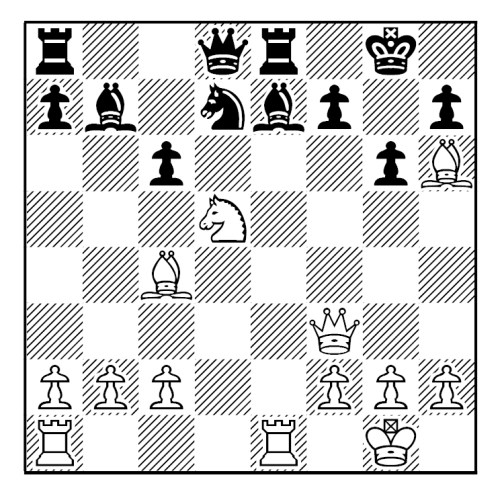
Doroshkevich-Astashin
USSR, 1967 (D24)
1.d4 d5 2.c4 dxc4 3.Nf3 Nf6 4.Nc3 a6 5.e4 b5 6.e5 Nd5 7.a4 Nxc3 8.bxc3 Bb7 9.e6 fxe6 10. Be2 Qd5 11.Ng5 Qxg2 12.Rf1 Bd5 13.axb5 Qxh2?! 14.Bg4 h5 15.Bxe6 Bxe6 16.Qf3 c6 17.Nxe6 Qd6 18.Qf5 g6 19.Qxg6+ Kd7 20.Nc5+ Kc8 21.Qe8+ Qd8 22.b6! 1-0


The Queen pseudo-sacrifice sacrifice for gain may turn into a mate if the opponent tries to hold on the extra female material.


Muller-Calderone
Compuserve, 1996 (B57)
1.e4 c5 2.Nf3 d6 3.d4 cxd4 4.Nxd4 Nf6 5.Nc3 Nc6 6.Nxc6 bxc6 7.Bc4 g6 8.e5 Nd7 (Certainly not 8…dxe5?? 9.Bxf7+. Best is 8…Ng4) 9.exd6 exd6 10.O-O Nf6 11.Re1+ Be7 12.Qf3 O-O 13.Qxc6 Bf5 14.Bh6 Re8 15.Nd5 Rc8

2019_09_18_A

16.Qxe8+! Qxe8 17.Nxe7+ Kh8 18.Nxf5 Ne4 19.Nxd6 Qc6 20.Nxf7+ (20…Kg8 21.Ne5+) 1-0


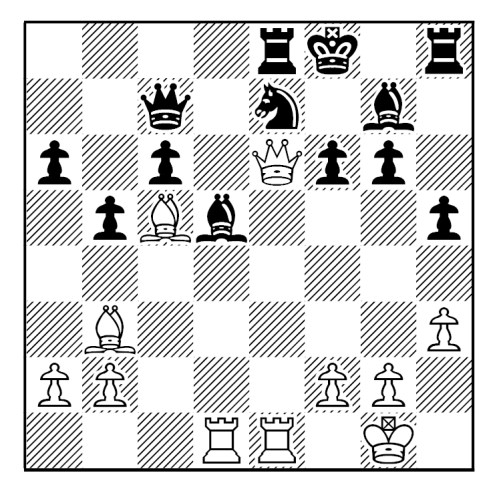
Levitzky-Marshall
Breslau 1912 (C10)
[Chernev says that spectators showered the board with gold pieces after Black’s 23rd move. Soltis says it was bettors who lost the wager on the outcome.]
1.d4 e6 2.e4 d5 3.Nc3 c5 (The Marshall Gambit, as played by its inventor.) 4.Nf3 Nc6 5.exd5 exd5 6.Be2 Nf6 7.O-O Be7 8.Bg5 O-O 9.dxc5 Be6 10.Nd4 Bxc5 11.Nxe6 fxe6 12.Bg4 Qd6 13.Bh3 Rae8 14.Qd2 Bb4 15.Bxf6 Rxf6 16.Rad1 Qc5 17.Qe2 Bxc3 18.bxc3 Qxc3 19.Rxd5 Nd4 20.Qh5 Ref8 21.Re5 Rh6 22.Qg5 Rxh3 23.Rc5 Qg3!!

2019_09_18_B

[O.K. Here are the variations: 24.Qxg3 Ne2+ 25.Kh1 Nxg3+ 26.Kg1 Nxf1 27.gxh3 Nd2 and extra piece wins. If White tries to hold onto the Queen, he tries loses his King. 24.hxg3 Ne2#, or 24.fxg3 Ne2+ 25.Kh1 Rxf1#.] 0-1


A second popular Queen sacrifice is made solely for to checkmate an opponent. The mate may be immediate as these short games show.


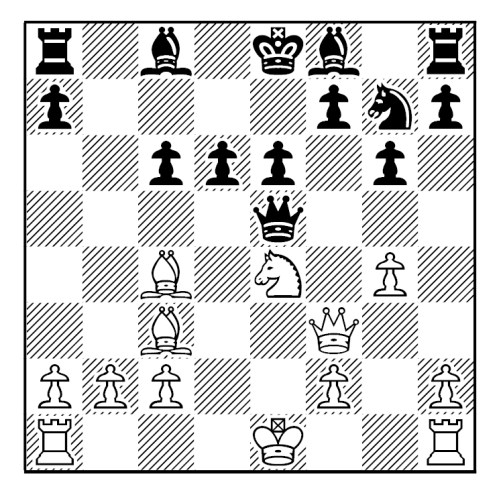
De Legal-Saint Brie
Paris, 1750? (C40)
1.e4 e5 2.Nf3 d6 3.Bc4 (3.d4 is now considered to be the best move when facing Philidor’s Defence. But then we would miss all the fun of this classical trap!) 3…Bg4? 4.Nc3 g6 5.Nxe5! Bxd1 6.Bxf7+ Ke7 7.Nd5mate 1-0


Greco-N.N.,
Rome, 1620?
(B20)
1.e4 b6 2.d4 Bb7 3.Bd3 f5 4.exf5 Bxg2 5.Qh5+ g6 6.fxg6 Nf6? (If Black plays 6..e5?, then White has the beautiful 7.g7+ Ke7 8.Qxe5+ Kf7 9.gxh8=N#!) 7.gxh7+! Nxh5 8.Bg6mate 1-0

 
Paul Morphy-Duke of Brunswick and Count Isouard
Paris, 1858 (C41)
[A short classic that displays all the qualities that make up a great game; rapid development, pins, sacrifices, and slightly inferior moves by the opponent.]
1.e4 e5 2.Nf3 d6 3.d4 Bg4? 4.dxe5 (Simple enough. White threatens 4…dxe5 5.Qxd8+ Kxd8 6.Nxe5, netting a pawn.) 4…Bxf3 5.Qxf3 dxe5 6.Bc4 Nf6 7.Qb3 Qe7 8.Nc3 c6 9.Bg5 b5 10.Nxb5! (The whole mating sequence begins with a Knight sacrifice.) 10…cxb5 11.Bxb5+ Nbd7 12.O-O-O! Rd8 13.Rxd7 Rxd7 14.Rd1 Qe6 15.Bxd7+ Nxd7 16.Qb8+! (And ends with a Queen deflection sacrifice!) 16…Nxb8 17.Rd8mate 1-0


Queen sacrifices for the checkmate may also be slightly more involved and take longer to execute the mate.


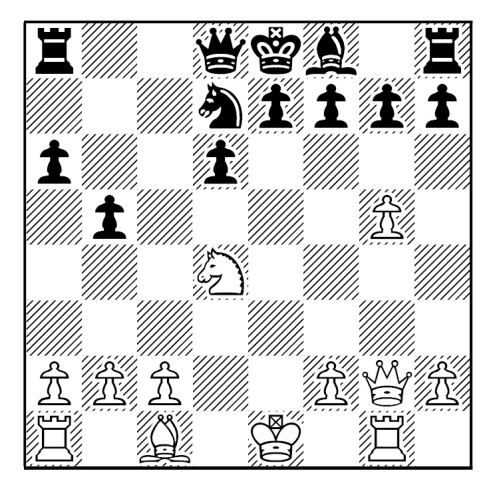
Maryasin-Kapengut
Minsk, 1969 (D01)
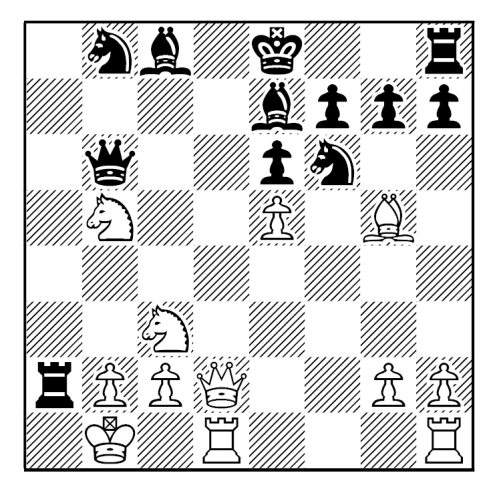
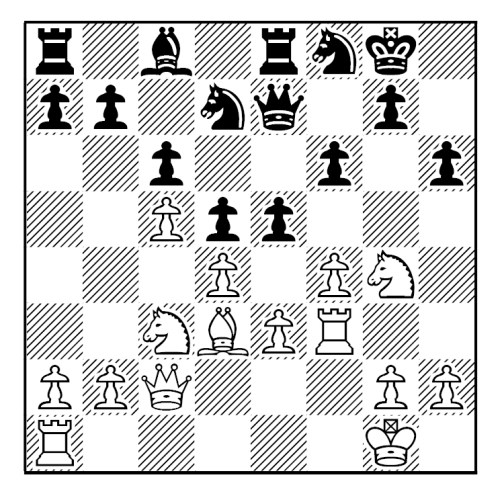
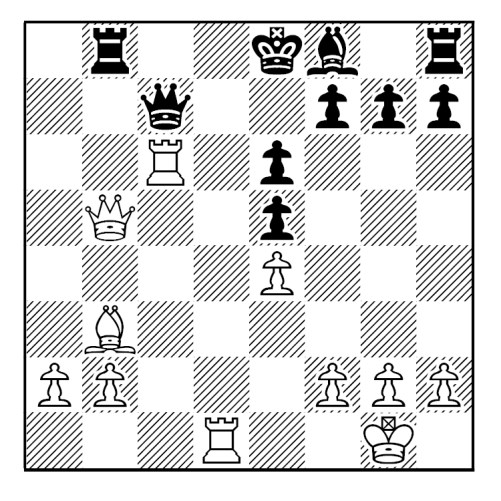
1.d4 Nf6 2.Nc3 d5 3.Bg5 (The often neglected Veresov’s Opening.) 3…Nbd7 4.Nf3 g6 5.e3 Bg7 6.Bd3 c5 7.Ne5 O-O 8.Qf3 Qb6 9.O-O-O e6 10.h4 Nxe5 11.dxe5 Nd7 12.h5 Nxe5 13.Qh3 f5 14.hxg6 hxg6 15.Be2 d4 16.Na4 Qb4 17.f4 Qxa4 18.fxe5 Qxa2 19.Qh7+ Kf7 20.Bf6 Qa1+ 21.Kd2 Qa5+ 22.c3 Rg8
2019_09_18_C

23.Qxg6+! Kxg6 24.Bh5+ Kh7 25.Bf7+ Bh6 26.Rxh6+ (with the idea of Rh1#) 1-0

 
The third type of Queen sacrifices are those initiating King hunts. The Queen is given up so that the enemy King is brought out into the open. The checkmate, if there, comes many moves later.

 
These sacrifices differ from the mating sacrifices in that, while a mating sacrifice can be usually calculated out to the end, a King Hunt is made on a player’s belief that he can find a mate somewhere down the line. In other words, a King Hunt is made more on intuition rather than calculation.


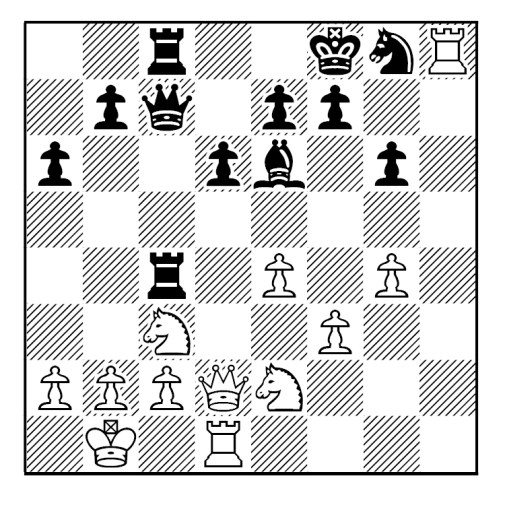
D. Byrne-Fischer
Rosenwald Memorial
New York 1956 (D97)
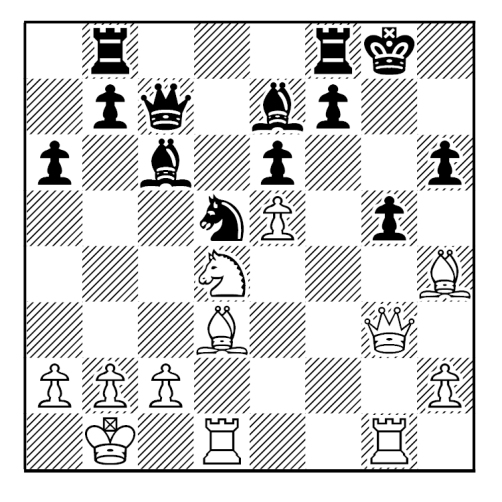
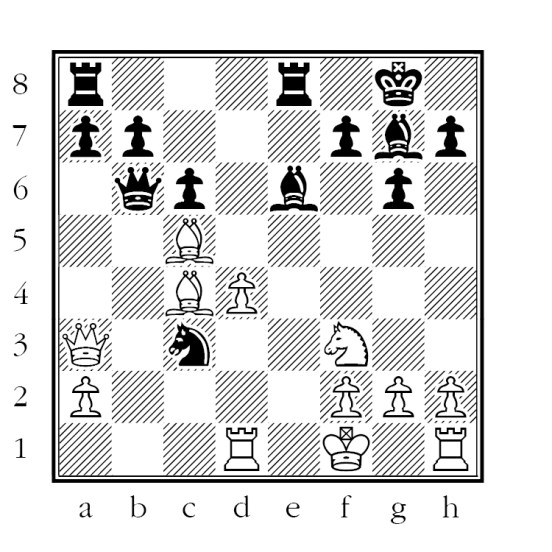
1.Nf3 Nf6 2.c4 g6 3.Nc3 Bg7 4.d4 O-O 5.Bf4 d5 6.Qb3 dxc4 7.Qxc4 c6 8.e4 Nbd7 9.Rd1 Nb6 10.Qc5 Bg4 11.Bg5 Na4 12.Qa3 Nxc3 13.bxc3 Nxe4 14.Bxe7 Qb6 15.Bc4 Nxc3 16.Bc5 Rfe8+ 17.Kf1 Be6!!
2019_09_18_D

18.Bxb6 Bxc4+ 19.Kg1 Ne2+ 20.Kf1 Nxd4+ 21.Kg1 Ne2+ 22.Kf1 Nc3+ 23.Kg1 axb6 24.Qb4 Ra4 25.Qxb6 Nxd1 26.h3 Rxa2 27.Kh2 Nxf2 28.Re1 Rxe1 29.Qd8+ Bf8 30.Nxe1 Bd5 31.Nf3 Ne4 32.Qb8 b5 33.h4 h5 34.Ne5 Kg7 35.Kg1 Bc5+ 36.Kf1 Ng3+ 37.Ke1 Bb4+ 38.Kd1 Bb3+ 39.Kc1 Ne2+ 40.Kb1 Nc3+ 41.Kc1 Rc2mate 0-1

 
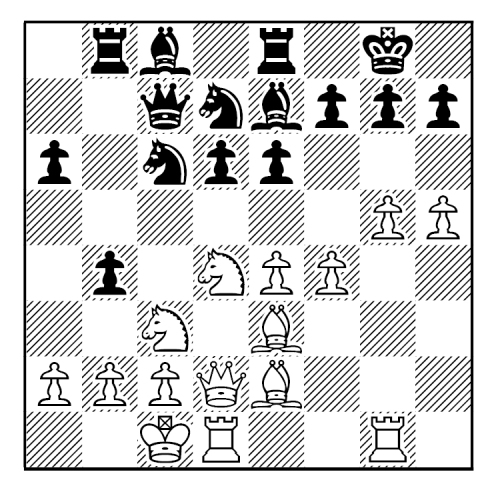
Averbakh-Kotov
Zurich, 1953 (A55)
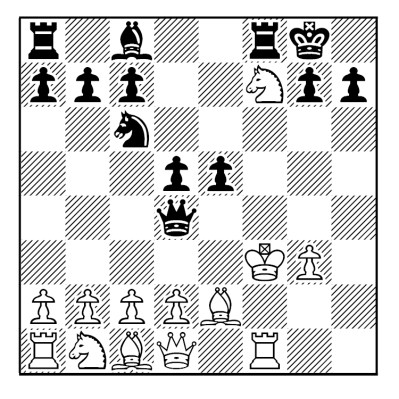
1.d4 Nf6 2.c4 d6 3.Nf3 Nbd7 4.Nc3 e5 5.e4 Be7 6.Be2 O-O 7.O-O c6 8.Qc2 Re8 9.Rd1 Bf8 10.Rb1 a5 11.d5 Nc5 12.Be3 Qc7 13.h3 Bd7 14.Rbc1 g6 15.Nd2 Rab8 16.Nb3 Nxb3 17.Qxb3 c5 18.Kh2 Kh8 19.Qc2 Ng8 20.Bg4 Nh6 21.Bxd7 Qxd7 22.Qd2 Ng8 23.g4 f5 24.f3 Be7 25.Rg1 Rf8 26.Rcf1 Rf7 27.gxf5 gxf5 28.Rg2 f4 29.Bf2 Rf6 30.Ne2
2019_09_18_E

30…Qxh3+!! 31.Kxh3 Rh6+ 32.Kg4 Nf6+ 33.Kf5 Nd7 34.Rg5 Rf8+ 35.Kg4 Nf6+ 36.Kf5 Ng8+ 37.Kg4 Nf6+ 38.Kf5 Nxd5+ 39.Kg4 Nf6+ 40.Kf5 Ng8+ 41.Kg4 Nf6+ 42.Kf5 Ng8+ (These last few moves were apparently played to reach adjournment.) 43.Kg4 Bxg5 44.Kxg5 Rf7 45.Bh4 Rg6+ 46.Kh5 Rfg7 47.Bg5 Rxg5+ 48.Kh4 Nf6 49.Ng3 Rxg3 50.Qxd6 R3g6 51.Qb8+ Rg8 0-1

 
Mating threats may occur more than once in a game. Which also means a player can sometimes a player can offer his original Queen more than once.

 
Nigmadzianov-Kaplun
USSR 1977 (B05)
1.e4 Nf6 2.e5 Nd5 3.d4 d6 4.Nf3 Bg4 5.Be2 c6 6.c4 Nb6 7.Nbd2 N8d7? (ECO suggests 7…dxe5.) 8.Ng5! Bxe2 9.e6!! (White offers his Queen for the first time. This offer can be turned down.) 9…f6 (9…Bxd1? fails to 10.exf7#) 10.Qxe2 fxg5 11.Ne4 +/- Nf6 12.Nxg5 Qc7 13.Nf7 Rg8 14.g4 h6 15.h4 d5 16.c5 Nc8 17.g5 Ne4 18.gxh6 gxh6 19.Qh5 Nf6 20.Nd6+ Kd8 21.Qe8+ (The second offer cannot be refused.) 1-0


Gonssiorovsky-Alekhine
Odessa 1918 (C24)
1.e4 e5 2.Bc4 Nf6 3.d3 c6 4.Qe2 Be7 5.f4 d5 6.exd5 exf4 7.Bxf4 O-O 8.Nd2 cxd5 9.Bb3 a5 10.c3 a4 11.Bc2 a3 12.b3?! (12.Rb1 is better. Lusin-Morgado, corres.1968 continued with 12…Bd6 13.Qf2 Ng4 14.Qg3 Re8+ 15.Kd1 Ne3+ 16.Kc1 Nf5 17.Qf2 Bxf4 18.Qxf4 Re1+ 19.Bd1 Ne3 20.Ngf3 Rxh1 21.Qxe3 axb2+ 22.Rxb2 Nc6 23.a4 Rxa4 24.Qe2 Ra1+ 25.Rb1 Rxb1+ 26.Nxb1 h6 27.Nbd2 Qe7 28.Kb2 Qxe2 29.Bxe2 g5 30.Nf1 Bg4 31.Ng3 Bxf3 32.Bxf3 Rxh2 33.Bxd5 h5 34.Kc1 Kg7 35.Kd2 Ne5 36.d4 Ng4 37.Ke2 h4 38.Nf1 Rh1 39.Bxb7 h3 40.gxh3 Rxh3 41.c4 f5 42.c5 Kf6 43.c6 Rc3 1/2-1/2) 12…Re8 13.O-O-O Bb4 14.Qf2 Bxc3 15.Bg5 Nc6 16.Ngf3 d4 17.Rhe1 Bb2+ 18.Kb1 Nd5! (The Queen is offered for the first time.)
2019_09_18_F

19.Rxe8+ (Naturally 19.Bxd8 fails to 19…Nc3#) 19…Qxe8 20.Ne4 Qxe4! (The second offer!) 21.Bd2 Qe3 (The third offer!) 22.Re1 (Now White gets into the act!) 22…Bf5 23.Rxe3 dxe3 24.Qf1 exd2 25.Bd1 Ncb4! (And White finally realizes that he cannot stop Nc3#.) 0-1


E. Z. Adams-C. Torre
New Orleans 1920 (C62)
1.e4 e5 2.Nf3 d6 3.d4 (Ah!, there is the better move in Philidor’s Defence) 3…exd4 4.Qxd4 Nc6 5.Bb5 Bd7 6.Bxc6 Bxc6 7.Nc3 Nf6 8.O-O Be7 9.Nd5 Bxd5 10.exd5 O-O 11.Bg5 c6 12.c4 cxd5 13.cxd5 Re8 14.Rfe1 a5 15.Re2 Rc8 16.Rae1 Qd7 17.Bxf6 Bxf6
2019_09_18_G

18.Qg4! (The first offer) 18…Qb5 19.Qc4! (The second offer) 19…Qd7 20.Qc7! (The third!) 20…Qb5 21.a4! Qxa4 22.Re4 Qb5 23.Qxb7 (This, the fourth offer, is too much for Black to handle.) 1-0

The Siberian Trap

In a correspondence game I was preparing an opening line as it was appearing to become a Smith-Morra variation in the Sicilian. But alas! – the game soon changed into an Advance French/Alapin hybrid.


So, my dear chess friends, here is what I was studying.


~~~~~~~~~~~~~~~~~~~~~~~~~~~~~~~~~~~~~~


The Siberian Trap is a good counter-attack in the Smith-Morra. You won’t find it in too many opening books, but it’s there!


The opening line begins as 1.e4 c5 2.d4 cxd4 3.c3 dxc3 4.Nxc3 Nc6 5.Nf3 e6 6.Bc4 Qc7!, and Black has his counterplay. But is it sound? Any good? Well, apparently, it is!


Here are some games and analysis for your consideration.


First of all, to reach the gambit proper, White continues with 7.O-O Nf6 8.Qe2 (a reasonable move). And now Black strikes back with 8…Ng4!


White can respond with 9.h3?, but this is bad, because of 9…Nd4! 10.hxg4 Nxe2+ 11.Bxe2 a6 12.Rd1 b5 and Black won soon in the game, Alekseev-Schipkov, Burevestnik Russian Ch., Krasnodar 1983. [Analysis by Boris Schipkov.]


Another bad move for White is 9.Bb3?. which led to a quick loss after 9…Nd4! (Kolenbet-Schipkov, Siberian & Far East Ch., Khabarovsk, 1987). At least now know where the name of this trap comes from!


Let’s look at some other games.


Ligoure (2240)–Milesi (2030)
Cannes, 1990
1.e4 c5 2.d4 cxd4 3.c3 dxc3 4.Nxc3 Nc6 5.Bc4 e6 6.Nf3 Qc7 7.O-O Nf6 8.Re1?! (The critical theoretical line is 8.Nb5 Qb8 9.e5!) 8…d6 9.Bf4 Ne5?! (9…a6 was preferable.) 10.Bb5+ Nfd7?! (> 10…Bd7) 11.Rc1 Qb8 12.Nd5!
2019_09_11_A
12…exd5 13.Nxe5 (Even more powerful was 13.Bxe5! dxe5 14.Rxc8+! Qxc8 15.Nxe5 +-) 13…dxe5 14.Bxe5! Qxe5 15.exd5 Kd8 16.Rxe5 Nxe5 17.f4 Bg4 18.Qe1 Nd7 19.h3 a6 20.Bxd7 Bxd7 21.Qa5+ +- Ke7 22.Re1+ Kf6 23.Qb6+ Kf5 24.Re5+ 1-0


Joe Blitzsein-M. Manik
SCCF H.S. Ch.
Los Angeles, 1993
1.e4 c5 2.d4 cxd4 3.c3 dxc3 4.Nxc3 Nc6 5.Nf3 e6 6.Bc4 Qc7 7.Qe2 Nf6 8.e5 Ng4 9.Bf4 f6 10.Nd5 Qa5+ 11.Bd2 Qd8 12.exf6 Nxf6 13.Nxf6+ Qxf6 14.Bc3 Bb4 15.Bxb4 Nxb4 16.O-O O-O 17.Rfd1 d5 18.a3 Nc6 19.Bb5 Bd7 20.Bxc6 Bxc6 21.Ne5 Rad8 22.Rac1 Ba4 23.Rd4 Bb5 24.Qe3 Rc8 25.Rxc8 Rxc8 26.h3 Qe7 27.Rf4 Qc5 28.Qg3 Rf8 29.Rxf8+ Qxf8 30.Qb3 Qc5 31.Qf3 Qc1+ 32.Kh2 Qc7 33.Qf4 Be8 34.Ng6 Qxf4+ 35.Nxf4 Kf7 36.Kg3 Kf6 37.Kf3 d4 38.Ke4 Bc6+ 39.Kd3 e5 40.Nh5+ Kg6 41.g4 Bg2 42.f4 Bxh3 43.fxe5 Bxg4 44.Nf4+ Kf5 45.Ng2 Kxe5 46.b4 g5 47.a4 h5 0-1


Lotti-Cilento
corres.
Italian Ch., 1993
[This game actually made it into CCY #10/79. Analysis by Lotti]
1.e4 c5 2.d4 cxd4 3.c3 dxc3 4.Nxc3 Nc6 5.Nf3 e6 6.Bc4 Qc7 7.O-O Nf6 8.Bg5! Ne5 9.Bb3 Be7 10.Rc1 Qa5?! (10…Nxf3+! 11.Qxf3 +/=) 11.Nxe5 Qxe5 12.f4 Qc5+ 13.Kh1 Qb6 14.e5 Ng8 15.Ne4 h6 16.Bxe7 1-0 [16…Nxe7 (16…Kxe7 17.Qd6+ Qxd6 18.Nxd6 +-) 17.Nd6+ Kf8 18.Nxc8 Rxc8 19.Rxc8+ Nxc8 20.Qxd7 Ne7 21.Rc1 g6 22.Rc7 Qb4 23.h3 +-]


Howard-Kechner
British Ch., 1996
1.e4 c5 2.d4 cxd4 3.c3 dxc3 4.Nxc3 e6 5.Nf3 Nc6 6.Bc4 Qc7 7.O-O a6 8.Be3 h6 9.Re1 Ne5 10.Nxe5 Qxe5 11.Nd5 exd5 12.exd5 Be7 13.Bc5 Qf4 14.Bxe7 Nxe7 15.d6 Qxc4 16.Rxe7+ Kf8 17.Qf3 g6 18.Qf6 Rg8 19.Re8+ 1-0


Klewin-Lau
Hamburg, 2002
1.e4 c5 2.Nf3 Nc6 3.d4 cxd4 4.c3 dxc3 5.Nxc3 e6 6.Bc4 Qc7 7.Qe2 a6 8.O-O b5?! (In combination with …Qc7 this often proves too risky.) 9.Bb3 Bb7 10.Rd1 d6 11.Bf4 Ne5?! 12.Rac1 Bc6?! (12…Nxf3+ 13.Qxf3) 13.Nd4 Ne7 14.Bxe5 dxe5 15.Ndxb5! axb5 16.Nxb5 +- Bxb5 17.Qxb5+ Nc6 18.Rxc6 Rb8!?
2019_09_11_B
19.Rxe6mate 1-0


Milman (2356)-GM Ehlvest (2587)
New York Masters, 2003
1.e4 c5 2.d4 cxd4 3.c3 dxc3 4.Nxc3 Nc6 5.Nf3 e6 6.Bc4 Qc7 7.O-O Nf6 8.Nb5 Qb8 9.e5! Ng4 10.Nd6+?! (> 10.Bf4) 10…Bxd6 11.exd6 b5 12.Bb3 O-O 13.h3 Nf6 14.Re1 a5 15.Bg5 a4 16.Bxf6 gxf6 17.Bc2 Nb4 18.Bb1 Nd5 19.Nh4 Qxd6 20.Qg4+ Kh8
2019_09_11_C

21.Nf5! 1-0


Sami Al Atarji-GM Todorovic (2540)
Belgrade Trophy, Nov. 24 2004
1.e4 c5 2.d4 cxd4 3.c3 dxc3 4.Nxc3 Nc6 5.Nf3 e6 6.Bc4 Qc7 7.O-O Nf6 8.Qe2 Ng4 9.g3 (Now this is White’s most common reply. A fianchetto makes it harder to attack the kingside. In most positions.) 9…a6 10.Nd5 Qd8 (Maybe Black can survive after 10…exd5 11.exd5+ Ne7 12.d6 Qxd6 13.Bf4, but why risk it?) 11.h3 Nge5 12.Bf4 d6 13.Ne3 Nxf3+ 14.Qxf3 g5! 0-1


Kobernat (2030)-GM Wojtkiewicz (2610)
Governor’s Cup
South Dakota, 2005
1.e4 c5 2.d4 cxd4 3.c3 dxc3 4.Nxc3 Nc6 5.Nf3 e6 6.Bc4 Qc7 7.O-O Nf6 8.h3 a6 9.Qe2 d6 10.Be3 Be7 11.Rac1 O-O 12.Nd4 Bd7 13.f4 b5 14.Nxc6 Qxc6 15.Bd3 Qb7 16.e5 dxe5 17.fxe5 Nd5 18.Nxd5 exd5 19.Qh5 g6 20.Qh6 Rac8 21.Rce1 Bc5?? (Black should have played 21…Qc7 22.Bd4 Bc5, and would have eventually won.) 22.Bxc5 Rxc5 23.e6! Bc6 24.e7 Re8 25.Rxf7 1-0


Leigh Hunt (1964)-Nisha Deolalkikar (1719)
LPCC Ch.
La Palma, CA, 2008
1.e4 c5 2.d4 cxd4 3.c3 dxc3 4.Nxc3 e6 5.Bc4 Qc7 6.Qe2 a6 7.Nf3 Nc6 8.Bb3 (Safeguarding the Bishop) 8…g6? (The move …e6 is usually played so Black’s bishop can move to either e7 or b4. Playing …g6 in this position, in conjunction to …e6, creates catastrophic weaknesses along the dark squares.) 9.Bg5! (White immediately takes advantage of the situation.) 9…Bg7 10.Rc1 f6?! (Further weakening Black’s kingside.) 11.Be3 (White is practically winning.) 11…b5 12.Nd5 exd5 13.exd5 Nge7 14.dxc6 dxc6 15.Bc5 Bg4 16.O-O Kf8 (Black might have tried 16.O-O-O, hoping for 17.Bxe7? Rde8!, and while he is not winning, he is not being mated.) 17.Rfe1 Re8 18.Rcd1 h5 19.h3 Bxf3 20.Qe6 Bd5
2019_09_11_D
21.Rxd5! (Threatening 22.Rd7. Meanwhile, White’s rook and two bishops are all en prise, but none of them can be taken because of mate on the next move.) 1-0


Jozsef Visloczki-Tibor Barabas (2097)
Hungarian Team Ch. 2, Mar. 27 2011
1.e4 c5 2.Nf3 e6 3.d4 cxd4 4.c3 dxc3 5.Nxc3 Nc6 6.Bc4 Qc7 7.O-O Nf6 8.Qe2 Ng4 9.g3 a6 10.Rd1? Bc5 (Already, Black has a definite advantage.) 11.Rf1 O-O 12.Bf4 d6 13.Rad1 b5 14.Bb3 h6 15.h4 Nge5 16.Nxe5 dxe5 17.Be3 Nd4 18.Bxd4 exd4 19.Nb1 a5 20.Rc1 Qb6 21.Qh5 Bd6 22.Nd2 Bb7 23.Bc2 Bxg3! 24.Bd3 Bf4 25.Rc2 e5 26.Kh1 f5 27.Rg1 Bxd2 28.Rg6 Rf6 0-1

AN INTRODUCTION TO THE UNDERPROMOTION, Part 1

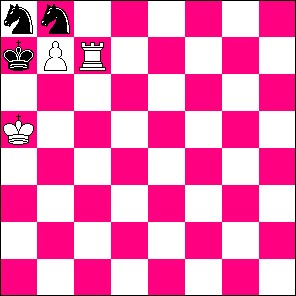
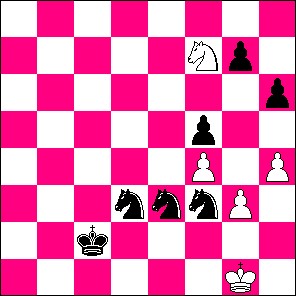
There seems to be some confusion about underpromotions. Some players believe the rule for underpromotion goes something like this: “a pawn, upon reaching the eighth rank can be promoted to any piece”. This definition can produce some rather interesting problems. For example, it is White to move and mate in the following two problems.


Zuckertort?
White to Mate in 1

2019_09_04_A


Unknown
White to Mate in 1

2019_09_04_B


White’s first move in both problems is, of course, an underpromotion. Just not to his own color. In the first diagram, White checkmates with 1.g8=black Knight, while in the second, he mates with 1.bxa8=Black Rook.


The exact rule for underpromotion is that a player may promote to a Queen, Rook, Bishop or Knight of his own color.


There is at least one more misunderstood area of underpromotion. Some players insist that you may not legally promote to a piece that did not come with the original set. That means you could not promote a pawn if you still had your original seven pieces (Not counting the King; if you need to promote to a King it probably means that you’ve already lost the game). And you certainly could not have three Knights on the board at the same time. The pawn then must remain immobile after reaching the 8th rank.


However, the rule clearly states that you may have three (or more!) Knights. You can promote to a dark colored Bishop, even if your original one is still on the board. You may also have as many as nine Queens at the same time (eight promoted pawns plus the original Queen). In fact, the biggest obstacle to having nine Queens at the same time may be your opponent, who may not want to defend against the armada!


This may seem simple enough, but there is still confusion out there in the tournament arena.


The following is a game played by the author;


Ko-Escalante
Southern California Open, 1996

2019_09_04_C


47.Nd3+ Kb1 48.Ke1 [48.Nc1? and Black can either play 48…Nf3+ or 48…Nf6 (with the idea of Ne4), winning in either case. Now back to the underpromotion theme. If Black promotes to a Queen, White would be forced to take the Queen with 49.Nxc1 Kxc1. The two Knights versus none are overwhelming, but if Black underpromotes then White could conceivably ignore the new piece. In any case, Black loses nothing by underpromoting.] 48…c1=N [Now White went off to the Tournament Director (TD), complaining that Black could not have three Knights on the board at the same time. And I should promote to a Queen. What did he expect to win by that argument!? The TD told him my move was legal and sent him back to the game. Where he promptly erred.] 49.Ne5? (Now three Knights versus one are better odds for White’s survival than two Knights versus none. But when White starts moving his Knight away, it becomes three knights versus none. And the White King is soon overwhelmed.) 49…Kc2 50.Kf1 Nd3 51.Nf7 Ne3+ 52.Kg1 Nf3+


2019_09_04_D

0-1 And mate next move.


Back to School!

Labor Day has traditionally been the last day of summer vacation. It’s a time to go back to school and re-engage the brain.


Perhaps you already started school. But whether you did or not, it’s time to exercise more than a suntan. We have to get you ready for your daily quizzes, your tests, and your exams.


What better way start than a short, but not-so-easy chess quiz?


So……


Here it is! You can’t use the Internet, nor books, and no help from your friends. It is a quiz, after all!


(well…. ok – you can use friendly help.)


Answers and explanations available on PDF file, should you need them (and you will).


~~~~~~~~~~~~~~~~~~~~~~~


Pub-Quizzes


ROB’S BASIC CHESS QUIZ


1) Where did the word, CHECKMATE, come from?


a) The Australians had morbid, slightly amusing, phrase that was most popular during WWII.  It was, “CHECK ON THE MATE PLEASE. HE’S DEAD”.

b) A term in which a sailing ship would briefly hit (or “checked”) another boat in order to board it, esp. in acts of piracy.

c) A Sanskrit phrase meaning “THE KING IS DEAD”.

d) An ancient Pharaoh’s curse.


2) Which chess piece is also the name of a GM?

(a) KING

(b) QUEEN

(c) ROOK

(d) KNIGHT

(e) SPRINGER


3) Who was not a World Chess Champion from the United States before Bobby Fischer?

(a) STEINITZ

(b) BERLINER

(c) LOMBARDY

(d) Trick Question! – Fischer was the first World Champion from the United States

(e) BELLE


4) Which word does not belong?

(a) CHECKMATE

(b) STALEMATE

(c) CASTLING

(d) RESIGNATION

(e) DRAW


5) Which word does not belong?

(a) KING

(b) QUEEN

(c) KNIGHT

(d) CASTLE

(e) PAWN

(f) ROOK

(g) RESIGN

(h) SACRIFICE

(i) ELO


6) Which word does not belong?

(a) PARIS

(b) MOSCOW

(c) VIENNA

(d) BERLIN

(e) BUDAPEST


7) A “RINGED PIECE” refers to:

 
(a) A pendant that hangs from the neck that is, or features, a chess piece.

(b) A piece of art created by Ringo Starr, who was inspired by Lennon’s chess set that featured two sets of white pieces to indicate harmony.

(c) A piece on the chessboard with a ring around it, indicating that this piece was to be the one to deliver the checkmate.


8) What is the definition of SCACCHIC?

(a) [n. the Computer World Champion for 1981.]

(b) [n. a famous correspondence player of the 1950’s who came up with a new move in the Two Knights Defence.]

(c) [adj. of or relating to chess.]

(d) [adj. referring to the queenside in chess.]

(e) [adj. referring to a dive into the ocean by leaping far off the side of a cliff.]


Answers below : 

Robs_Words_Quiz_Answers


Chess Computers in 1977

Before we start, I capitalize the name of chess playing computers to clarify who (or what?) is playing White or Black. Now let’s get to the main event.


~~~~~~~~~~~~~~~~~~~~~~~~~~~~~~~~~~~~~~~~~~~


computerchess1


Chess computers, of course, had been in development for a couple of decades before 1977. But in that year, several notable events brought the chess computer to the public’s attention.


But let’s first mention that the International Computer Chess Association was established, which is important to this article, even if the public was not aware of it.


More worthy for public interest was the first microcomputer chess playing machines, CHESS CHALLENGER and BORIS, were created and sold to the general public. You could now buy a computer to play chess. Even better was the fact they were not too strong and existed more of a novelty than a challenge, making them easy prey to most players. Nevertheless, I heard many people brag how they “beat the computer”, or they were “better than a computer”. What they sometimes forget to mention they played the same opening repeatedly, until they got the result they wanted. Not exactly cheating, but not entirely honest either! (I must pause and smile here, as I the only reason I didn’t do such things was that I couldn’t afford these machines).


Also, in 1977, CHESS 4.6, a stronger machine than either CHESS CHALLENGER or BORIS, became the first chess computer to win a major chess tournament. That occurred at 84th Minnesota Open in February of 1977. It achieved an Expert USCF rating.


In August, SNEAKY PETE played in the U.S. Open. It was the first machine to do so, was promoted and gathered much attention, but its results were not impressive.

The December 1977 issue of Chess Life and Review had this to say;


“Computers were everywhere during the U.S. Open. A major attraction for the entire tournament was SNEAKY PETE. The poor machine had to stick it out on Board 69 for the entire two weeks and was constantly surrounded and scrutinized by Class As and Experts. SNEAKY rated 1209, was so nervous he lost seven games in a row. And every back-rank mate was immortalized in the daily games bulletins.”


In 1977, Michael Stean, who earlier in the year earned the GM title, became the first Grandmaster to lose a computer program.


CHESS 4.6-GM Michael Stean
Blitz Game
London, 1977
1.e4 b6 2.d4 Bb7 3.Nc3 c5 4.dxc5 (This does not seem best. 4.d5!? is probably better.) 4…bxc5 5.Be3 d6 6.Bb5+ Nd7 7.Nf3 e6 8.O-O a6 9.Bxd7+ Qxd7 10.Qd3 Ne7 11.Rad1 Rd8 12.Qc4 Ng6 13.Rfe1 Be7 14.Qb3 Qc6 15.Kh1 O-O 16.Bg5 Ba8 17.Bxe7 Nxe7 18.a4 Rb8 19.Qa2 Rb4 20.b3 f5 21.Ng5 fxe4 22.Ncxe4 Rxf2 23.Rxd6 Qxd6 24.Nxd6 Rxg2 25.Nge4 Rg4 26.c4 Nf5 27.h3 Ng3+ 28.Kh2 Rxe4 29.Qf2 h6 30.Nxe4 Nxe4 31.Qf3 Rb8 32.Rxe4 Rf8 33.Qg4 Bxe4 34.Qxe6+ Kh8 35.Qxe4 Rf6 36.Qe5 Rb6 37.Qxc5 Rxb3 38.Qc8+ Kh7 39.Qxa6 1-0

 
But this was a blitz game. Chess computers still could not compete against World Champions, either current or past, in blitz games, or under tournament conditions.


Fischer (yes, that one!) play three games against a chess computer. The first one is the most well-known and perhaps his best effort.


Greenblatt was the name of the programmer. I do not know the name of his computer, or if it even had one, so I’ll just use his name.


Here are the three games Fischer was known to have played after his 1972 World Championship win.


GM Fischer-GREENBLATT
Cambridge, 1977
1.e4 e5 2.f4 exf4 3.Bc4 d5 4.Bxd5 Nf6 5.Nc3 Bb4 6.Nf3 O-O 7.O-O [Fischer liked to experiment with the Bishop’s Gambit, probably as a result of publishing an article titled, The King’s Gambit is Busted, where he showed how Black should win after 1.e4 e5 2.f4 exf4 3.Nf3 d6. Here’s a game from his simul tour of 1964: GM Fischer-Nyman, Simul, Cicero, May 20 1964, 7.O-O Bxc3 8.dxc3 c6 9.Bc4 Qb6+ 10.Kh1 Nxe4 11.Qe1 Re8 12.Bxf4 Nd6 13.Bxd6 Rxe1 14.Raxe1 Bd7 15.Ng5 Na6 16.Rxf7 1-0.] 7…Nxd5 8.Nxd5 Bd6 9.d4 g5 10.Nxg5 Qxg5 11.e5 Bh3 12.Rf2 Bxe5 13.dxe5 c6

2019_08_22_A
14.Bxf4 +- Qg7 15.Nf6+ Kh8 16.Qh5 Rd8 17.Qxh3 Na6 18.Rf3 Qg6 19.Rc1 Kg7 20.Rg3 Rh8 21.Qh6mate 1-0


GREENBLATT-GM Fischer
Cambridge, 1977
1.e4 c5 2.Nf3 g6 3.d4 Bg7 4.Nc3 cxd4 [Black tried the original 4…b6 in GM Božidar Ivanović-Grigic, Vinkovic, 1982 and lost after the spectacular 5.dxc5! bxc5 6.Qd5 Bxc3+ 7.bxc3 Qa5 8.Qxa8 Qxc3+ 9.Kd1! 1-0.] 5.Nxd4 Nc6 6.Be3 Nf6 7.Nxc6 bxc6 8.e5 Ng8 9.f4 f6 10.exf6 Nxf6 11.Bc4 d5 12.Be2 Rb8 13.b3 Ng4 14.Bd4 e5 15.fxe5 O-O 16.Bxg4 Qh4+ 17.g3 Qxg4 18.Qxg4 Bxg4 19.Rf1 Rxf1+ 20.Kxf1 c5 21.Bf2 Bxe5 22.Be1 Rf8+ 23.Kg2 Rf3 24.h3 Rxc3 25.Bxc3 Bxc3 26.Rf1 Bf5 27.Rf2 h5 28.Re2 Kf7 29.Re3 Bd4 30.Rf3 Ke6 31.c3 Be5 32.Re3 d4 33.cxd4 cxd4 34.Re1 d3 35.h4 d2 36.Rd1 Bc3 37.Kf2 Bg4 38.Rh1 Bd4+ 39.Kg2 [Any player would automatically see that promoting the pawn would force White to part with his rook for bishop (winning the exchange and eventually win the game). Fischer, however, wants the rook for free.]
2019_08_22_B
39…Kd5! 40.a3 Ke4 41.Rf1 Kd3 42.Kh2 Ke2 43.Kg2 Bh3+ 44.Kxh3 Kxf1 45.b4 d1=Q 46.Kh2 Qe2+ 47.Kh3 Qg2mate 0-1


GREENBLATT-GM Fischer
Cambridge, 1977
1.e4 c5 2.Nf3 d6 3.d4 cxd4 4.Nxd4 Nf6 5.Nc3 a6 6.Be2 e5 7.Nb3 Be7 8.Be3 O-O 9.Qd3 Be6 10.O-O Nbd7 11.Nd5 Rc8 12.Nxe7+ Qxe7 13.f3 d5 14.Nd2 Qb4 15.Nb3 dxe4 16.Qd1 Nd5 17.Ba7 b6 18.c3 Qe7 19.fxe4 Ne3 20.Qd3 Nxf1 21.Qxa6 Ne3 22.Bxb6 Qg5 23.g3 Ra8 24.Ba7 h5 25.Qb7 h4 26.Kf2 hxg3+ 27.hxg3 f5 28.exf5 Rxf5+ 29.Ke1 Raf8 30.Kd2 Nc4+ 31.Kc2 Qg6 32.Qe4 Nd6 33.Qc6 Rf2+ 34.Kd1 Bg4 35.Bxf2 Qd3+ 36.Kc1 Bxe2 37.Nd2 Rxf2 38.Qxd7 Rf1+ 39.Nxf1 Qd1mate 0-1


It would take another two decades for chess computers to score a win against World Champion.

An Introduction to the Magnus Smith Trap.

An early …Nc6 in the Sozin Dragon (1.e4 c5 2.Nf3 d6 3.Nc3 Nf6 4.d4 cxd4 5.Nxd4 g6 6.Bc4 Nc6?!) is not particularly useful, or even safe, for Black. White has a forceful reply with after 7.Nxc6 bxc6 8.e5. It’s now more commonly known as the Magnus Smith trap.


The trap was well known before the 20th century. A 19th century example is given below.


Blackburne-Paulsen
Vienna, 1882
1.e4 c5 2.Nf3 Nc6 3.Nc3 Nf6 4.d4 cxd4 5.Nxd4 d6 6.Bc4 g6 7.Nxc6 bxc6 8.e5 Ng4 9.exd6 Qxd6 10.Qe2 Bg7 11.Ne4 Qc7 12.h3 Ne5 13.Bf4 Nd3+ 14.cxd3 Qxf4 15.O-O O-O 16.Rac1 Rb8 17.Rc2 Rb6 18.a3 Be5 19.g3 Qf5 20.g4 Qf4 21.Ng3 Qd4 22.Qf3 Rxb2 23.Ne2 Qb6 24.Rxb2 Qxb2 25.d4 Bd6 26.a4 Bb7 27.Qd3 Qb6 28.Rb1 Qc7 29.h4 Qd7 30.Qf3 Bc8 31.g5 Qh3 32.Qxh3 Bxh3 33.Rb3 Bc8 34.Nc3 Kg7 35.Ne4 Bc7 36.d5 cxd5 37.Bxd5 Rd8 38.Bc6 Bb6 39.Kg2 f5 40.gxf6+ exf6 41.h5 f5 42.Ng5 Rd2 43.Nh3 Rd6 44.Bf3 Rd2 45.hxg6 hxg6 46.Bc6 Kh6 47.Kg3 g5 48.Rc3 g4 49.Be8 Bb7 50.Bc6 Ba6 51.Bg2 gxh3 52.Rc6+ Kg7 53.Bxh3 Bb7 54.Re6 Bxf2+ 55.Kh2 Bh4+ 56.Kg1 Bd5 57.Rd6 Bf2+ 0-1

 
So why is this trap known as the Magnus Smith trap, and not the Blackburne trap?


For at least two reasons. One is that Blackburne didn’t play the best moves and lost the game, so most players did not notice how powerful White’s attack could be.


Secondly, the first known player to properly analyze the trap and have it published was the Canadian player, Magnus Smith (1869–1934). A player of master strength, he played this now well-known trap against Kreymborg in the sixth round of the 1911 New York Masters Open and won in 49 moves.


This game, plus a related article by Smith, was published in the March 1911 issue of the American Chess Bulletin. The game can be found on page 59 and the article on pages 62-63.


Magnus Smith-Alfred Kreymborg
New York Masters Open, 1911
1.e4 c5 2.Nf3 Nc6 3.d4 cxd4 4.Nxd4 Nf6 5.Nc3 d6 6.Bc4 g6 7.Nxc6 bxc6 8.e5 Ng4 (Of course not, 8…dxe5?? because of 9.Bxf7+, winning the queen. A trap not easy to see, but only if you have seen it played before. Many beginners have been on the wrong side of it.) 9.Bf4 (This is perhaps White’s best move.) 9…d5 (The text move, along with 9…Qb6 10.Qf3, are the two main responses to 9.Bf4.) 10.Nxd5 cxd5 11.Bxd5 Be6 12.Bc6+ Bd7 13.Bxa8 Qxa8 14.O-O Bg7 15.Re1 h5 16.Qd2 Bc6 17.Rad1 Nh6 18.c4 Nf5 19.f3 O-O 20.Qc2 e6 21.b4 a6 22.a4 Qa7+ 23.Kh1 Rc8 24.b5 Be8 25.Qe4 Bf8 26.Re2 Be7 27.g4 hxg4 28.fxg4 Ng7 29.Be3 Qa8 30.Qxa8 Rxa8 31.Rc1 axb5 32.axb5 Rc8 33.Kg2 Kf8 34.Kf3 Bd7 35.Rd1 Be8 36.Rc1 Bd7 37.Ra2 Bd8 38.Rd2 Be8 39.Rb2 Rb8 40.Ke2 Bc7 41.Bd4 Bd7 42.Rcb1 Ne8 43.c5 f6 44.c6 fxe5 45.Be3 Bc8 46.b6 Bd6 47.b7 e4 48.Ba7 Be5 49.Bxb8 1-0


The Magnus Smith trap has been named after him for his game, commentary, and publication of this now well-known trap.

 
Let’s look at some other games with this trap.


After 8.e5 Black has 8…Nh5, but this is not recommended as White has 9.Qf3!, which is almost winning.


GM Fischer-N.N.
Simul
New York, 1963
1.e4 c5 2.Nf3 Nc6 3.d4 cxd4 4.Nxd4 Nf6 5.Nc3 d6 6.Bc4 g6 7.Nxc6 bxc6 8.e5 Nh5 9.Qf3 e6 (9…d5? 10.Nxd5! cxd5 11.Bxd5) 10.g4 Ng7 11.Ne4 Qa5+ (11…d5? 12.Nf6+ Ke7 13.Qa3+ Qd6 14.Qxd6#) 12.Bd2 Qxe5 13.Bc3 (trapping the Queen.)
2019_08_15_A
1-0


Bilek-Bachtiar
Beverwijk, 1966
1.e4 c5 2.Nf3 Nc6 3.d4 cxd4 4.Nxd4 Nf6 5.Nc3 d6 6.Bc4 g6 7.Nxc6 bxc6 8.e5 Nh5 9.Qf3 e6 10.exd6 Qxd6 11.O-O Bb7 12.Rd1 Qc5 13.Qd3 (with the threat of 14.Qd7#) 13…Qe7 (13…Nf6 14.Ne4!) 14.Bg5! f6 15.Be3 Kf7 16.Qd7 (threatening 17.Bxe6 Qg7 18.Qxe7+ Bxe7 19.Rd7 ; 16…Ng7 17.Bc5) 1-0


Sarapu-Cornford
New Zealand Ch.
Christchurch, 1967
1.e4 c5 2.Nf3 Nc6 3.d4 cxd4 4.Nxd4 Nf6 5.Nc3 d6 6.Bc4 g6 7.Nxc6 bxc6 8.e5 Nh5 9.Qf3 e6 10.exd6 Qxd6 11.g4 Ng7 12.Bf4 e5 13.Bxf7+ Kd7 14.Rd1 exf4 15.O-O Ba6 16.Ne4 Bxf1 17.Nxd6 Bxd6 18.Qxf4 1-0

 
Black also has the better 8…Nd7, but White again gets the advantage.


GM Fischer-Wilkerson
Clock Simul
Davis, Apr. 16 1964
1.e4 c5 2.Nf3 Nc6 3.d4 cxd4 4.Nxd4 Nf6 5.Nc3 d6 6.Bc4 g6 7.Nxc6 bxc6 8.e5 Nd7 9.exd6 exd6 10.O-O d5 11.Nxd5 +/- Nc5 (11…cxd5 12.Qxd5! +-) 12.Qd4 cxd5 13.Bb5+ Bd7 14.Bxd7+ Qxd7 15.Qxh8 f5 16.Re1+ Ne6 17.Qf6 1-0


Imannuel Guthi-E. O’Hare
Tel Aviv Ol.
Israel, 1964
1.e4 c5 2.Nf3 Nc6 3.d4 cxd4 4.Nxd4 Nf6 5.Nc3 d6 6.Bc4 g6 7.Nxc6 bxc6 8.e5 Nd7 9.exd6 exd6 10.O-O d5 11.Nxd5 Nc5 12.Qf3 (with the idea of Nf6+) 12…f5 (better is 12…Bg7) 13.Re1+ Kd7 (13…Ne4 14.Rxe4+ fxe4 15.Qxe4+ +-; 13…Kf7 14.Nc7+ and Ne8+ +-) 14.Bf4 Ne4 15.Rad1 Nd6 16.Nb4 Qb6 17.Qc3 Bb7 18.Be6+ (18.Rxd6+ Bxd6 19.Qe7+ +-) 18…Kc7 19.Nd5+ 1-0


Rhee-Hinrichsen
El Segundo, CA, 1969
1.e4 c5 2.Nf3 Nc6 3.d4 cxd4 4.Nxd4 d6 5.Nc3 Nf6 6.Bc4 g6 7.Nxc6 bxc6 8.e5 Nd7 9.exd6 exd6 10.O-O Be7 11.Re1 O-O 12.Bh6 Re8 13.Qf3 d5 14.Nxd5 Bb7

2019_08_15_B
15.Qxf7+!! Kxf7 16.Ne3+ Kf6 17.Ng4+ Kf5 18.Be6mate 1-0


Silva-Sosonko
Lucerne Ol., 1982
1.e4 c5 2.Nf3 Nc6 3.d4 cxd4 4.Nxd4 Nf6 5.Nc3 d6 6.Bc4 g6 7.Nxc6 bxc6 8.e5 Nd7 9.exd6 Qxd6 10.Qxd6 exd6 11.Bf4 Be6 12.Bb3 d5 13.h3 Nf6 14.Be5 Be7 15.O-O O-O 16.Rhe1 Nd7 17.Bf4 Nc5 18.Ne2 a5 19.Nd4 Rfc8 20.c3 Bf6 21.Bc2 Bd7 22.Be5 Kg7 23.Bxf6+ Kxf6 24.Re3 Re8 25.Rde1 Rxe3 26.Rxe3 Ne6 27.Ba4 Rc8 28.Nf3 Ra8 29.Nd4 Ra6 30.Nf3 Ke7 31.c4 Rb6 1/2-1/2


Ladic (2195)-Mutapcic
Croatia U20 Team Ch.
Medulin, 1997
1.e4 c5 2.Nf3 d6 3.d4 cxd4 4.Nxd4 Nf6 5.Nc3 Nc6 6.Bc4 g6 7.Nxc6 bxc6 8.e5 Nd7 9.exd6 e5?! 10.Qf3 Nf6 11.Bg5 Bg7 12.Ne4 Bf5 13.Nxf6+ Bxf6 14.Bxf6 e4 15.Qc3 Qxd6 16.Bxh8 O-O-O 17.Ba6+ 1-0


Which brings us back to 9…Ng4, which as mentioned before, is Black’s best move as he has some counterplay. But it’s not an easy thing to discover, especially with the clock ticking in a rated OTB game.


White has two good responses here; 9.e6 and 9.Bf4.


Let’s see games from both.


Schlechter-Lasker
World Ch.
Berlin, 1910
1.e4 c5 2.Nf3 Nc6 3.d4 cxd4 4.Nxd4 Nf6 5.Nc3 d6 6.Bc4 g6 7.Nxc6 bxc6 8.e5 Ng4 9.e6 f5 10.O-O Bg7 11.Bf4 (It seems White has the advantage and should win. But Lasker was at his best when facing an uphill battle.) 11…Qb6 12.Bb3 Ba6 13.Na4 Qd4 14.Qxd4 Bxd4 15.c4 O-O 16.Rad1 Bf6 17.Rfe1 g5 18.Bxd6 exd6 19.Rxd6 Be5 20.c5 Rfe8 21.g3 Bf6 22.Rxc6 Bb7 23.Rc7 Be4 24.Nc3 Bxc3 25.bxc3 Ne5 26.Rd1 Nf3+ 27.Kf1 Nxh2+ 28.Ke1 Nf3+ 29.Ke2 Ne5 30.Rdd7 f4 31.Rg7+ Kh8 32.Rxg5 Bd3+ 33.Kd1 fxg3 34.fxg3 Ng6 35.Rd5 Be4 36.Rd6 Bf5 37.Bd5 Rab8 38.c6 Nf8 39.Rb7 Rbc8 40.e7 Ng6 41.Bf7 Rxe7 42.Bxg6 Bg4+ 43.Kc1 Re1+ 44.Kb2 hxg6 45.Rxg6 Bf5 46.Rf6 Be4 47.Rxa7 Rb1+ 48.Ka3 Bxc6 1/2-1/2


Blatny-Dasek
Chocen, 1950
1.e4 c5 2.Nf3 Nc6 3.d4 cxd4 4.Nxd4 Nf6 5.Nc3 d6 6.Bc4 g6 7.Nxc6 bxc6 8.e5 Ng4 9.e6 f5 10.Bf4 d5
2019_08_15_C
11.Nxd5 cxd5 12.Bb5+ (A tactic worth remembering.) 1-0


M. Costa-Saltzberg
US Open, 1972
1.e4 c5 2.Nf3 Nc6 3.d4 cxd4 4.Nxd4 Nf6 5.Nc3 d6 6.Bc4 g6 7.Nxc6 bxc6 8.e5 Ng4 9.e6 f5 10.Qe2 Bg7 11.h3 Nf6 12.h4 d5 13.Ba6 Bxa6 14.Qxa6 Qd6 15.Qe2 O-O 16.Bd2 Rab8 17.O-O Rxb2 18.Kxb2 Ne4 19.Rb1 Qb4+ 20.Kc1 Qa3+ 21.Kd1 Bxc3 22.Rb3 Qxa2 23.Bxc3 Qxb3 24.Qxe4 Qxc3 25.Qa4 Rb8 26.Ke2 Rb4 27.Qxa7 Qxc2+ 28.Ke3 f4+ 29.Kf3 Qe4+ 0-1


Reijnen-Marino
corres.
IECG 1995
1.e4 c5 2.Nf3 Nc6 3.d4 cxd4 4.Nxd4 Nf6 5.Nc3 d6 6.Bc4 g6 7.Nxc6 bxc6 8.e5 Ng4 9.e6 f5 10.Bb3 Bg7 11.O-O Ba6 12.Re1 Be5 13.h3?
2019_08_15_D
13…Bh2+ (14.Kh1 Nxf2+) 0-1


And now for 9.Bf4, which is best approach as it activates a piece and keeps pressure on some key squares. Here’s another reason to think it’s the best move. Any move that is preferred in correspondence chess is usually the best, as correspondence players have days, and even longer, to decide on their next move.


Flykt-Johansson
corres., 1947
1.e4 c5 2.Nf3 Nc6 3.d4 cxd4 4.Nxd4 Nf6 5.Nc3 d6 6.Bc4 g6 7.Nxc6 bxc6 8.e5 Ng4 9.Bf4 Qb6 10.Qf3 e6 11.exd6 Bg7 12.O-O-O Ne5 13.Bxe5 Bxe5 14.d7+ Bxd7 15.Rxd7 1-0


Beach-Graham
corres.
Great Britain, 1975
1.e4 c5 2.Nf3 Nc6 3.d4 cxd4 4.Nxd4 Nf6 5.Nc3 d6 6.Bc4 g6 7.Nxc6 bxc6 8.e5 Ng4 9.Bf4 Qb6 10.Qf3 Bf5 11.exd6 e5 12.d7+ Kxd7 13.Rd1+ Bd6 14.Bc1 Rhf8 15.h3 Nf6 16.g4 Qb4 17.Bb3 Be4 18.Qxf6 Bxh1 19.a3 Qb7 20.Bg5 Bd5 21.Nxd5 cxd5 22.Bxd5 Qxb2 23.Bxa8 1-0


Kapic-Movre
corres.
Yugoslavia Ch., 1978
1.e4 c5 2.Nf3 Nc6 3.d4 cxd4 4.Nxd4 Nf6 5.Nc3 d6 6.Bc4 g6 7.Nxc6 bxc6 8.e5 Ng4 9.Bf4 Qb6 10.Qf3 dxe5 11.Bxf7+ Kd8 12.Bg3 Bg7 13.O-O Kc7 14.Qe2 Rf8 15.h3 Ne3 16.Bb3 Nxd1 17.Bxe5+ Bxe5 18.Qxe5+ Kd8 19.Rxd1+ Ke8 20.Re1 Qb4 21.Re4 Qb7 22.Nd5 1-0

Markotic-Tomkowicz
corres., 1980
1.e4 c5 2.Nf3 Nc6 3.d4 cxd4 4.Nxd4 Nf6 5.Nc3 d6 6.Bc4 g6 7.Nxc6 bxc6 8.e5 Ng4 9.Bf4 Bh6 10.e6 Bxf4 11.Qxg4 Be5 12.exf7+ Kf8 13.Qf3 d5 14.Bb3 Kg7 15.O-O e6 16.h4 Rf8 17.Ne2 Qf6 18.Qxf6+ Bxf6 19.f4 Rxf7 20.c3 a5 21.Ba4 c5 22.g3 Rb8 23.Rhe1 Rfb7 24.Rd2 Rb6 25.Ng1 Bxc3 0-1


Hentzgen-Melzer
corres.
E. Germany, 1988
1.e4 c5 2.Nf3 Nc6 3.d4 cxd4 4.Nxd4 Nf6 5.Nc3 d6 6.Bc4 g6 7.Nxc6 bxc6 8.e5 Ng4 9.Bf4 d5 10.Nxd5 Bg7 11.e6 cxd5 12.exf7+ Kf8 13.Qxd5 Bf5 14.h3 Nf6 15.Qxd8+ Rxd8 16.c3 h5 17.Ke2 e6 18.Be3 a5 19.f3 Kxf7 20.Rhd1 Nd5 21.Bxd5 exd5 22.Kf2 Rb8 23.Rd2 Be6 24.Re1 Rhe8 25.Bf4 Rb7 26.g4 hxg4 27.hxg4 Bf6 28.g5 Bxg5 29.Bxg5 Reb8 30.Ree2 Rb5 31.Kg3 Rh8 32.Rd4 Rh5 33.Bf4 Rh1 34.Bd6 g5 35.a4 Rb3 36.Bc7 Rb1 37.Rdd2 Ra1 38.Bxa5 Rxa4 39.Bb4 Ra2 40.f4 gxf4+ 41.Kxf4 d4 42.Rf2 dxc3 43.Ke5+ Kg6 44.Bxc3 Ra4 45.Kxe6 1-0


Vayrynen-Ullrich
corres., 1990
1.e4 c5 2.Nf3 Nc6 3.d4 cxd4 4.Nxd4 Nf6 5.Nc3 d6 6.Bc4 g6 7.Nxc6 bxc6 8.e5 Ng4 9.Bf4 d5 10.Nxd5 cxd5 11.Bxd5 Bf5 12.f3 Nh6 13.Bxa8 Qxa8 14.Qd2 Ng8 15.O-O h5 16.Be3 Bg7 17.Qa5 Nh6 18.Qa4+ 1-0


Rezan-Kuraja
Croatian Cup
Pula, 1996
1.e4 c5 2.Nf3 Nc6 3.d4 cxd4 4.Nxd4 d6 5.Nc3 Nf6 6.Bc4 g6 7.Nxc6 bxc6 8.e5 Ng4 9.Bf4 d5 10.Nxd5 cxd5 11.Qxd5 Qxd5 12.Bxd5 Rb8 13.h3 Nh6 14.Bc6+ Kd8 15.e6 Rb6
2019_08_15_E
16.O-O-O+ Bd7 17.Rxd7+ Kc8 1-0


So the main line of the Magnus Smith is 1.e4 c5 2.Nf3 Nc6 3.d4 cxd4 4.Nxd4 Nf6 5.Nc3 d6 6.Bc4 g6 7.Nxc6 bxc6 8.e5 Ng4 9.Bf4. There are many alternate moves to the games above. And I’ll let you explore them on your own.

THE HORIZON EFFECT

Wikipedia defines the horizon effect as: a problem in artificial intelligence whereby, in many games, the number of possible states or positions is immense and computers can only feasibly search a small portion of them, typically a few plies down the game tree. Thus, for a computer searching only five plies, there is a possibility that it will make a detrimental move, but the effect is not visible because the computer does not search to the depth of the error (i.e., beyond its “horizon”).


What it means, in more understandable words, is that when a chess computer finds a move, or a series of moves, that loses material, or some other advantage, it stops analyzing that move or series of moves. This can lose the game, or at least the advantage, as it fails to see a strong reply or the continuation of play that will allow it to retain or increase its advantage.

 
An early example of the horizon effect can be found in this game.

 
De Legal-Saint Brie?
France, 1750
1.e4 e5 2.Nf3 d6 3.Bc4 Bg4 4.Nc3 Nc6

De_Legal
5.Nxe5 Bxd1?? (There were many computers in the early 1980’s would simply take the offered queen, as it was taught that being up a queen would lead to victory and would therefore stop analyzing. This simple trap caused consternation and scorn by some players as they wanted a “serious” chess computer. By the way, this trap is known as De Legal’s mate.) 6.Bxf7+ Ke7 7.Nd5mate 1-0

 
A more recent example can be found in this game:


Escalante-“andersonwillians” (1511)
Najdorf Thematic Tournment
Chess.com, July-August 2019
1.e4 c5 2.Nf3 d6 3.d4 cxd4 4.Nxd4 Nf6 5.Nc3 a6 6.Bc4 g6 7.f3 Bg7 8.Be3 O-O 9.Qd2 Nc6 10.O-O-O Bd7 (The Najdorf has transposed into a Dragon, B77 to be exact.) 11.g4 Rc8 12.Be2 Ne5 13.h4 Nc4 14.Bxc4 Rxc4 15.h5 Qc7 16.Kb1 Rc8 17.hxg6 hxg6 18.Nde2 (This is an important move as it provides another piece to guard c3 and puts a stop to Black’s attack.) 18…Be6 19.Bh6 Bh8?
2019_08_08_A
20.Bf8! (This keeps the Black’s king from escaping to the center.) 20…Kxf8 (Not 20…Rxf8 21.Qh6! +-. Best for Black is 20…Nh5 21.Rxh5 gxh5 22.Qh6 Rxf8 23.Rh1 Bg7 24.Qxh5, and now if 24…f5 25.Nf4! wins on the spot.) 21.Rxh8+ Ng8

2019_08_08_B
22.Rxg8+! (The chess.com computer recommends 22.Qh6+ Ke8 23.Rxg8+ Kd7 24.Rxc8 Qxc8 25.e5 Kc7 26.exd6+ exd6, when White is obviously winning. But the text move is better as it leads to a forced mate. So why did chess.com computer miss this move? Probably because it saw that White loses the exchange and concluded that’s not a good way to proceed. So it stopped analyzing.) 22…Kxg8 23.Qh6! f6 (Black is in Zugzwang, as his king is paralyzed and he can’t get help in time. 23…d5 24.Rh1 +-) 24.Qxg6+ Kf8 25.Rh1 1-0 (25…Bg8 26.Rh8 e6 and now either 27.Qxg8+ or 27.Rxg8+ mates.)


Najdorf Miniatures

I’ve entered another Najdorf thematic tournament. This is a good way to (really) learn an opening.


There are many approaches to learning an opening. One can consult an expert in the variation (but illegal once the games begin). Another approach is to gather up the books, a board, pens, paper, and some highlighters.


My favorite approach to play over some miniatures and learn some tactics and ways to take down an opponent quickly. It saves time on studying. Extra time to take down other opponents. Plus, it’s fun!

 
Here are some Najdorf miniatures.


They are breathtaking in their elegance, clarity, and forcefulness. And they all begin with the moves 1.e4 c5 2.Nf3 d6 3.d4 cxd4 4.Nxd4 Nf6 5.Nc3 a6.

 
To warm up the tactic monster in you we’ll start with some games that are not exactly main line.


Markus Loeffler (2426)-J. Ramseier
Ticino Open
Mendrisio, Oct. 30 1999
1.e4 c5 2.Nf3 d6 3.d4 cxd4 4.Nxd4 Nf6 5.Nc3 a6 6.Qf3!? (Not exactly book, but White is trying to lay claim to some key squares.) 6…Qc7 7.Bg5 Nbd7 8.O-O-O b5 9.Nd5 Qa5 10.Nc6 1-0


GM Onischuk (2581)-IM Bajarani (2417)
Voronezh Master Open
Russia, June 14 2013
1.e4 c5 2.Nf3 d6 3.d4 cxd4 4.Nxd4 Nf6 5.Nc3 a6 6.Nb3!? g6 7.Be2 Bg7 8.O-O O-O 9.Re1 Nbd7 10.a4 b6 11.Be3 Bb7 12.f3 Qc7 13.Qd2 Rfe8 14.Red1 Rac8 15.Bf1 Nc5 16.Qf2 Nfd7 17.Nd4 Qb8 18.Rd2 Ne5 1-0


GM David Anton Guijarro (2631)-GM Hao Wang (2729)
FIDE World Blitz Ch.
Dubai, June 19 2014
1.e4 c5 2.Nf3 d6 3.d4 cxd4 4.Nxd4 Nf6 5.Nc3 a6 6.Qd3!? Nbd7 7.Be2 Nc5 8.Qe3 e6 9.Bd2 Be7 10.g4 d5 11.exd5 exd5? 12.O-O-O O-O 13.f3 Bd7 14.g5 Nh5? 15.f4 g6 16.Bxh5 gxh5 17.Nxd5 Re8 18.Bc3 Bg4 19.Nf5! Bxf5 20.Qe5 f6 21.Qxf5 Qc8 22.Nxf6+ 1-0

 
6.Rg1 is relatively unexplored and rare in OTB tournaments. Just perfect for correspondence play!


M. Mahjoob (2510)-R. Kalugampitiya (2135)
Tata Steel Team Ch.
Kolkata, India, Dec. 27 2009
1.e4 c5 2.Nf3 d6 3.d4 cxd4 4.Nxd4 Nf6 5.Nc3 a6 6.Rg1!? (White takes command of the g-file, important in many variations of the Najdorf.) 6…b5 7.g4 Bb7 8.g5 Nxe4 9.Nxe4 Bxe4 10.Qg4 Bb7 11.Bg2 Bxg2 12.Qxg2 Nd7

2019_08_01_A
13.g6! e6 (Black can’t take the pawn due to 13…hxg6 14.Ne6! fxe6 15.Qxg6#. If instead Black moves his queen, then White wins material. I’ll you figure it out.) 14.gxf7+ Kxf7 15.Bg5 Qc8 16.O-O-O Ra7 17.Nxe6 1-0

 
Here are two more games with the interesting 6.Rg1!?.


Luis Esquivel (2212)-Neuris Delgado (2254)
G. Garcia Memorial
Santa Clara, Cuba, June 2 2004
1.e4 c5 2.Nf3 d6 3.d4 cxd4 4.Nxd4 Nf6 5.Nc3 a6 6.Rg1 e5 (A common reply to 6.Rg1.) 7.Nb3 h5 8.Bg5 Be6 9.Qd2 Nbd7 10.O-O-O Rc8 11.f4 Be7 12.f5 Bc4 13.Bxc4 Rxc4 14.Qd3 b5 15.Rge1 Qc8 16.Bxf6 Nxf6 17.Re2 Qc7 18.Nd5 Nxd5 19.Qxd5 O-O 20.f6 Bxf6 21.Qxd6 Bg5+ (22.Kb1 Rd8 23.Qxc7 Rxd1+ 24.Nc1 Rxc1#.) 0-1


Wojciech Moranda (2451)-Roman Nechepurenko (2431)
European Jr. Ch.
Herceg Novi, Sept. 2005
1.e4 c5 2.Nf3 d6 3.d4 cxd4 4.Nxd4 Nf6 5.Nc3 a6 6.Rg1 e5 7.Nb3 b5 8.g4 Bb7 9.Bg2 b4 10.Nd5 Nxd5 11.exd5 Be7 12.a3 bxa3 13.Rxa3 a5 14.Ra4 Nd7 15.Bd2 Nb6 16.Bxa5 Qc8 17.Ra2 O-O 18.Nc1 Nc4 19.Bc3 Rxa2 20.Nxa2 Qc5 21.Be4 Bh4 22.Qe2 Ra8 23.b3 Rxa2 24.bxc4 Ra3 (White faces the embarrassing 25.Bb2 Re3! -+) 0-1

 
The move 6.a4 leads to a slower game. But one can lose the game just as quickly.


Karasov-Korsunsky
Sevastopol, 1978
1.e4 c5 2.Nf3 d6 3.d4 cxd4 4.Nxd4 Nf6 5.Nc3 a6 6.a4 e6 7.a5 b5 8.axb6 Qxb6 9.Be3 Ng4 10.Qxg4 Qxb2 11.Bb5 Nd7 12.Kd2 axb5 13.Rxa8 Ne5 14.Qe2 Nc4 15.Qxc4 bxc4 16.Rxc8 Kd7 17.Ra8 1-0


Balashov-Sunye Neto
Wijk aan Zee, 1982
1.e4 c5 2.Nf3 d6 3.d4 cxd4 4.Nxd4 Nf6 5.Nc3 a6 6.a4 e5 7.Nf3 h6 8.Bc4 Qc7 9.Bb3 Be6 10.O-O Nbd7 11.Nh4 g5 12.Nf5 Nc5 13.Ne3 Nxb3 14.cxb3 Rd8 15.Bd2 Bg7 16.Rc1 Qb8 17.Ncd5 Nxd5 18.exd5 Bd7 19.h4 Bf6 20.Qf3 Ke7 21.Bb4 b5 22.Rc6 1-0

 
The move 6.Be3 is an interesting combination of tactics and strategy. It’s played by many Grandmasters. Let’s take a close look.


Perenyi-Lengyel, 1983
1.e4 c5 2.Nf3 d6 3.d4 cxd4 4.Nxd4 Nf6 5.Nc3 a6 6.Be3 b5 7.a4 bxa4 8.Rxa4 e6 9.Bb5+ Nfd7 10.O-O Bb7 11.Bc4 Nc5 12.Rb4 Qc8 13.f4 Be7 14.f5 e5 15.f6 exd4 16.fxg7 Rg8 17.Bxf7+ Kd7 18.Rxb7+! 1-0


Nicolau (2290)-Nowarra
Subotica, Yugoslavia, 1967
1.e4 c5 2.Nf3 d6 3.d4 cxd4 4.Nxd4 Nf6 5.Nc3 a6 6.Be3 e6 7.Qf3 Nbd7 8.O-O-O Qc7 9.Be2 Ne5 10.Qg3 b5 11.f4 Nc4 12.e5 dxe5 13.fxe5 Nxe3 14.Qxe3 Nd7 15.Rhf1 Nxe5 16.Ncxb5 axb5 17.Bxb5+ Bd7 18.Bxd7+ Nxd7 19.Qf3 Nb6 20.Nb5 1-0


IM J. Peters (2572)-O. Maldonado (2275)
American Open
Los Angeles, Nov. 1995
1.e4 c5 2.Nf3 Nc6 3.d4 cxd4 4.Nxd4 Nf6 5.Nc3 d6 6.Be2 e6 7.Be3 Be7 8.Qd2 a6 9.O-O-O Qc7 10.f4 O-O 11.Rhg1 Re8 12.g4 Nd7 (Jack Peters suggested 12…Nxd4 13.Bxd4 e5.) 13.g5 Rb8 14.h4 b5 15.h5 b4

2019_08_01_B
16.g6! (Again, the move g6. Maybe there is something to attacking with one’s own g-pawn.) 16…Nc5 17.gxf7+ Kxf7 18.Nf5! exf5 19.Bc4+ Kf8 20.Bxc5 Na5 21.Qd5 1-0

 
White can try to include a Keres Attack (an early g4) plan with Be3. But that idea seems risky.


GM Shirov (2746)-GM Van Wely (2643)
Istanbul Ol
Turkey, 2000
1.e4 c5 2.Nf3 d6 3.d4 cxd4 4.Nxd4 Nf6 5.Nc3 a6 6.Be3 e6 7.g4 e5 8.Nf5 g6 9.g5 gxf5 10.exf5 d5 11.Qf3 d4 12.O-O-O Nbd7 13.Bd2 Qc7 14.gxf6 dxc3 15.Bxc3 Qc6 16.Qg3 Qxh1 17.Bg2 Bh6+ 18.Bd2 Bxd2+ 19.Kxd2 Qxg2 20.Qxg2 a5 21.f4 exf4 22.Qg7 Rf8 23.Re1+ Kd8 24.Re7 Kc7 25.Qxf8 1-0


GM Alexander Onischuk (2660)-GM Bologan (2668)
Poikovskii International
Russia, 2001
1.e4 c5 2.Nf3 d6 3.d4 cxd4 4.Nxd4 Nf6 5.Nc3 a6 6.Be3 e6 7.g4 e5 8.Nf5 g6 9.g5 gxf5 10.exf5 d5 11.Qf3 d4 12.O-O-O Nbd7 13.Bd2 Bd6 14.Bc4 Qc7 15.Bb3 dxc3 16.Bxc3 e4 17.Rhe1 Be5 18.Rxe4 Nxe4 19.Qxe4 O-O 20.Rxd7 Bf4+ 0-1


Shapiro (2251)-Mirabile (2202)
National Chess Congress
Philadelphia, Nov. 27 2005
1.e4 c5 2.Nf3 d6 3.d4 cxd4 4.Nxd4 Nf6 5.Nc3 a6 6.Be3 e6 7.g4 e5 8.Nf5 g6 9.g5 gxf5 10.exf5 d5 11.Qf3 d4 12.O-O-O Nbd7 13.Bd2 dxc3 14.Bxc3 Qc7 15.gxf6 Nxf6 16.Bd3 Bh6+ 17.Kb1 Bf4 18.Rde1 Qe7 19.Qxf4 1-0

 
I do not know what is the best response to the Keres. But I do know that …h6 is perhaps not the best response.


Horvath (2350)-Schinzel (2385)
Baden, 1980
1.e4 c5 2.Nf3 d6 3.d4 cxd4 4.Nxd4 Nf6 5.Nc3 a6 6.Be3 e6 7.g4 h6 8.Qf3 Nc6 9.Rg1 Ne5 10.Qh3 Nexg4 11.Rxg4 e5 12.Nf5 g6 13.Rh4 gxf5 14.exf5 d5 15.O-O-O d4 16.f4 Qa5 17.fxe5 dxc3 18.exf6 Qxa2 19.Re4+ Be6 20.Rxe6+ 1-0


GM Svidler-GM Topalov
Elista, 1998
1.e4 c5 2.Nf3 d6 3.d4 cxd4 4.Nxd4 Nf6 5.Nc3 a6 6.Be3 e6 7.g4 h6 8.f4 e5 9.Nf5 h5 10.Nd5 Nxd5 11.Qxd5 g6 12.O-O-O gxf5 13.exf5 Nc6 14.Bc4 Qf6 15.fxe5 Nxe5 16.g5 Qxf5 17.Bb3 Qf3 18.Qd2 Qc6 19.Rhf1 Be6 20.Bxe6 fxe6 21.Rf6 O-O-O 22.Rxe6 Bg7 1-0


R. Sullivan-D. Dimit
corres., prison game, 2003
1.e4 c5 2.Nf3 d6 3.d4 cxd4 4.Nxd4 Nf6 5.Nc3 a6 6.Be3 e6 7.g4 h6 8.f4 b5 9.Bg2 Bb7 10.g5 hxg5 11.fxg5 b4 12.Na4 Nxe4 13.Qg4 d5 14.Bxe4 dxe4 15.O-O-O Bd5 16.Nxe6 TN fxe6 17.Nb6 Nd7 18.Nxd5 exd5 19.Qe6+ Be7?! 20.Qg6+ +- Kf8 21.Rhf1+ 1-0

 
Let’s jump a little ahead.


The most common response to the Najdorf is 6.Bg5. It leads to fascinating combinations with many ideas. I know I will face it at least once in the tournament.


Book-Naegili
Munich Ol., 1936
1.e4 c5 2.Nf3 d6 3.d4 cxd4 4.Nxd4 Nf6 5.Nc3 a6 6.Bg5 e6 7.Qd2 Be7 8.O-O-O Qc7 9.f4 b5 10.e5 dxe5 11.Bxb5+ axb5 12.Ndxb5 Qb6 13.fxe5 Rxa2 14.Kb1

2019_08_01_C
14…Ne4! 15.Nxe4 Rxb2+! 16.Kxb2 Qxb5+ 0-1


Matov-GM Fischer
Vinkovci, 1968
1.e4 c5 2.Nf3 d6 3.d4 cxd4 4.Nxd4 Nf6 5.Nc3 a6 6.Bg5 e6 7.f4 Be7 8.Be2 Qb6 9.Qd2 Qxb2 10.Rb1 Qa3 11.O-O Nbd7 12.f5 Ne5 13.Kh1 O-O 14.Rb3 Qc5 15.Bxf6 Bxf6 16.Na4 Nc4 17.Qf4 Qxd4 18.Rd3 Qe5 19.Qg4 exf5 20.exf5 Ne3 0-1


Svensson (2386)-J. Zimmermann (2327)
Spiltan Fonder IM
Gothenburg, Sweden, Aug. 15 2007
1.e4 c5 2.Nf3 d6 3.d4 cxd4 4.Nxd4 Nf6 5.Nc3 a6 6.Bg5 e6 7.f4 Qb6 8.Qd2 Be7 9.e5 Ng8 10.exd6 Qxd6 11.Bxe7 Qxe7 12.O-O-O Bd7 13.g3 Nc6 14.Bg2 O-O-O 15.Bxc6 bxc6 16.Rhe1 Nh6 17.Qd3 Kb7 18.Qc4 c5 19.Nb3 Ka7 20.Re5 Nf5 21.Rxc5 Rc8 22.g4 1-0


Vitolins-Anetbayev
USSR, 1975
1.e4 c5 2.Nf3 d6 3.d4 cxd4 4.Nxd4 Nf6 5.Nc3 a6 6.Bg5 e6 7.f4 Be7 8.Qf3 Qc7 9.O-O-O Nbd7 10.Qg3 b5 11.Bxb5 axb5 12.Ndxb5 Qb8 13.e5 dxe5 14.fxe5 Nxe5 15.Rhe1 Nc4 16.Qc7! +- Nd5 17.Rxd5 O-O 18.Bxe7 1-0


Wedberg-Bernard
Sweden, 1983
1.e4 c5 2.Nf3 d6 3.d4 cxd4 4.Nxd4 Nf6 5.Nc3 a6 6.Bg5 e6 7.f4 Be7 8.Qf3 h6 9.Bh4 Qc7 10.O-O-O Nbd7 11.Be2 Rb8 12.Qg3 O-O 13.Rhf1 Nb6?! (This move seems too slow.) 14.Kb1 Bd7 15.Qe1 Na4 16.Nxa4 Bxa4 17.Bd3 Bd7 18.g4 Nxg4 19.Rg1 Nf6 20.e5 dxe5 21.fxe5 Nd5 22.Qg3 g5 23.Bxg5! Bxg5

2019_08_01_D
24.Qxg5+!! 1-0 [Because of 24…hxg5 (forced) 25.Rxg5+ Kh8 26.Rh5+ Kg7 27.Rg1#]

 
New ideas can come from relatively unknown sources. This one is from a 1973 issue of Tennessee Chess News.


Robert Coveyou-Ed Porter
Tennessee, 1973
1.e4 c5 2.Nf3 d6 3.d4 cxd4 4.Nxd4 Nf6 5.Nc3 a6 6.Bg5 e6 7.f4 Be7 8.Qf3 Qc7 9.O-O-O Nbd7 10.Bd3 b5 11.Rhe1 Bb7 12.Qg3 b4 13.Nd5! exd5 14.exd5 Nc5 15.Nf5 O-O 16.Rxe7 Qb6 17.Bxf6 Nxd3+ 18.Kb1 1-0

 
New ideas can come also come from correspondence games. Here are two of them.


Rott-Daneker
corres., 1971/3
1.e4 c5 2.Nf3 d6 3.d4 cxd4 4.Nxd4 Nf6 5.Nc3 a6 6.Bg5 e6 7.f4 b5 8.e5 dxe5 9.fxe5 Qc7 10.Qe2 Nfd7 11.O-O-O Bb7 12.Qg4 h5 13.Nxe6! Qc6 14.Qe4 Qxe6 15.Qxb7 Qc6 16.Rxd7 1-0


Schuler-Kammel
corres., 1967
1.e4 c5 2.Nf3 d6 3.d4 cxd4 4.Nxd4 Nf6 5.Nc3 a6 6.Bg5 e6 7.f4 b5 8.e5 dxe5 9.fxe5 Qc7 10.Nf3 b4 11.Nb5 axb5 12.exf6 Nd7 13.Bxb5 Ra5 14.Qe2 gxf6 15.Bxf6 Rg8 16.Nd4 Qb6 17.Bxd7+ Bxd7 18.O-O-O Rxa2 19.Kb1? (>19.Nb3) 19…Ra8 20.Nb3 (And now it’s too late!) 20..Qa7 (21.Kc1 Bh6+ 22.Rd2 Qa1+ 23.Nxa1 Rxa1#) 0-1

 
We’ll stop here and allow you to catch your breath.


Until next time.

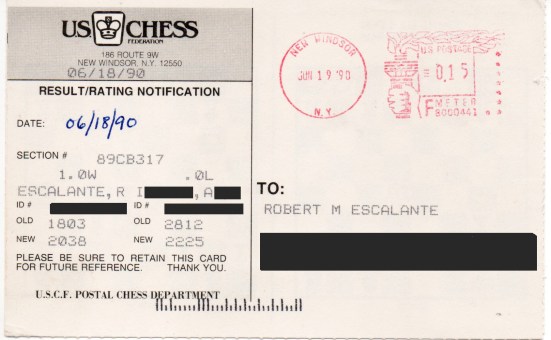
I Beat A 2812!

Yes, this is true.


And this is the story.


In order to gain an established rating, you must play events obviously. During the time you start playing tournament games and your rating more or stabilizes, you are issued a provisional rating. This rating can wildly swing as you win and lose games.


In 1988 my correspondence rating was settling into a stable one. My opponent’s rating was still in wild flux before he and I started our game.


And this is the game.


A.I.-Escalante
corres. 1990
1.e4 e5 2.Nf3 Nc6 3.Bc4 Nf6 4.Ng5 Bc5 (This is the Wilkes-Barre Variation, an extremely tactical and popular opening in the 1980s.  It was my favorite opening at this time as well. And it also seems to have been a favorite of my opponent as he made book move almost to the end of the game. Kenneth Williams’s pamphlet, The Real American Wilkes-Barre, published in 1979, was probably the reason for its popularity.) 5.Nxf7 (An alternate move is 5.Bxf7+. But if tactical is your M.O., then you can’t beat 5.Nxf7 for the pins, forks, checks, and sacrifices.) 5…Bxf2+ 6.Kxf2 Nxe4+ 7.Ke3!? [7.Kg1 is another move. But boldly (or maybe even recklessly) moving one’s king to the center in this variation is stronger than it appears (IMHO) as Black doesn’t have too many pieces developed and White is ahead materially.]

7…Qh4

[Black has the choice of the text move and 7…Qe7. I chose 7…Qh4 as I felt the queen was more active on this square.

Remember I mentioned this was popular opening back in the 1980s? Here two very strong players trying out 7…Qe7!? Notes are from NIC Yearbook #4.

Van de Loo-Hesslin
Netherlands, 1985
1.e4 e5 2.Nf3 Nc6 3.Bc4 Nf6 4.Ng5 Bc5 5.Nxf7 Bxf2+ 6.Kxf2 Nxe4+ 7.Ke3 Qe7 8.c3 Nd4 9.Kxe4 Qh4+ 10.Ke3 Qf4+ 11.Kd3 d5 12.Bxd5 Bf5+ 13.Kc4 b5+ 14.Kc5 Qh4 15.Nxe5 O-O-O 16.c4 Rxd5+ 17.cxd5 Rd8 18.Nc3 Nc6 19.Qa4!! Qe7+ (19…bxa4 20.Nc6 -/+) 20.Kxb5 Qxe5 21.Qc4?! (21.Qa6+!? Kb8 22.Qc6 Bd7) 21…Nd4+ 22.Ka4 Bd7+ 23.Ka5?! (Ka3!?) 23…Nc6+ 24.Ka6? (Ka4) 24…Nb8+ 25.Kxa7 (unclear) c6? (Qd6! -+) 26.Nb5! (with the idea of Kb6, Na7#) 26…Bf5 27.d4 Rd7+ 28.Ka8 (Kb6!) 27…Qe7 29.dxc6 Be4 30.d5 Bxd5 31.Qxd5 Rxd5 32.Na7+ Kd8 33.Kxb8?! (33.Bf4 with the idea of c7) 33…Qc7+? [33…Qe5 34.Kb7 (34.Ka8? Kc6!) Rb5 35.Nxb5 Qxb5=] 34.Ka8 Ra5 (Ke8!?) 35.Bg5+!! Rxg5 (35…Ke8 36.Rae1 Kf7 37.Re7+ -+) 36.Rad1+ Ke8 37.Rhe1+ Kf8 38.Rd7 Qxh2 39.Ree7 Qxg2 40.Rb7 Rc5 41.c7 Qg4 42.Rf7+! Ke8 43.b4 Rc2 44.a4 h5 45.a5 h4 46.b5 h3 47.Nc6! h2 48.Rxg7!! 1-0 Back to the game!]

8.g3 Nxg3 9.hxg3 Qd4+ 10.Kf3 d5!

[Black has the option of 10…O-O, letting his rook into play. However, again IMHO, the text move is stronger as it allows Black’s c8-bishop to come into play AND lay claim to the center.

Oleksenko-Malksirits, corres., 1984, continued with 11.Rh4!? e2+ 12.Kg2 d5 13.Rf4 dxc4 14.Qf1 Rxf7 15.Rxf7 Bg4 16.Nc3 Ne5 17.Qf2! Bf3+ 18.Rxf3 exf3+ 19.Kg1 Qd7 20.d4 cxd3 21.Bf4 Ng6 22.Qxf3 dxc2 23.Rc1 Nxf4 24.Qxf4 Rf8 25.Qc4+ Kh8 26.Rxc2 c6 27.Qc5 Rf5 28.Rf2+ 1-0]

11.Be2

[All this studying for correspondence can pay off. Here is another game by the author.

Escalante-Tym Belanger, US Amateur Team Ch., Feb., 20 2006, 11.Rh4 e4+ 12.Kg2 Rf8 13.Bxd5 Qxd5 14.Qh5 Qxh5 15.Rxh5 Rxf7 16.Rxh7 Nd4 17.Na3 Bg4 -/+ 18.Rh8+ Rf8 19.Rxf8+ Kxf8 20.c3 Bf3+ 21.Kf2 Nf5 22.d3 Rd8 23.dxe4 Bxe4 24.Bg5? (>24.Bf4 c6 25.Nc4) 24…Rd3 25.Bf4 Rf3+ 26.Ke2 Nxg3+ 27.Bxg3 Rxg3 28.Rf1+ Ke7 29.Kd2 Rd3+?! (>29…Rg2+ 30.Ke3 Bc6 31.Nc4? Bb5) 30.Ke2 Rg3 31.Kd2 g5 32.Re1 Kf6 33.Rxe4 Kf5 34.Re2 Kf4 35.Nb5 Kf3 36.Nd4+ Kg4 37.Rf2 Kh3 38.Ke2 Rg4 39.a4 Re4+ 40.Kd3 Re1 41.Rf3+ Kg2 42.Rf7! +- (White wins with a windmill.) 42…g4 43.Rxc7 Kf2 44.Rf7+ Kg1 45.Rxb7 Rf1 46.Rg7 g3 47.Rxg3+ Kh1 48.Rg7 Rb1 49.b4 Rd1+ 50.Kc2 Rf1 51.Rxa7 Rf2+ 52.Kd3 Rf8 53.Rg7 Rf3+ 54.Kc4 (Of course not Nxf3, stalemate!) 54…Rf8 55.b5 Rc8+ 56.Kb4 Rf8 57.a5 Rf3 (Another attempt at stalemate.) 58.a6 Rf2 59.c4 Rf1 60.a7 Ra1 61.b6 Rb1+ 62.Kc5 Ra1 63.b7 Rxa7 64.b8=Q Rc7+ (Yet another try at stalemate; the third of the game. 65.Qxc7 is a draw, so…) 65.Rxc7 1-0]

11…O-O (11…Bxe2 Bg4 12.Kg2 Qe4 13.Bf3! +-) 12.Rf1? (Kg2! – K. Williams)

2019_07_25

12…Bh3!! 0-1 (This is stronger than 12…Qe4+ 13.Kf2 Rxf7+ and either 14.Ke1 or 14.Kg1 and the White king lives. But after 12…Bh3!!, White has a choice between …Rxf7# or losing a massive amount of material with 13.Bd3 Rxf7+ 14.Ke2 Bg4+ 15.Ke1 Rxf1+ 16.Kxf1 Bxd1.)


correspondence_AI_1

The Thematic Pawn Move – Pushing the “e” Pawn

Generally, in an Indian Defence, if White can get his king pawn to e4, he gains the advantage. Preventing that should be one of Black’s chief concerns.

 
We’ll start with the Nimzo-Indian to illustrate some ideas with short games.

 
In the Classical Variation of the Nimzo-Indian (1.d4 Nf6 2.c4 e6 3.Nc3 Bb4 4.Qc2) Black sometimes plays …b6. This move allows Black to play …Bb7, preventing White’s pawn from moving to e4. Unfortunately, he is a move too slow.

 
Rubinstein-Chwojnik
Lodz, 1927
1.d4 Nf6 2.c4 e6 3.Nc3 Bb4 4.Qc2 b6 5.e4 Bxc3+ 6.bxc3 d6 7.f4 Bb7 8.e5 Ne4 9.Nf3 f5 10.exf6 Nxf6 11.Ng5 Qe7 12.Bd3 Nbd7 13.O-O O-O-O 14.Re1 e5 15.Bf5 Kb8 16.Ba3 g6 17.dxe5 gxf5 18.exd6 Qxe1+ 19.Rxe1 cxd6 20.Bxd6+ Ka8 21.Qxf5 1-0


Euwe-Colle
Amsterdam, 1928
1.d4 Nf6 2.c4 e6 3.Nc3 Bb4 4.Qc2 b6 5.e4 Bb7 6.Bd3 (White’s bishop is on a great diagonal and is supported by the Queen on c2. Black should be wary of castling kingside as the h7 pawn is vulnerable.) 6…Bxc3+?! 7.bxc3 d6 8.Ne2 h6 9.O-O O-O 10.f4 Nbd7 11.e5 Ne8 12.Ng3 c5 13.Qe2 Qh4 14.f5 cxd4 15.Rf4 Qd8 16.cxd4 dxe5 17.dxe5 Nc7 18.Rg4 Qe7 19.Rxg7+ 1-0


Noteboom-Flohr, 1930
[ECO, E32]
1.d4 Nf6 2.c4 e6 3.Nc3 Bb4 4.Qc2 b6 5.e4 Bxc3+ 6.bxc3 d6 7.f4 e5 8.Bd3 Qe7 9.Nf3 Nc6 10.O-O Bb7 11.Re1 +/- (Of course White wants the “e” file to be opened soon.)


Dunne (2183)-R. Hughes (2046)
corres.
Golden Knights, 1996
1.d4 Nf6 2.c4 e6 3.Nc3 Bb4 4.Qc2 b6 5.e4 Bb7 6.Bd3 O-O 7.e5 Bxg2 8.exf6 Bxh1 9.Bxh7+ (Of course, this is the main reason White plays .Bd3 in the first place!) 9…Kh8 10.Be4 Bxe4 11.Qxe4 Bxc3+ 12.bxc3 Nc6 13.Bg5 Kg8 14.Qh4 Re8 15.fxg7 f6 16.Bxf6 1-0


We’ll now take a look at the Queen’s Gambit Declined.


Eugenio Torre (2520)-Yukio Miyasaki (2200)
Malta Ol., Nov. 1980
[D61]
1.c4 Nf6 2.Nc3 e6 3.Nf3 d5 4.d4 Be7 5.Bg5 O-O 6.e3 (Black is doing quite well here in stopping .e4.) 6…Nbd7 7.Qc2 c6 8.Bd3 h6 9.Bh4 Re8 10.O-O Nf8 11.Rad1

[11.Ne5 also worked well in Belen Miguel Fernandez-Esteban Ignacio Gonzalez de Cima, Asturias Ch. Primera B, Norena, Apr. 7 2001: 11…N6d7 12.Bxe7 Qxe7 13.f4 f6 14.Ng4 Nb6 15. c5 Nbd7 16.Rf3 e5 (On deciding on a candidate move or threat, a player should also ask if his proposed move has depth (long-term gain), a follow up plan, or if such a move also provides defense as well as attacking possibilities. Black’s threat of 17…e4 is obvious, but this move has no depth, does not provide any type of defense, and as far as we know, Black had no follow up plan.)

2019_07_18_A

17.Rg3! e4 (Black’s idea of getting HIS pawn to e4, should make equal sense as White getting his to e4. But chess is not that simple.) 18.Nxh6+! +- Kh7 19.Nf5 Qe6 20.Nxg7 Qe7 21.Nxe8 (And now White can play 22.Nxe4 and more tactics will follow.) 1-0]


11…Nh5 12.Bxe7 Qxe7 13.e4 (Didn’t we tell Black not to allow this move a few games back?) 13…Nf4 14.Rfe1 Nxd3 15.Qxd3 dxc4 (Just about forced as …exd5 opens lines in White’s favor.) 16.Qxc4 Bd7 17.e5 (Now if e4 is a good move for White, then e5 is even stronger.) 17…Red8 18.Nd2 b5 19.Qe2 c5 20.d5 exd5 21.Nxd5 Qh4 22.Ne4 (We’ve going to give the position a +/-, but White’s advantage is probably stronger than that evaluation.) 22…c4 23.Nd6 Ng6 24.Nxf7! Bg4?

2019_07_18_B

25.Qxg4!! (Black is lost. The game could have continued with 25…Qxg4 26.Nxh6+ gxh6 27.Nf6, but you probably figured it out.) 1-0


Interesting enough, in the Queen’s Gambit Accepted, White can also get the advantage with .e3 instead of .e4. An old trap goes like this: 1.d4 d5 2.c4 dxc4 3.e3 b5 4.a4 (White could also play 4.Qf3 c6 5.a4, and merely get his pawn back with the advantage.) 4…c6 (or 4…a6 5.axb5!) 5.axb5 cxb5 6.Qf3!, winning.

This trap will catch beginners and even computers.

GM Kasparov-ELITE A/S EXPERIMENTAL
Simul
Hamburg, 1985
1.d4 d5 2.c4 dxc4 3.e3 b5 4.a4 Ba6 5.axb5 Bxb5 6.Nc3 c6 7.b3 e6 8.bxc4 Ba6 9.Nf3 Nf6 10.Bd3 Bd6 11.O-O O-O 12.e4 Bb4 13.Qc2 Nh5 14.e5 f5 15.exf6 Nxf6 16.Re1 Bc8 17.Bb2 a5 18.Rad1 Ra7 19.Ne5 a4 20.Re3 a3 21.Ba1 Bb7 22.Ne2 Nbd7 23.Nf4 Re8 24.Rh3 Nf8 25.g4 h6 26.g5 hxg5 27.Nfg6 N8h7 28.Nh8 g6 29.Bxg6 Nf8 30.Nhf7 Qe7 31.d5 cxd5 32.Nh6+ Kg7 33.Bxe8 Qxe8 34.Neg4 Be7 35.Ng8 Kxg8 36.Bxf6 Ng6 37.Bxe7 1-0

Black, even with a better third move, still lost in this game:

Tarrasch-Kurschner
Nuremburg, 1889
1.d4 d5 2.c4 dxc4 3.e3 Bf5!? 4.Bxc4 e6 5.Qb3 Be4 6.f3 Bc6 7.Ne2 Nf6 8.e4 Be7 9.Nbc3 Qc8 10.d5 exd5 11.exd5 Bd7 12.d6 Bxd6 13.Bxf7+ Kd8 14.Bg5 Nc6 15.Ne4 Be7 16.Bxf6 gxf6 17.O-O-O Ne5 18.Nf4 Qb8 19.Qe6 Rf8 20.Nxf6 Bd6 21.Nxd7 Nxd7 22.Rhe1 1-0


Maybe someone will get the bright idea, of when playing Black against a known 1.d4 player, to glue the e4 pawn to the board before the start of the game, so White can’t play his king pawn to e3, e4, e5, or any other square!